
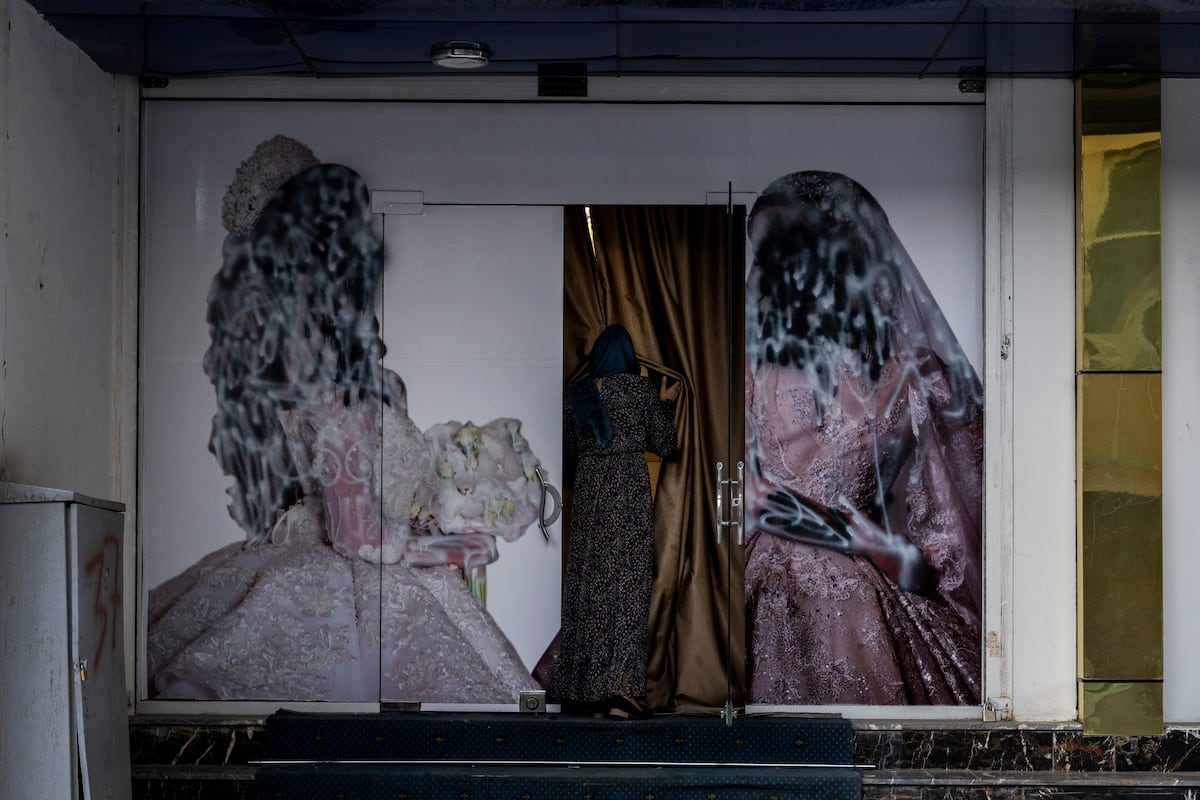
A name is a gift received at birth, and one that endures after death. It is “a face, a voice, a story,” as the Germany-based Afghan activist Lalah Osmany describes it. In Afghanistan, it is also one of the few things the Taliban have not taken from women since their return to power in 2021. But who knows for how long, because fundamentalists in the Balj province in the north of the country have just banned the use of Afghan women’s names in official documents, including prescriptions and medical records, according to several women who talked to EL PAÍS. Hospital healthcare workers in that province and other public employees have been instructed to address women as “Bibi,” according to an investigation published by the Afghan media outlet Zan Times and the British newspaper The Guardian. Bibi means “Granny” or “old woman” and is a respectful form of address in a country where pronouncing a woman’s first name, especially in public, has traditionally been considered an affront to the honor of her husband or children.However, Osmany says that “the reality” plays out quite differently. Various testimonies from women, doctors, and civil rights activists confirm that “the Taliban have now not only ordered [Balj] officials to stop writing and pronouncing women’s real names, labeling them all as Bibi,” but “in many cases, they are referred to in degrading terms associated with animals like ‘goat’ or ‘cow’,” she says. “This is a systematic process of dehumanization. When a regime replaces a woman’s name and gives her one of an animal, it is stripping her of her human soul and reducing her to a mere biological creature or the property [of a man].” Osmany refers to another custom in Afghanistan: presenting women in official documents as the “wife” or “daughter” of a male relative. This lack of individual identity is also evident on tombstones where a woman’s name is not inscribed.During the Taliban’s first spell in power between 1996 and 2001, it removed the word “woman” from street names and public spaces. In the long five years since its return in 2021, the Taliban’s policies toward women have been based on “the sole purpose of denying their humanity,” Osmany says. And “the first step to dehumanizing a person is to take away their name.” Karishma, an activist from Kabul who uses a false name, confirms via WhatsApp the Taliban’s order from Balj province, although she says that so far the ban on the use of women’s names has been ignored. However, Zubaida Akbar, director of the Afghanistan program at the NGO Femena, in the United States, says she fears that a local initiative that is initially resisted will be followed by an edict imposing a ban on women’s names throughout the country. This, she says, has happened before with regard to other issues.“The Taliban are very creative when it comes to imposing bans on women,” Akbar says wryly. The ban on names (“a complete erasure of female identity”) is in the same vein as the more than 144 decrees curtailing Afghan women’s rights, as counted by Femena. These go from a law preventing girls from studying beyond the age of 12 to banning them from the vast majority of jobs and from speaking in public. There is also a law passed on May 14 this year that has legalized the rape of girls. The Taliban’s Penal Code states that breaking a woman’s arm deserves a sentence of 15 days in prison, while hitting a camel could put the perpetrator behind bars for five months. “A nameless person cannot dream, cannot own property, cannot claim justice, nor be remembered in history,” Osmany points out. “Calling a woman by her real name in Afghanistan is an act of resistance.”Osmany tells the story of an Afghan man who contacted her to tell her he had never known his mother’s first name. No one had called her by her name, not even in the home. By the time the man finally learned her name, his mother was dead.“Where is my name?”The erasing of Afghan women’s names is an ancient tribal custom that has nothing to do with Islam. For example, Surah 19 of the Quran is titled “Maryam” (the Virgin Mary) and her name is mentioned more than 30 times. But the tribal tradition was maintained in Afghanistan even during the pro-Western regime that surrendered to the Taliban in 2021 after the abrupt withdrawal of U.S. troops.In those 20 years of pro-Western rule, the identity of Afghan women remained absent from their graves and even from invitations to their own weddings. Even so, Akbar states that situation “is not comparable to what is happening now. Women’s names were not banned and appeared in some documents [Afghan passports still mention the names of their female holders]. Afghan women could work publicly with their names and were fighting to ask for more [rights].” In 2017, Lalah Osmany launched the campaign “Where is my name?” in a bid to have the names of Afghan women included in the numerous official documents from which they were absent, such as a child’s birth certificate. The campaign put a target on her back, she recalls, even before the Taliban took power. Aged 25, Osmany received a photograph of the body of a woman who had been skinned by extremists. “If you don’t stop this campaign, this will be your fate,” she was warned.“I was afraid, but that didn’t stop me,” says Osmany whose campaign managed in September 2020 to get the last Afghan government prior to the Taliban to approve the voluntary inclusion of women’s names in documents such as their children’s birth certificates. “In cities and among the younger generation, using a woman’s name was no longer taboo: it was becoming a symbol of respect, modernity, and justice. We had planted a seed of awareness that was growing rapidly,” she recalls. A 2017 report by the Afghan Analysts Network, titled What’s in a woman’s name? No name, no public persona, also confirmed the relationship between the use of Afghan women’s real names and their presence in the public arena. It seems a lifetime away. Afghan women now face the possible denial of their identity, which threatens to have serious practical repercussions. “Imagine a hospital where dozens of prescriptions and medical records are filed under the same name – Bibi – or a number. The risks of making medical errors are huge,” says Osmany. Compounding these risks to women’s health is the ban on male doctors treating women and girls and the ban on Afghan women from studying healthcare professions. Basically, the fundamentalists “are depriving women of medical care,” says Osmany.Khadija Amín is an Afghan journalist exiled in Spain. When her first child was born after an arranged marriage at 19, her name was not included on the child’s birth certificate, nor on that of her twins who were born after. Having become a popular Afghan television presenter, Khadija had to flee the Taliban when they resumed power in 2021. Her husband then took the three children from her.In 2024, when Khadija learned that her ex-husband had settled as a refugee in Germany with her children, she traveled to Berlin to report him to the authorities and request a visit with her children. Khadija went to a police station to file the complaint, but was unable to do so as she had no document proving her identity as the mother of his children. It took a further two years until Khadija managed to get a German court to process her claim, giving her ex-husband time to escape; he took the children back to Afghanistan and out of her reach.Sign up for our weekly newsletter to get more English-language news coverage from EL PAÍS USA Edition
Afghan women stripped of their names are called ‘granny’ or ‘goat’
Full Article
Original Source
Read the full article at English →KhanList aggregates and links to publicly available news content. We do not host full articles from third-party sources. Always verify important information with original sources.