
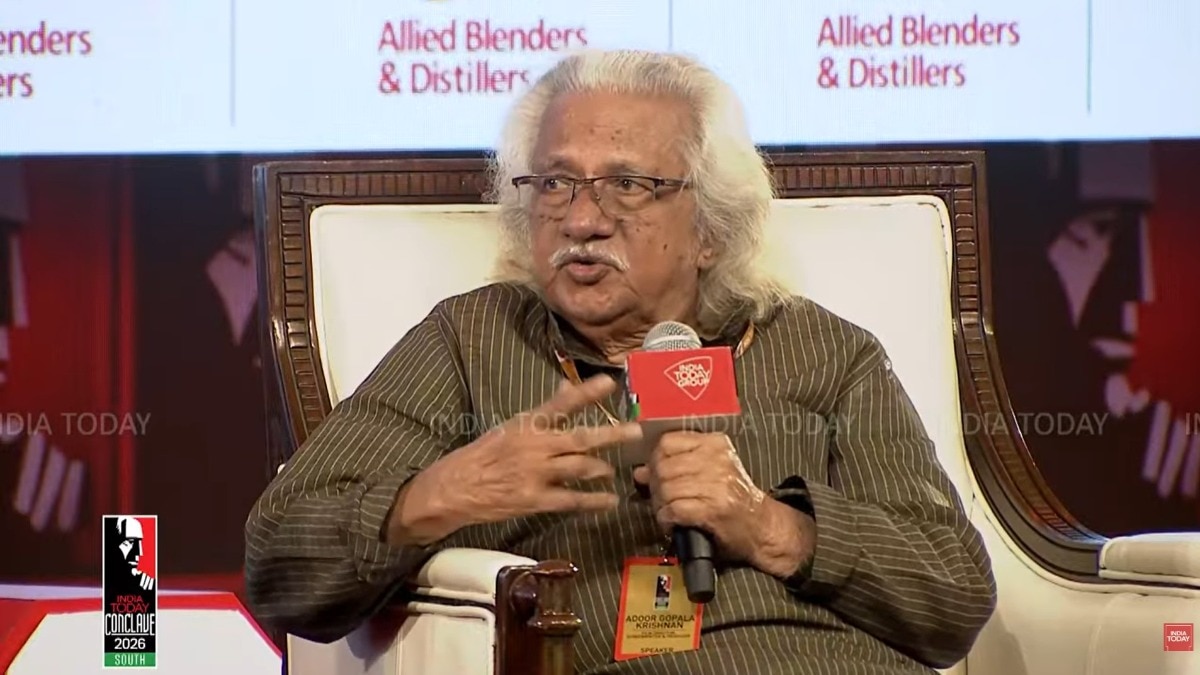
Renowned Malayalam filmmaker Adoor Gopalakrishnan said he makes films for theatres and not for OTT platforms. As he returns with Padayaatra after 10 years, he also defended budget discipline and praised Mammootty's support.Veteran Malayalam filmmaker Adoor Gopalakrishnan talked about making films for theatres and on limited budget. Filmmaker Adoor Gopalakrishnan said he did not believe in making films specifically for OTT platforms, arguing that cinema was meant to be experienced in theatres. Speaking about his return to filmmaking with Padayaatra after a gap of 10 years, the veteran Malayalam filmmaker said the shift to OTT viewing during the Covid-19 pandemic had, at one point, made him question whether there was any point in continuing to make films.Adoor was speaking at India Today Conclave South in Kochi on Wednesday, where he chaired a session titled Master's touch: The transforming power of cinema.Why Adoor preferred the theatrical experienceReflecting on what brought him back to filmmaking after 10 years, Adoor said the Covid-19 pandemic had made him question whether he should continue making films at all. “My new film, Padayaatra, I am making after 10 years. Sometime during Covid-19, people stopped going to theatres and watched OTTs. They were watching films on OTT. Around that time, I thought it's of no use making films,” he said.Adoor made it clear that he did not believe in creating films specifically for streaming platforms. “I don't believe in making films for OTT, because people will have to watch films in theatres. That's where the experience lies,” he said.For the filmmaker, watching cinema on a smaller screen was fundamentally different from experiencing it in a theatre. “It's a compromise. I make films to be seen in a darkened hall, in an auditorium with proper acoustics and all,” he said, adding that he had a dedicated audience who came to theatres specifically to watch his films. “There are so many films, but they have come to see me. I should do justice to that. I am sharing my experience with the audience. I should not lead them to wrong things,” Adoor said. He believed cinema should leave audiences with something to think about, adding, “By watching films, they should become wiser, critical, and they should understand the world.”That, however, did not mean Adoor was opposed to his films eventually arriving on streaming platforms. He said he had no objection to an OTT release once a film had completed its theatrical run. “When my films finish it run in theatres, I don't mind it coming on OTT. That will bring some revenue,” he said. But the theatrical experience remained non-negotiable for him. “Primarily, my films are made for cinemas not for OTTs or small screens. It is terrible. That's no experience of cinema,” he said. Adoor added that the experience of cinema demanded engagement from the viewer, particularly through its visuals and sound. “There's nothing to learn from visuals or sounds. You don't need to apply your mind. I cannot take my mission to make films in that vein,” he said.Mammootty returned for their fourth collaborationPadayaatra also marked another collaboration between Adoor and Mammootty, with the actor making an exception to the filmmaker's usual practice of not repeating performers. Adoor said Mammootty was the only actor he had repeated in his films, with Padayaatra marking their fourth collaboration.“I have made few films, only 13, including Padayaatra. I don't usually repeat actors in my films. Mammootty is the only exception – this is our fourth one. He's an exception in every way,” Adoor said.According to the filmmaker, Mammootty had also expressed an interest in producing the film when he learnt that Adoor was making it. “When he knew I was making a film, he said he'd like to produce the film. I was very happy. He told me, 'whatever you want, you ask me, it'll be given'. He has a role that's perfect for him. I cannot think of anyone else,” he said. Adoor on Mammootty and film budgetsAdoor also recalled working with a younger Mammootty and said the actor's approach to remuneration had always been aligned with the film's budget.“Mammootty is not the same actor I worked with him in the first film. At that time, he was a bigger star then, but never quoted a big price. He knew he'd be paid, but according to the budget only,” he said.The filmmaker had maintained a strict approach to production costs throughout his career. “I never cross my budget. I finish my film in the least number of days and in one go. I choose my artists in such a way to keep them free for these days,” he said.At the same time, Adoor stressed that working within a controlled budget did not mean compromising on the scale or quality of his films. “It doesn't mean I am working on small budgets. I am not doing big or small budgets. I don't make any compromises. I am working on a proper budget, which the movie deserves,” he said.Adoor remained critical of the practice of spending excessively on films simply because it was possible. “You can spend any amount of money to make a film. I don't believe in that. But, it's criminal to use that kind of money,” he said.Adoor wanted his films to outlive the momentFor Adoor, the responsibility of filmmaking extended beyond simply holding an audience's attention for a couple of hours. He saw the time a viewer spent watching his film as something he had borrowed from them and therefore felt compelled to make every minute count.“I am borrowing two hours of your life to watch my film. It has to make it worthwhile for my audience. I am very responsible in that session. I have to pack in as much information as possible into the film. There are many layers to my work, so it can stand several viewings. And with every watch, you get new meaning. I am not making a newspaper story, because that gets old the next day," he said.Elaborating further, he added, "I don't want my film to be old. It should be valid and relevant for the future. Fortunately, people ask about my first and second film now. That is very important.”On cinema and the glorification of villainsAdoor also spoke about the expectations placed on audiences by commercial cinema, particularly the assumption that viewers were primarily looking for easy entertainment.“In commercial cinema, they believe the audience is stupid and that the audience has no power to think. They are also right in such a way. It's a tightrope. If you make them think, you'll fail because they don't want to think. Generally, they want entertainment.”He said cinema's role had evolved considerably from its early perception as a means of passing time.“Traditionally, cinema has been taken for passing time. That's the role cinema was given for a long time. Today, things have changed, it has gone through several depths and rebirths. It has come out as a great medium – probably the best that man has invented.”Tracing the evolution of the medium, Adoor said cinema had emerged from humanity's long-standing desire to reproduce movement and sound, before absorbing elements from other art forms.“It comes from a small movement that they want to reproduce – that was the dream of mankind for several 1000s of years. Finally, they discovered. Then they started making recorded images moving and recorded sounds talking. All these became possible. Slowly, it started evolving into literature, theatre, painting and more."With every new artistic work being done in cinema, it started developing its own character and soul. Cinema has evolved into a great medium. You want everyone to make long speeches. We don't realise that. We cannot make films for them. So, I believe that we should make them think. Characters don't just stand to deliver dialogues - what they do convey specific meanings," he explained.The filmmaker was critical of what he saw as an increasing preference for easily consumable cinema.“What people are doing is people are producing what's easily consumable. There is no commitment to provide the right kind of cinema. It's not preaching or teaching you anything. It should have some meaning for the audience. I have great respect for the audience. But they should also respect my work.”Why Adoor spoke up on issuesAdoor had also been vocal on issues concerning cinema and society, but he drew a distinction between speaking as a citizen and involving himself in electoral politics.“I have nothing to do with politics nor can I blame someone who's ruling the state or country. As a citizen, when it concerns cinema or people or my family, then along with other artists and intellectuals, we express it so it receives the attention. More than that, I don't go into their politics at all. I have friends in every political party, irrespective of their ideology. Politicians are good people – they are not detestable," he said.For Adoor, remaining silent could sometimes weigh on him. “Sometimes I feel guilty if I don't speak out.”He was also aware that films could become targets of political criticism, particularly when their themes were interpreted without considering their larger context.“Films can be targeted. Some political parties look at a simplistic level and misinterpret it. It's not fair. I have every right to talk about things that concern citizens. I don't talk about everything, I talk only about things that I have knowledge of," he said.Adoor rejected the ‘legend’ tagDespite his decades-long career and influence on Indian cinema, Adoor did not describe himself as a legend. Instead, he saw his filmmaking journey as a continuous process of learning, questioning and discovering.“I don't consider myself a legend. I have never compromised. After finishing every film, I have the impression that I have done the best. At the moment, Padayaatra is my best film. I could be wrong or right. I put in my best in every film at every point.”For Adoor, experience had not meant settling into a fixed filmmaking style. “As years go by, you come to learn and unlearn so many things. In my case, it's a question of learning and revealing. This is my process. One film will not be like the other. Because I am learning," he said.His admiration for younger filmmakers also reflected that openness to discovering new voices. Adoor recently watched Christo Tomy's Ullozhukku and was impressed by what he saw.“Recently, I liked a film made by Christo titled Ullozhukku. It's a very good film. That's his first film," he said as he signed off.- Ends
Adoor Gopalakrishnan backs theatres over OTT, calls huge film budgets 'criminal'
Full Article
Original Source
Read the full article at Indiatoday →KhanList aggregates and links to publicly available news content. We do not host full articles from third-party sources. Always verify important information with original sources.