
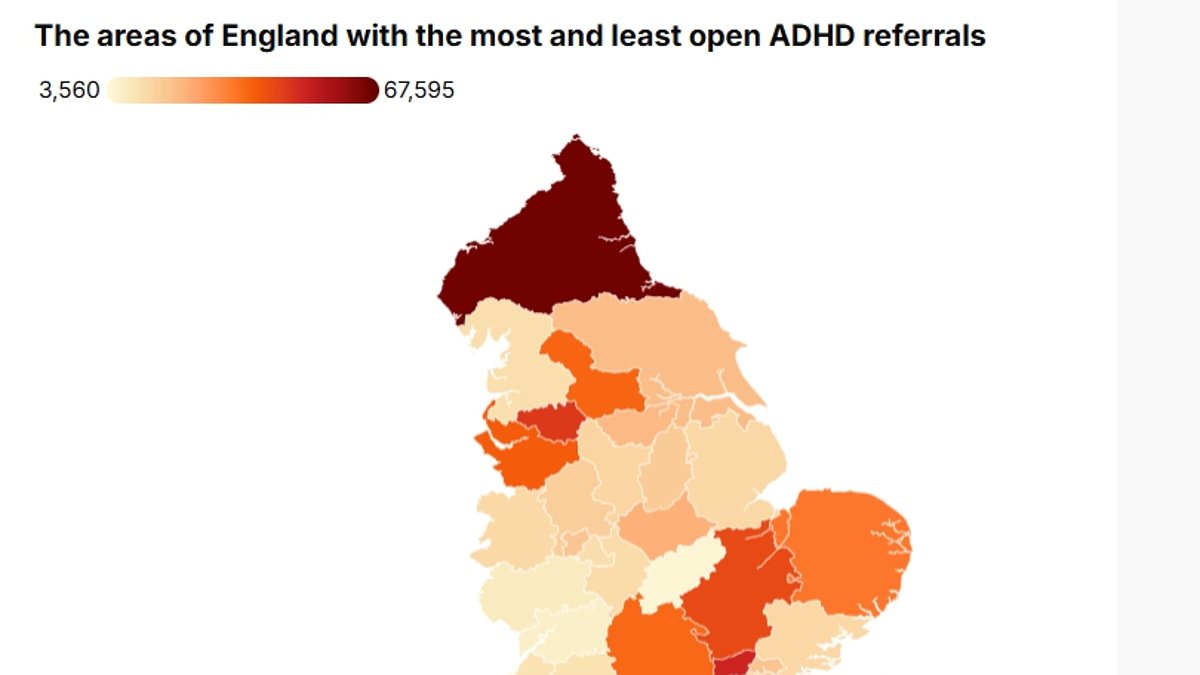
Referrals for suspected ADHD have surged by more than 55 per cent in just a year – and are 25 times higher than 2019, NHS figures reveal.There were 835,390 people either awaiting specialist care or receiving treatment for attention deficit disorder in September, a jump from 538,265 the year before.It is a seismic increase in just a year, yet the longer-term trend is even more striking. A landmark Government review published last month found that around 5,000 people a month were being referred for ADHD assessments in 2019. But the latest NHS figures show almost 38,400 new referrals were recorded in September alone – equivalent to around 1,300 a day.Meanwhile, the total number of open referrals has risen from around 33,000 seven years ago - an increase of around 25-fold.The surge comes amid ongoing scrutiny into how conditions like ADHD – or attention deficit hyperactivity disorder – and autism are diagnosed.Experts say the rise is being fuelled by the 'marketing strategies' of private clinics that convince Britons they have a disorder for profit. An NHS trust chief executive also warned this week that the health service may be forced to close ADHD assessment services after losing staff to private providers. The new statistics count open referrals – patients who have been referred for an ADHD assessment and whose case remains active with specialist services. In every month apart from one over the past year, the total number of referrals has climbed. The sharpest increase came between May and June when there was a rise from 717,395 to 801,870 – an increase of almost 85,000, or 12 per cent.The trend shows soaring demand for assessments, a trend experts say is allowing private providers to 'exploit' vulnerable adults seeking 'identity'.Clinical psychologist Professor Peter Fonagy, who led the Government review, also raised concerns about the 'consistency and quality' of private ADHD evaluations.Private firms now conduct more than half of NHS-funded assessments, because demand has outstripped supply in many local areas, forcing bosses to farm mental health services out to private companies. A recent survey of GPs said many had never known a private provider to reject a diagnosis request. Autism pioneer Professor Dame Uta Frith and clinical psychologist Dr Naomi Fisher have called for stricter regulation of private providers.'What we mean by autism and ADHD has changed both formally and informally,' they wrote in the British Medical Journal last month. 'This makes them ripe for exploitation by providers who see ADHD and autism assessments as a business opportunity.'Convincing more people that they could be autistic or have ADHD is a marketing strategy to increase their customer base.'The new data also reveals the locations in England with the highest and lowest numbers of open referrals.Readers can explore the Daily Mail's interactive map to see how their area compares. Surrey and Sussex has the highest number of open referrals, with 67,595, the figures show.It is followed by North East and North Cumbria on 65,370 and west and north London on 49,745.At the other end of the scale, Somerset recorded just 3,560 referrals, while Northamptonshire and Gloucestershire had 5,430 and 7,210 respectively. The data shows that 5,350 referrals were from unknown locations, meaning they cannot be accounted for in the map. The NHS says some patients remain on open referral lists even after receiving a diagnosis.'This is due their ongoing care, including medication reviews, still being managed by the provider who provided the diagnosis as there are issues with patients not being accepted back to their primary care setting,' they say.'As a result there will be patients still appearing on the waiting list despite having received their assessment and diagnosis.'The figures underline the extraordinary growth in demand for ADHD services in recent years.Diagnoses of the condition, which affects concentration, activity levels and control, have risen around 20-fold since the turn of the century. Prof Fonagy's review warned that Britain risks harming a generation of children defined by diagnoses rather than opportunity. The report found that children diagnosed with ADHD before 17 are around four times less likely to be in education, employment or training in early adulthood, with each youngster in this situation costing taxpayers £244,000 over their lifetime.
ADHD map of England: Areas where nearly 70,000 are being treated for the condition - as referrals explode 25-fold since 2019
Full Article
Original Source
Read the full article at Dailymail →KhanList aggregates and links to publicly available news content. We do not host full articles from third-party sources. Always verify important information with original sources.