
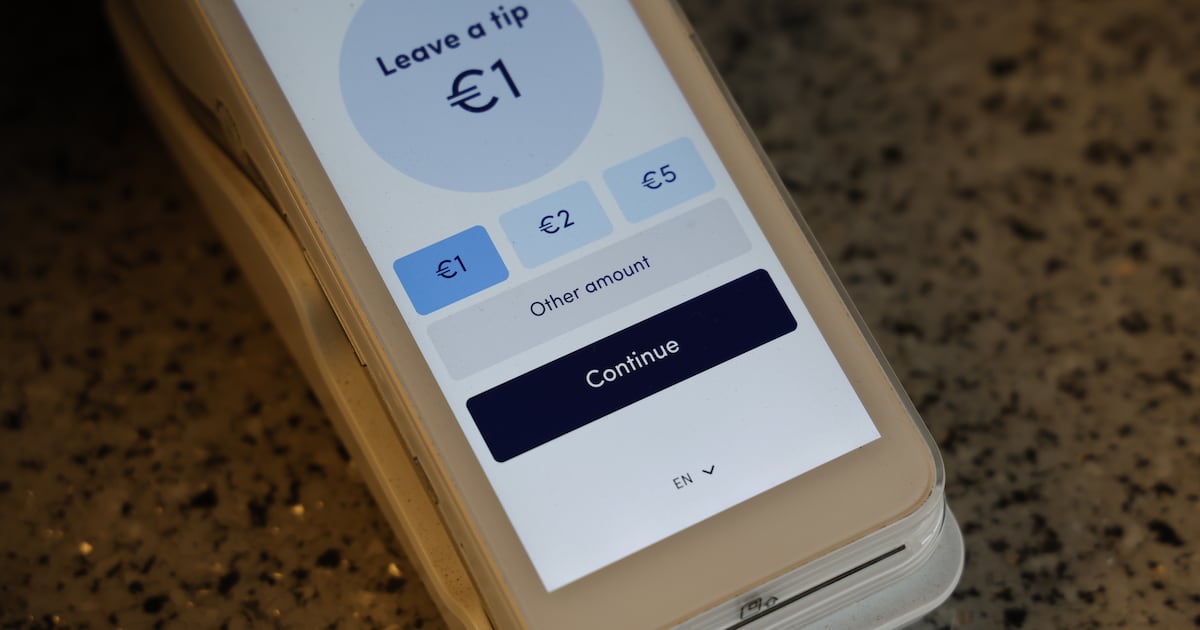
A small takeaway Americano and an insubstantial pastry at a relatively new and Instagram-friendly coffee shop south of the Liffey in Dublin cost an eye-watering €9 this week.On top of that, the heavily pierced staff member manning the till pointedly turned a small screen in the direction of customers. It outlined suggested tips of 10, 15 and 20 per cent, with a “no tip” option included in the bottom corner, almost as an afterthought. It’s a sign of our times and people don’t like it. In response to a social media query from The Irish Times last Wednesday, Instagram users were united in their loathing of the tipping terminals that are popping up all over the place.READ MORE“With the price of a coffee being painful I can’t tip financially,” Ruth Walsh posts. “My Americano in Killarney is €4.20 so adding a tip is crazy.”Jacinta Shinnock visits a Dublin coffee shop which presents a suggested tip for every transaction starting at 15 per cent. “Like, they are lovely people and the products are nice (without being amazing) but I find this kind of galling. Every time I press Skip Tip, I feel the guilts but also the annoyance,” she says.A growing number of cafes and shops in Ireland are prompting customers to pay a tip for takeaway coffees. Photograph: Getty Images “I know a number of bars where you have to navigate the tip page each time you pay for drinks by card and a few coffee shops too,” responds Darragh Bailey. “And I have even come across it when buying a takeaway ice cream. It is presented as expected and the question isn’t will you tip but what percentage tip will you pay? A refusal risks offence so the pressure’s on to at least hit the 10 per cent tab. It’s extortion.” The proliferation of tipping terminals has seen gratuities pop up on the radar of the Competition and Consumer Protection Commission (CCPC) for the first time. Earlier this year, it issued a report suggesting 90 per cent of consumers tip at least some of the time, with many believing they’re being strong-armed into doing so. Two-thirds of Irish consumers reckon tipping is less voluntary than it used to be, with technology at least partially to blame. Paynt is a Latvian tech company driving digital tipping. In a report published earlier this year, it said Irish businesses that deploy such technology “have reported tip volumes increasing by more than three times”.The company’s country director for Ireland, Kia Morice, says its tips “are clearly presented, fully voluntary and distributed directly to staff in line with agreed business practices”.She suggests that “making tipping easy and transparent for customers helps businesses ensure staff can benefit while maintaining clarity and compliance.”Compliance when it comes to tipping has become increasingly important since 2022 when the Payment of Wages (Amendment) (Tips and Gratuities) Act became law over fears that some restaurants were using staff tips as a means of meeting payroll obligations and other overheads. Eoin Cluskey is the owner of Bread 41 in Dublin and his coffee shops offer customers ordering food the chance to tip at the tills.“It is the employees who want it,” he says.“Not many people tip and it wouldn’t be a big part of our business but the staff like it. We had it as an option in one store and not in others, and the staff said they wanted it. You can’t really fight that battle.”As the owner he has no involvement in handling the tips and sees none of the money with all of it going directly to staff. “It might amount to €15 a week for them but if you are working 20 hours a week and going to college and renting in Dublin, then that €15 is a lot of money. It can be a night out or cover a Leap card for the week.”He stresses that people always have the option to hit “no tip” and he is adamant that staff will never hold it against their customers.“If you don’t want to tip, don’t tip - that really is okay,” he says. Adrian Cummins, chief executive of the Restaurants Association of Ireland, welcomes greater transparency and the sharp jump in the numbers of Irish people who tip, but he is more circumspect when it comes to the tipping terminals. He believes tipping after a sit-down meal is right and proper. However, he also reckons the terminals that encourage people to give more are “bringing it to the US extreme where everything is tipped”. “But each to their own,” he adds. Jp McMahon is a Galway-based, Michelin-starred chef and food writer who has been living and breathing hospitality since he started out on his restaurant journey at the age of 15.He, more than most, understands the value of tips and what they mean to all those who work in restaurants – in the kitchens, at the sinks and on the main floor. But even so, he believes the tipping terminals are “an abuse of the system”. McMahon first came across them “a few years back in Canada”. “I remember paying for a double espresso and the tip options were 15, 20 and 25 per cent. You’d have to cancel the coffee to get out of the tip thing, so you’d end up giving 15 per cent,” he says. Chef Jp McMahon says tips are important to restaurant workers, but tipping terminals are an entirely different matter. Photo: Andrew Downes, Xposure Many of the best cafes will “bypass the tip when someone orders a coffee”, he says, adding that he will happily tip in his favourite spots.“But if I’m just getting a random coffee from somewhere, I don’t see why I’m paying 15 per cent for someone to make a coffee from a press-button machine,” he says.“Maybe if I’m in a specialist coffee shop and someone gives me a single estate Ethiopian blend that takes a bit of skill to make, but if they’re just lashing out the cappuccinos, what am I tipping for? I do see the benefit of tips but I think this is an abuse of the system.”Ed Coombe is the manager of Lilliput Stores, a cafe/shop in Arbour Hill, Dublin. Staff there routinely swipe past the tip option that automatically pops up on the till. “Honestly, we’re too embarrassed to be standing there waiting for a tip like that,” says Coombe. “First, we lowered the default options to start at 5 per cent, but it’s just easier to swipe past it. If someone wants to tip us with coins, that’s great, but it shouldn’t be seen as an obligation.”While the idea of tipping terminals has been imported from the US, even there some have railed against a liberal tipping culture. Just over a decade ago, New York City restaurateur Danny Meyer called time on all tipping across his chain of restaurants, including three-star, two-star and one-star Michelin restaurants in Manhattan. He replaced tips with much higher wages for all staff, funded by much higher menu prices.“Imagine, if to prompt better service from your shoe salesman, you had to tip on the cost of your shoes, factoring in your perception of his shoe knowledge and the number of trips he took to the stockroom in search of your size,” Meyer said at the time.“As a customer, isn’t it less complicated that the service he performs is included in the price of your shoes?”His experiment lasted five years before its demise during the Covid pandemic.“It was going pretty well,” he told CNBC in the aftermath. “Although I will say the math was incredibly difficult [and] not many restaurants around the country joined in.”When Covid happened, he says: “People could not work in this industry and didn’t necessarily want to work in this industry. We found that it was almost inhumane to tell our servers [they] may not accept [tips]. So we scrapped it.”He wasn’t a lone voice. In more recent times, other restaurants in the US have tried to improve the conditions of their staff at the expense of their tips. Despite their efforts, the tipping culture has become even more embedded, largely as a result of technology. The US – and indeed Ireland – might do well to borrow from Japan, where tipping and tipping terminals are considered an affront to their concept of Omotenashi, or selfless service, where the pursuit of excellence is untethered from any financial reward. It is perhaps too late for that now.
‘Adding a tip is crazy’: Irish people united on their view of tipping terminals
Full Article
Original Source
Read the full article at Irishtimes →KhanList aggregates and links to publicly available news content. We do not host full articles from third-party sources. Always verify important information with original sources.