
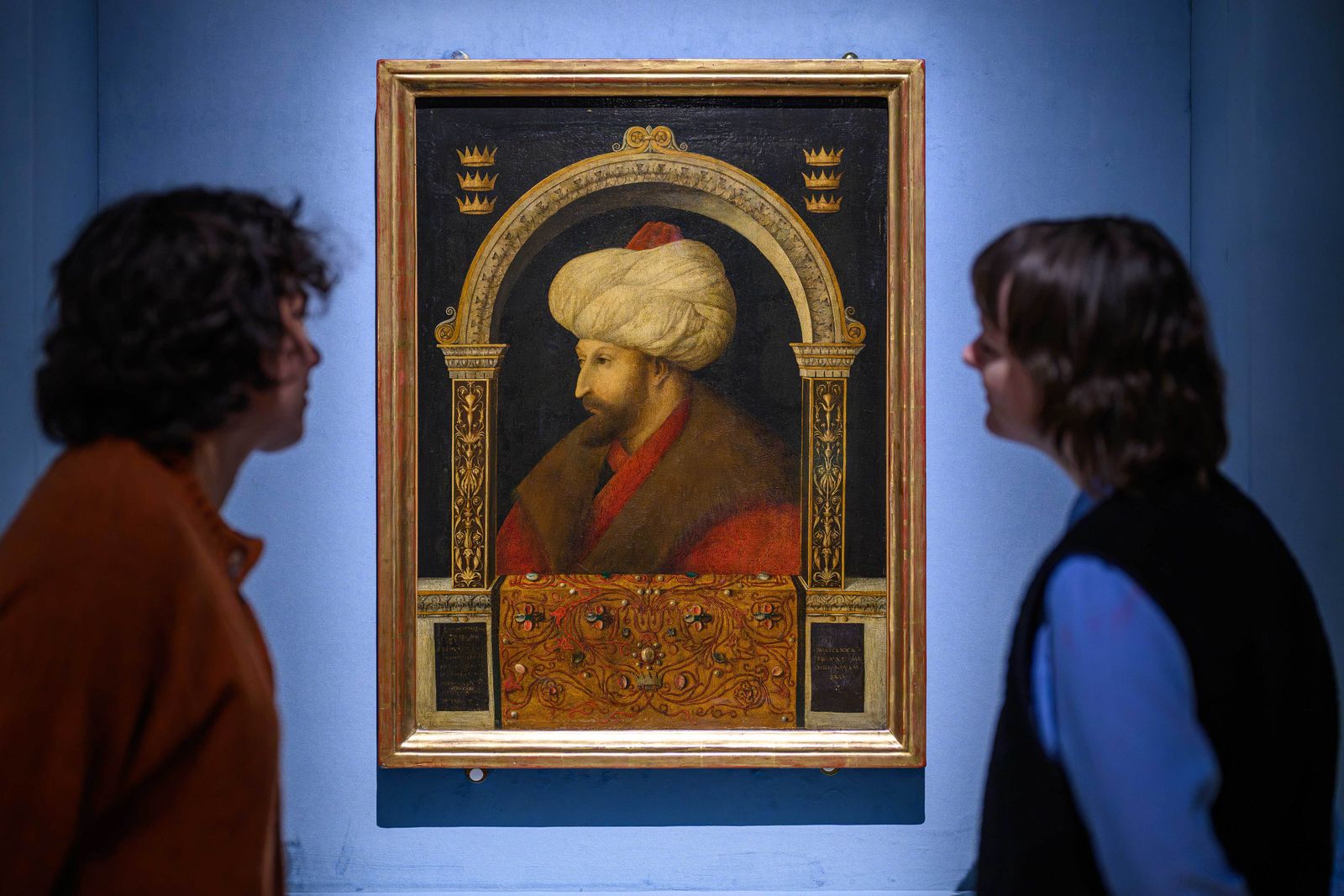
“Constantinople to Istanbul: One City, Two Empires” at London’s Victoria and Albert Museum tracks the storied city’s evolution from a 4th-century capital to a bustling 19th-century metropolis—hippodromes, bathhouses and all November 4, 2026 5:27 p.m. Gentile Bellini’s 1480 portrait of Ottoman Sultan Mehmet II Jas Lehal Assignments Press Association / V&A Napoleon Bonaparte once supposedly declared Constantinople to be “the empire of the world.” From its founding as the capital of the Byzantine Empire under Roman emperor Constantine in the 4th century C.E. until the fall of the Ottoman Empire in the 1920s, the city today known as Istanbul was indeed the epicenter of two successive, world-defining civilizations. The city’s role in that sweeping, nearly 1,600-year saga is the focus of “Constantinople to Istanbul: One City, Two Empires,” a major exhibition at London’s Victoria and Albert Museum. Opening November 7, the exhibition unites more than 200 rare objects from Byzantine and Ottoman times. “Creating this exhibition has been an exciting adventure, bringing together two worlds that are usually kept well apart,” Tim Stanley, the exhibition’s curator, says in a statement. “The artistic ideas generated there in its double history as an imperial capital still play a major role in the world,” he adds. “By combining the stories of these two empires and the amazing art they both produced, we have been able to release the stories of Constantinople and Istanbul from their separate boxes and let them enjoy the limelight together.” The exhibition unfolds across four chronological sections: “Roman Beginnings,” charting the city’s imperial origins; “Heaven and Earth,” exploring monumental sacred architecture; “A Capital Reborn,” examining the Ottoman imperial court’s role in artmaking; and “Life in the City,” capturing the vibrant, multi-ethnic metropolis of the 19th century. The journey begins in 330 C.E., when Constantine selected the former Greek settlement of Byzantium as an eastern counterpart to Rome. Among the early relics is a bronze serpent head from the famous Serpent Column, which Constantine relocated directly from Delphi to furnish the city’s central hippodrome. At the hippodrome, Romans “thronged in their thousands to cheer on the chariot racers and wolf whistle dancing girls as they performed lascivious burlesques,” Peter Sarris, a historian at the University of Cambridge, writes in the London Times. One such dancer, Sarris points out, was Theodora, the future wife of the Byzantine emperor Justinian. In the sixth century, Justinian commissioned the Hagia Sophia, a spellbindingly large cathedral that was built in less than six years and served as the religious core of the East Roman world. When envoys sent by Vladimir the Great, the pagan Grand Prince of Kyiv, visited the Hagia Sophia in the 10th century, they were so mesmerized by its grandeur that they “knew not whether [they] were in heaven or earth.” An illuminated portrait from the 14th-century Lincoln Typikon, on public display for the first time in six decades from Lincoln College, Oxford. Permission of the Rector and Fellows of Lincoln College, Oxford The exhibition assembles a “rich range of liturgical objects” from the cathedral and beyond, per the statement. One rare object on view is the Lincoln Typikon, an illuminated, 14th-century manuscript from a Constantinople nunnery, on loan from Lincoln College, Oxford, for the first time in six decades, the Art Newspaper’s Gareth Harris reports. The typikon’s delicate illustrations of the convent of the Virgin of Sure Hope offer a vivid window into monastic life just a century before the capital’s fall. After the Ottomans conquered Constantinople in 1453, the city’s new rulers both honored and transformed their new domain. Sultan Mehmet II converted Hagia Sophia into a mosque while intentionally retaining its original name, turning the ancient Christian monument into the aesthetic blueprint for grand Islamic architecture across the capital. Did you know? Holy diplomacy The Byzantine Empire used religious art, such as portable icons and jeweled reliquaries, to bolster geopolitical alliances. One standout example is Saint Lawrence’s Pallium, a lavish 13th-century silk depiction of the patron saint of Genoa guiding Byzantine emperor Michael VIII into a strategic pact with the Genoese. Michael gifted the Genoese this cloth to seal the deal. The transition to Ottoman splendor is heralded by Gentile Bellini’s 1480 portrait of Mehmet II, reflecting a court hungry for Renaissance artistry. The later imperial rooms showcase opulent displays of secular and military authority. Among them are a 30-foot-long, 17th-century processional scroll illustrating the sultan’s elaborate palace retinue, a silk kaftan woven with shimmering gold thread and a pair of gold pistols presented by the Ottoman court to Britain’s King George III, per the Telegraph’s Alastair Sooke. The exhibition concludes away from royal palaces, diving into the lively social spaces of the 19th-century city of Istanbul through depictions of buzzing coffee houses, literary salons and public bathhouses. “This is a sumptuous voyage to Byzantium via Istanbul,” Jonathan Jones writes for the Guardian. “Linger in the baths, in your tall wooden shoes and silk towel, and enjoy the artifice of eternity.” “Constantinople to Istanbul: One City, Two Empires” is on view at the V&A South Kensington in London from November 7, 2026, to May 9, 2027. You Might Also Like Get the latest stories in your inbox every weekday. More about: Art Art History Byzantine Empire Christianity Islam London Museums Religion Religious History Turkey
Actually, You Can Go Back to Constantinople. A Landmark Exhibition Reconstructs the Imperial City With 1,600 Years of Treasures From Byzantine and Ottoman Times
Full Article
Original Source
Read the full article at Smithsonianmag →KhanList aggregates and links to publicly available news content. We do not host full articles from third-party sources. Always verify important information with original sources.