
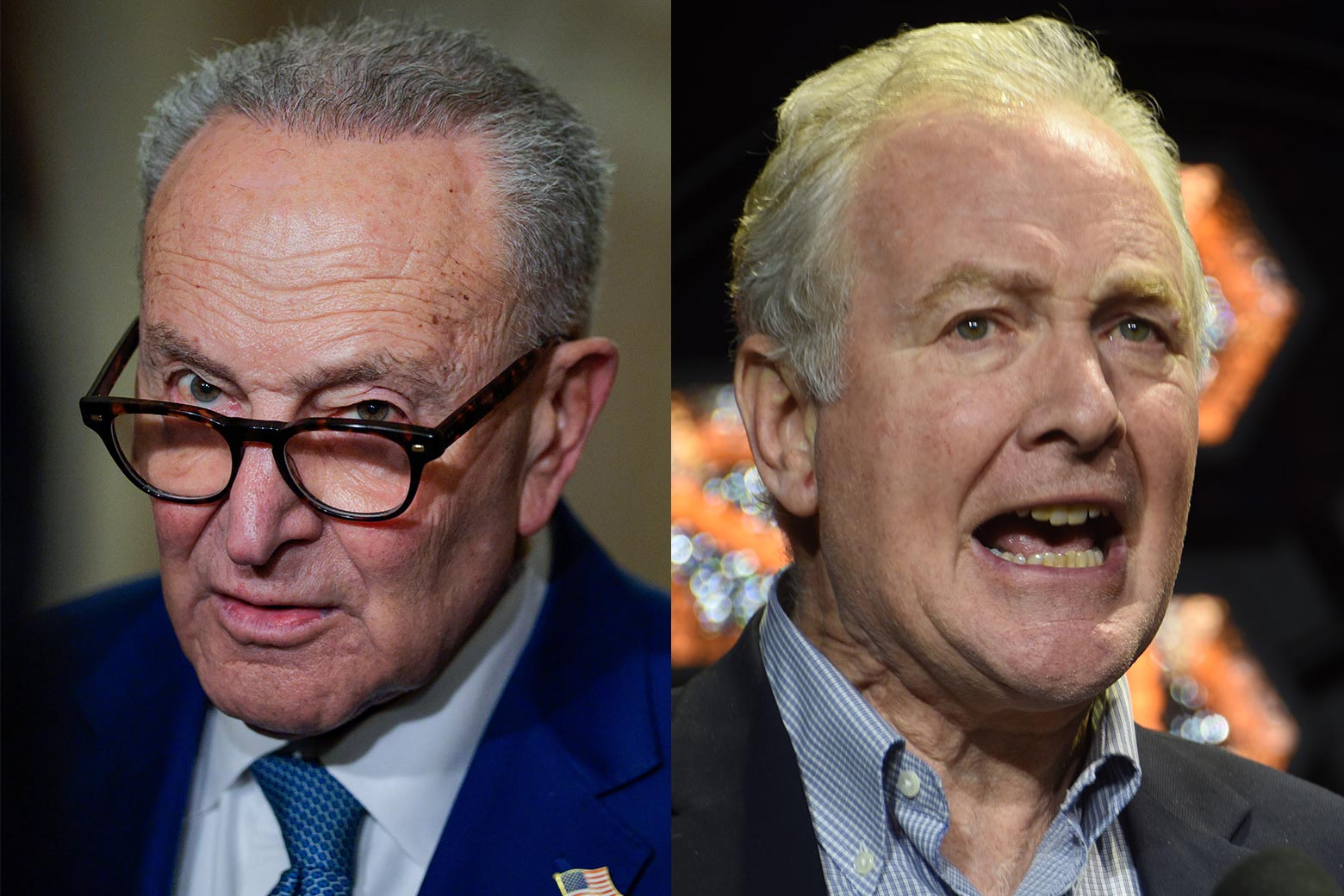
Politics Chuck Schumer facing a progressive challenger is the sign of a healthy party, not another indication of disarray. Photo illustration by Slate. Photos by Chip Somodevilla/Getty Images and Mark Makela/Getty Images. Sign up for the Slatest to get the most insightful analysis, criticism, and advice out there, delivered to your inbox daily. Democrats, you may have heard, are divided. Chuck Schumer, the current Democratic Party leader, is facing a challenge from Maryland Sen. Chris Van Hollen for Senate majority leader. The fight is now serving as something of a stand-in for many other cleavages within the Democrats’ newly expanded tent: older vs. younger, moderate vs. leftist, supportive of Israel vs. more hostile toward it, economic populism vs. liberal order. It has been covered in the press as another example of the “Democrats in disarray” cliché: “For Democrats, a Leadership Fight Is Marring an Electoral Triumph,” reads one representative headline in the New York Times. Here is my take: This is exactly the fight Democrats should be having. And this is exactly the time to be having it. The leadership battle feels particularly pitched because the Democratic tent just became extremely capacious, ranging from self-identified socialists and left-wing activists to religious Christians and politicians who are so conservative they only nominally identify as Democrats at all. Given this ideological breadth, it’s remarkable that Democrats nationwide ran on such similar issues: affordability and lowering prices, fighting Trumpian corruption, ending the war in Iran, and ensuring that Americans would see their government helping them out on housing, healthcare, and gas prices. But how Democrats address those issues, the priority they give to each, and how they approach a handful of other topics—including aid to Israel, the kind of healthcare reform to propose, and the proper balance between legislating and holding the kinds of hearings and investigations that might hold the Trump administration to account—differ quite a bit. No wonder there’s disagreement. The battle is also pitched because of what it represents: Is the Democratic Party what it has been, a place of cautious moderation, or is the Democratic Party the home for progressives, leftists, and the younger constituencies? Schumer has been at the helm for almost a decade. And he just presided over a historic victory for Democrats, flipping nine Senate seats. He personally helped recruit many of the red- and purple-state moderates who outperformed and delivered the Senate, including Sherrod Brown in Ohio and Mary Peltola in Alaska. He also backed some losing moderates over progressives (Janet Mills vs. Graham Platner in Maine, Haley Stevens vs. Abdul El-Sayed in Michigan), but once the primaries were over, he generally threw Democratic support behind whoever was on the ballot. (Angie Nixon in Florida was one notable exception, and a candidate who perhaps could have won with more party support.) Regardless of what you’ve thought of Schumer’s leadership over the past 10 years, it is hard to argue with this outcome. Schumer’s critics, though, see these victories as happening in spite of him, not because of him. They say that a party trying to lead America forward should not look like a gerontocracy, and are willing to settle for someone even slightly younger (Van Hollen, though younger than Schumer, is still 67). More importantly, the left wing of the party has consolidated around Van Hollen because of his economic populism, which was the primary fuel for Democratic victories in the midterms. Voters want their government to go on the offense for better healthcare, lower prices, higher wages, and more affordable housing. Israel is an animating issue too: Van Hollen wants to cut aid to the country, a position that many progressive and leftist Democrats back; Schumer is critical of the Netanyahu government but does not want to fully pull back U.S. support to Israel. Van Hollen has been leading with his vision and making the case that he’s a populist outsider, while Schumer’s case has rested on his accomplishments and his track record. (But to be clear: Van Hollen isn’t exactly a newbie or an outsider—he has been in Congress for 25 years and was Nancy Pelosi’s deputy when she was speaker of the House.) These are very real differences in substance, style, and priorities. But this is exactly the time to have a debate about what this newly ascendant Democratic Party looks like. Newly elected Democrats are not yet in office. The party and its voters are still riding high on the blue tsunami. There is some nitpicking over whether moderates outperformed progressives (the data suggests yes) and also many good arguments in favor of embracing exciting, galvanizing candidates who can rally support and make elections feel exciting (those candidates tend to be the progressives). The party is sorting out how it governs given its new ideological heterogeneity. Importantly, it’s doing so in the context of a win—and so there is less bitterness and blame-gaming than there might have been had Election Day not gone quite so splendidly. Instead, the arguments are about who gets credit for which wins, and which ideologies and priorities should dominate the next congressional term. This is a good position to be in. “Democrats in disarray” is a stereotype born of truth. But Democrats, and the left side of the political spectrum more broadly, tend to be fractious because inherent to the ideology is a skepticism of top-down hierarchies and an allergy to falling in line behind an authoritarian leader. Sometimes the fractiousness can get ridiculous, moving from disagreement to hard-nosed ideological factionalism that keeps our politics incapacitated. But the impetus toward dissent and debate comes from a fundamentally democratic impulse. Thoughtful mediated conflict within a political party is a good thing. Parties grow and change, as voters do, and Democrats in particular have prided themselves on being the party of the young, the party of the downtrodden, and the party of progress. Until these midterms, young people have been largely shut out of the party—of course their entrance into it is going to change it. That doesn’t necessarily mean that Chuck Schumer shouldn’t be, or won’t be, Senate majority leader. It doesn’t mean that he can’t take significant credit for Democrats’ midterm victories. But the fact that he’s not being simply anointed leader is a sign of healthy evolution, not chaos and disorder. This is a good fight, and Democrats should have it in good faith. The two candidates also aren’t so different that Democrats won’t be able to rally around whoever wins. Whoever does win will immediately face the task of uniting the party and setting it in forward motion. Once it’s over, they should put aside their differences and get to work proving that American voters were right to trust them. That’s what healthy political parties do. Chuck Schumer Democrats Senate 2026 Midterms
Actually, the Senate Leadership Fight Is Good for Democrats
Full Article
Original Source
Read the full article at Slate →KhanList aggregates and links to publicly available news content. We do not host full articles from third-party sources. Always verify important information with original sources.