
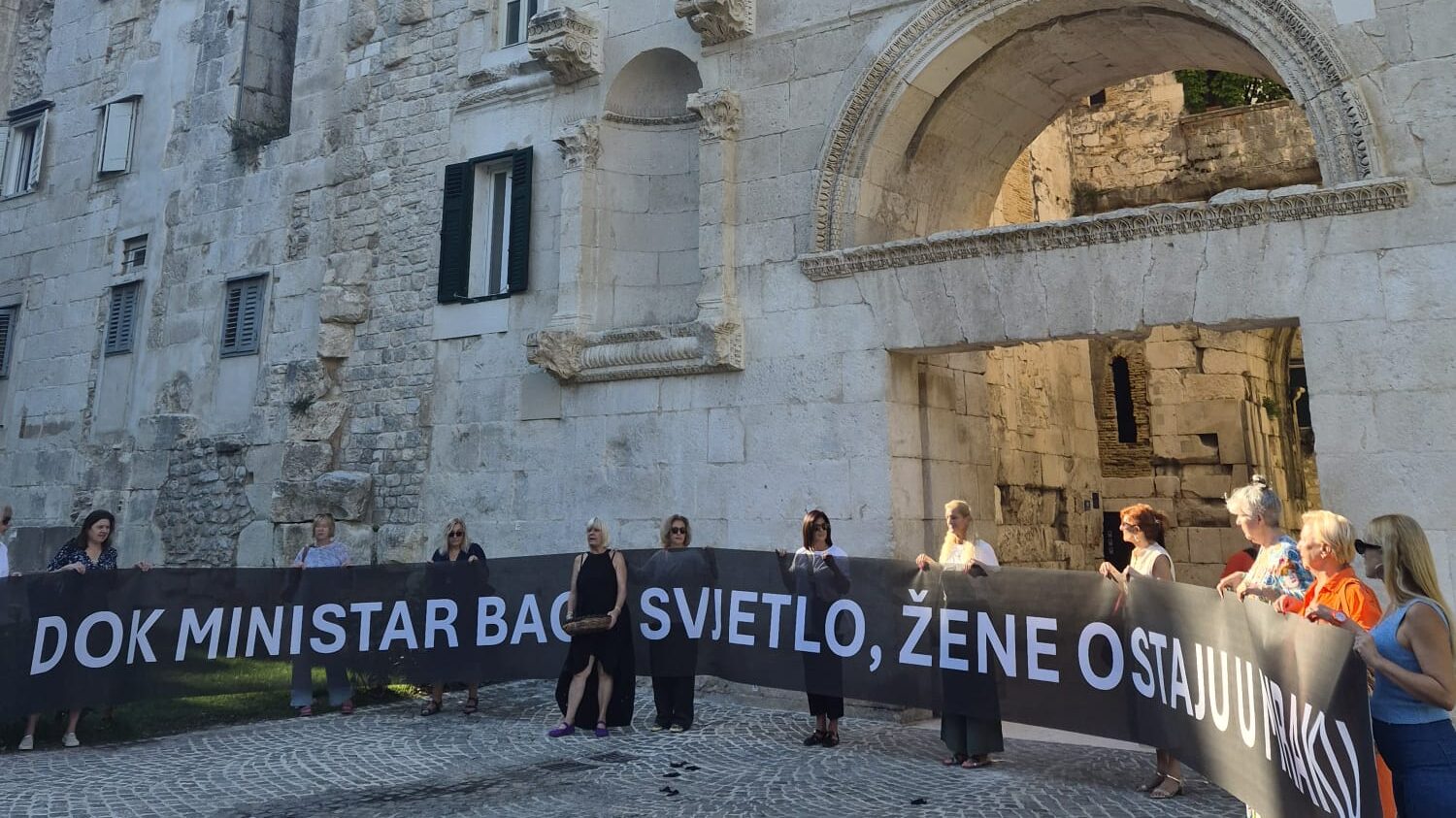
Women’s organisations staged symbolic public protests in 17 towns and cities across Croatia on Monday, titled “While the Minister Sheds Light, Women Remain in the Dark” – a slogan pouring scorn on a comment made by Family and Social Policy Minister Alen Ruzic after a woman’s murder. The groups’ demands include moving violence against women from the realm of misdemeanours into the criminal justice sphere. “We demand a specific law against all forms of gender-based violence,” the organisations and initiatives said ahead of the National Day Against Violence Against Women, observed on September 22. They also called for a unified, mandatory and standardized assessment of the risk of recurring violence and femicide, as well as mandatory specialized training for everyone involved in risk assessment and decisions concerning the protection of women. Protest in Zagreb in front of the Ministry of Labour, Pension System, Family and Social Policy. Photo: Women’s Network of Croatia“We seek systemic solutions; we do not want explanations or a mere tally of femicides – we demand that the system change and protect women,” said Sanja Juras, coordinator of the Women’s Network of Croatia at a gathering in Zagreb. She said women’s organisations and initiatives want legislation addressing all forms of violence against women, a strategy featuring clear measures and a financial plan, and inter-agency cooperation. They say the response to violence against women must go beyond suspended sentences and minor measures. Juras said that violence against women is not the problem of a single institution but of the entire system – a system, she put it, that is not functioning. Protest in Slatina. Photo: Women’s Network of Croatia“A pattern of ongoing violence precedes femicide and, unfortunately, institutional failures. The system must change, and everyone responsible for the lapses that led to the femicide in Slatina – as well as other femicides – must be held accountable,” Juras said. In Slatina on September 8, a 40-year-old man killed his wife with a knife following years of verbal and physical abuse. The organisations’ demands include identifying the failures and holding accountable all those responsible for them in the Slatina case as well as changing the way the whole system operates to prevent such failures from recurring. Protest on the island of Korcula. Photo: Women’s Network of Croatia“We are not looking for explanations after the murder. We demand a system that recognises risk, stops the perpetrator and protects the woman before the violence escalates to femicide,” the Women’s Network of Croatia said. They also pointed out that, following the femicide in Slatina, Family and Social Policy Minister Alen Ruzic shifted the blame onto the murdered woman, saying she had withdrawn protective measures and claiming that this cast the case in a “specific light”. “Such a statement demonstrates a serious lack of understanding of the dynamics of violence against women,” said the Women’s Network of Croatia. Protest in Beli Manastir, the center of the Baranja region. Photo: Women’s Network of CroatiaThey further noted that women often withdraw reports and protective measures due to fear, threats, coercive control, economic dependence, and concerns for their children. “Withdrawing a measure does not erase the violence, eliminate the risk or absolve the state of responsibility. A woman may withdraw a report or a measure, but the state cannot withdraw its obligation to protect her life,” they said. The Vukovar Women’s Association unfurl a banner. Photo: Women’s Network of Croatia“Murders of women are very often preceded by violence, threats, fear and various forms of control, and in many cases, institutions are already aware of the violence,” said Mirjana Mizdrag Misanovic, coordinator of the Vukovar Women’s Association. She noted that when women withdraw reports or seek the lifting of protective measures, “that does not mean the danger has passed. “That is why we are calling for a system that will recognize the risk in a timely manner, react in a coordinated way and protect the woman beforehand,” she added. In Koprivnica, black balloons were released in memory of the 19 women killed last year. Photo: Women’s Network of CroatiaMarina Svagelj Jazic, president of the Hera association from Krizevci, pointed out that 10 of the 19 women killed last year were victims of femicide, and the perpetrators in those cases had already been recorded in police files for violence. In Koprivnica, the association released black balloons symbolizing the murdered women, on which participants wrote encouraging messages to show that the victims had not been forgotten. People also gathered in the small town of Pakrac, which has a population of only 4,000. Photo: Women’s Network of CroatiaPublic events were held in Zagreb, Osijek, Split, Rijeka, Beli Manastir, Pakrac, Vukovar, Virovitica, Bjelovar, Karlovac, Korenica, Koprivnica, Sibenik, Trogir, Korcula, Zadar and Novska. “Not one victim more, not one woman fewer” reads a placard at the protest in Zagreb. Photo: Women’s Network of CroatiaNational Day Against Violence Against Women in Croatia is observed in memory of the events of September 22, 1999, when Judge Ljiljana Hvalec, litigant Gordana Oraskic and her lawyer, Hajra Prohic, were killed during divorce proceedings at the Municipal Civil Court in Zagreb. They were killed by Oraskic’s husband, who also severely injured a court employee, Stanka Cvetkovic.
Across Croatia, Protesters Demand Tougher Response to Violence Against Women
Full Article
Original Source
Read the full article at Balkaninsight →KhanList aggregates and links to publicly available news content. We do not host full articles from third-party sources. Always verify important information with original sources.