
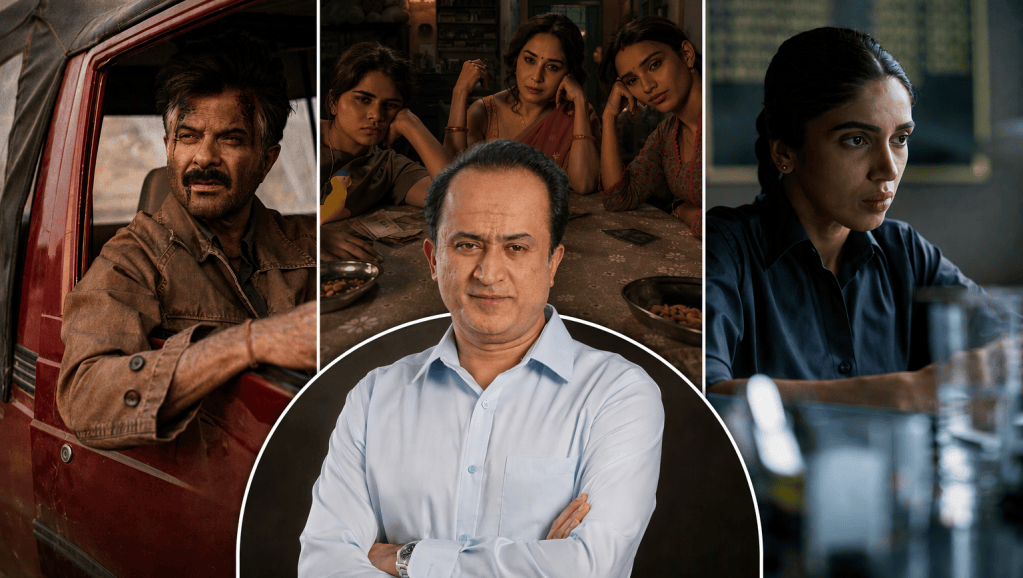
EXCLUSIVE: This time last year, India‘s Abundantia Entertainment launched an AI production division named Abundantia AiOn. Today, we can reveal that is morphing into a fully standalone native AI studio that will seek harness in an influx of ideas from non-traditional sources. “AiOn will develop its own stories, create its own content, produce fully generated as well as hybrid work, and manage the entire ecosystem, just as Abundantia does as a standalone studio,” Vikram Malhotra, Abundantia’s founder and CEO told Deadline during an exclusive interview. Malhotra will remain in charge of AiOn for the time being. “For the moment, it will sit within Abundantia, but we are building it in a way that gives it its own identity and scope,” he said. Watch on Deadline “Workflows have become hybrid, and production and creative thinking are becoming hybrid. The capability needed to run AI at studio level will not be found solely within the conventional media and entertainment system. It is truly a confluence of technology and art.” Malhotra said the move had been taken after receiving “three times as many pitches from people who have never written, made films or belonged to the conventional filmmaking ecosystem as I have in the past” over the last six months. He cited the rise of directors such as Obsession‘s Curry Barker and Backrooms‘ Kane Parsons as evidence of a “democratization” of ideas that would be powered by AI studios in the future. “AiOn defines itself as human-first and AI-empowered, and I’m seeing that happen in front of my eyes in real time,” he added. Earlier in the year, Abundantia announced another AI studio initiative, teaming with AI video tech company InVideo to launch a film studio, which will develop a slate of five films over the next few years. That company is also teaming with Abundantia aiOn. Malhotra, one of India’s most experienced execs and producers, launched Abundantia back in 2013 after exiting a role as COO of Viacom18 Motion Pictures and a shorter spell leading Balaji Motion Pictures. The company has since made films such as Baby, Airlift, Toilet – Ek Prem Katha, Shakuntala Devi, Sherni, and Chhorii and Chhorii 2. On the series from, it produced Prime Video’s Breathe. This year has seen the launch of Netflix films Maa Behen and a movie and series for Prime Video, Subedaar and Daldal, respectively. The former is an action drama directed by Suresh Triveni and fronted by Anil Kapoor; and the latter an original drama series starring Bhumi Pednekar. Maa Behen, a Hindi-language black comedy starring Madhuri Dixit and Triptii Dimri among others, was well received on Netflix. It became the #1 trending film on Netflix India in the week of its release in June and rose to #2 in global non-English films. Subedaar, meanwhile, was notable for being Anil Kapoor’s first action movie since S. Shankar’s Nayak: A Real Hero, which was released in 2001. Malhotra addressed how he tempted the actor back to the genre (clue: It wasn’t a hard sell) and gave his assessment of the Indian production as we look ahead to 2027 and beyond. DEADLINE: There’s a lot of interesting work going on at Abundantia right now. How has the year been so far? Vikram Malhotra: It’s been an exciting year. We completed 13 years on the 26th of this month, and in many ways this year has been the manifestation of the 12 years that came before it – and hopefully a sign of things to come. The last nine months have been exciting for us on all fronts. DEADLINE: What has happened that really punctuates that progress? Malhotra: When I started building Abundantia in 2013, the fundamental gap I had identified throughout my time in the business, including at Viacom18 and Balaji, was that the supply of high-quality, progressive content for a younger, more evolved audience wasn’t meeting demand. Abundantia was formed and built with studio economics in mind, rather than project economics. I was always focused on building an institution, rather than approaching the business on a project-by-project basis, which is often the short-sighted way demand or opportunity is evaluated in this market. If we use 2026 as a symbol of that approach, the year has included three releases: One film on Prime Video, one series on Prime Video and one film on Netflix. We also have theatrical work lined up, more projects with those two streamers and a number of things in development. The founding philosophy remains the same: Put the customer at the heart of the business, let creativity drive the velocity of the business and continue disrupting the kinds of stories you tell. Whittock: One of the major strategic moves you have made is into AI, including the deal with InVideo in February and your AI studio. There is a lot of discussion around AI, and companies are still working out what it means for them, but Abundantia seems to have moved beyond the theoretical stage. How would you describe the strategy? Malhotra: AI is a strategic priority for us. It is not simply another means of reducing costs and saving time. Throughout our journey, we have factored in technological shifts. COVID taught us how to work remotely, and we naturally began weaving that into our production workflow. When streaming arrived in India, it completely changed how hundreds of millions of Indian consumers experienced content. We were the first company from the film ecosystem to move into streaming. I sense an even bigger opportunity with AI. Abundantia has been working on it in our own way for the past two years. As with streaming, the idea was to first understand what we were dealing with, build capability and build for the long term. DEADLINE: Will AI end up as a positive thing for the industry, then? Malhotra: I look at AI as an amplifier of imagination and an accelerator of growth. More importantly, I see it addressing a fundamental aspect of the content business: Risk. This business has risk built into it because risk comes from the consumer side. It is an intangible reason why people spend time and money on what we offer. Any attempt to eliminate that risk would be futile. So we asked ourselves: Can AI help reduce the cost of going wrong? Beyond the logistical benefits – cost, time and scale – can it improve our ability to understand how and where we go wrong? If we do go wrong, can we learn quickly from those mistakes and build that learning into a replicable model? That is fundamentally how AI is built into Abundantia’s strategy.” We have a dedicated creative division called AiOn, under which we have been doing all our AI work. I’m happy to tell you this today that in 2027 we are launching AiOn as a fully fledged, fully native AI studio. AiOn will develop its own stories, create its own content, produce fully generated as well as hybrid work, and manage the entire ecosystem, just as Abundantia does as a standalone studio. DEADLINE: Will it remain within Abundantia? Malhotra: For the moment, it will sit within Abundantia, but we are building it in a way that gives it its own identity and scope. Workflows have become hybrid, and production and creative thinking are becoming hybrid. The capability needed to run AI at studio level will not be found solely within the conventional media and entertainment system. It is truly a confluence of technology and art. Technology has already disrupted the conventional media and entertainment model in two important ways. First, through funding from technology-native companies; and second, through disruption in distribution, whether via streaming or other non-conventional forms that are now mainstream. This is technology creating a new wave of creatives. AiOn is intended to harness that at a dedicated level as a native AI studio. DEADLINE: Who will lead AiOn? Malhotra: In the immediate term, it will remain under Abundantia’s leadership, with me leading AiOn as well. To clarify, we will continue to call it AiOn – we are not calling it AiOn Studios. I’m using that description for ease. We will draw on Abundantia’s learning and capability across the ecosystem, from creative to screen and everything in between. We will also draw on the networks, knowledge and access we have built, while rapidly creating a similar ecosystem under AiOn. The strategy is based on the fact that we will need new skill sets. The person telling the story will still be human, but that person’s background may be very different from what we have conventionally seen. DEADLINE: What prompted you to make this move? Malhotra: One statistic excites me most. In the last six months, on average, I have received three times as many story pitches from people who have never written, made films or belonged to the conventional filmmaking ecosystem as I have in the past. That is the impact of AI-driven democratization on our business. People can bounce ideas around, refine pitches, create an audiovisual package around the story they want to tell and add music. AiOn defines itself as human-first and AI-empowered, and I’m seeing that happen in front of my eyes in real time. DEADLINE: You have spoken about two films coming out of the studio – Chiranjeevi Hanuman and Jai Santoshi Mata: Sukh Sampatti Daata. Where do those projects stand? Malhotra: Chiranjeevi Hanuman is completing readiness. Jai Santoshi Mata is a hybrid project and is set to go on the floors early next year. The work on world-building and on every aspect of AI generation is already under way. Beyond that, we have accelerated the slates we have been building. Our work with one of our long-standing partners, InVideo, is bearing fruit. Two films are under way, including one that is about to go on the floors, and three other scripts – with defined filmmakers, timelines and budgets – are already in development. My understanding of using AI to create films is that the only way to do it is to get on and do it. We have accumulated significant learning through the production process of Chiranjeevi Hanuman. We are building on that as we take Jai Santoshi Mata and two other films to the floors, as we find new filmmaking voices and as we learn through consumer research. When I say AiOn will operate like a studio, there is a reason I distinguish that from its current form as a creative division. AiOn will leverage AI across the value chain. DEADLINE: You have mentioned the increase in pitches from non-traditional sources. In Hollywood, YouTube creators and people from the wider creator economy are moving into film and television rapidly. Are you seeing the same change in India, and are you looking in those places? Malhotra: It is safe to say that the penetration of AI into daily life, especially among people under 35 in India, is virtually 100%. Anyone with a smartphone is experiencing AI at work. Anyone with a smart device is experiencing AI at work. That gives me confidence and optimism. I no longer have to sell the concept. A year or 18 months ago, I was talking about upskilling writers and directors and asking how people would be able to create. People have moved so aggressively along the learning curve that those challenges are falling by the wayside. Anyone with a story to tell now has the ability to get that story into tangible form. The democratization of distribution through YouTube, Instagram and WhatsApp means those stories can reach audiences. The gatekeepers who controlled which stories were told to the wider public are falling away. As a studio and producer, my ability to access disruptive, non-conventional voices is greater than ever. We are constantly scouting these platforms to see whether there is a distinctive voice, a concept or a story we would otherwise not encounter. It is easier said than done, because much of the time we have to go to those creators rather than simply wait for them to come to us. DEADLINE: So how do you harness all of this? Malhotra: The key issue is mindset. Before you build an AI team, workflow, company or film, you need an AI mindset. I’m constantly telling my team to think about timelines, opportunity and economics as they would in technology, while retaining blue-sky thinking in the way we tell stories. It is happening in real time. The number of pitches I receive from creators, especially those under 30, is phenomenal. Yesterday, my team and I heard a story and looked at one another, saying that it would never have occurred to someone who was native to the conventional system because it was so far outside the usual way of thinking. There has never been a better time to be in the storytelling business. Audiences are more willing than ever to consume and accept differentiated content – look at the success of phenomena such as Obsession and Backrooms. At the other end, creators of all kinds are being empowered to tell their stories better. The challenge is to identify the right voices and build an institution around them, rather than treating them as one-off projects. DEADLINE: Moving back to your traditional business, Abundantia has this year launched films for Prime Video and Netflix and a series for Amazon. Maa Behen performed well on Netflix and charted strongly. Are there plans to expand that universe, perhaps through a sequel or series spin-off? Malhotra: Both films we made this year, Subedaar and Maa Behen, are built around strong central characters and large, expandable worlds. The director they have in common, Suresh Triveni, our partner and collaborator, who imagined these worlds and characters as extending beyond a single outing. Development work is under way, given that both films landed with reasonable success. If the creative interests align, they lend themselves to franchising and future instalments without a doubt. However, a sequel should build on the original and its foundations, and it cannot depend on the original alone for its success. There has to be a solid reason for a second instalment of anything. Whittock: There was a lot of excitement about Anil Kapoor returning to the action genre with Subedaar. Was it an easy sell, or did he need convincing? Malhotra: Anil and I have known each other since 2011, when I was running Viacom18 and we were marketing and distributing Mission: Impossible – Ghost Protocol in India, which featured him. We have enjoyed each other’s company and shared sensibility ever since. When Suresh was developing Subedaar – a unique mainstream action drama around an older hero, something Hindi cinema and much of Indian cinema is not known for – he had one actor in mind: Anil Kapoor. At the time, Anil hadn’t led an action film for 23 years. I called him and said, ‘Anil, I’m producing this film with the wonderful director Suresh Triveni, who made Jalsa and Tumhari Sulu for us. We’re building an action film about an older ex-serviceman who takes on the system.’ Before I could ask whether he was interested, he said, ‘Done. I’m in. I’ll do the film. When do we start?’ Although it seemed like an instinctive decision, he knew the genre was right for him. He knew his audience and understood that his fans wanted to see him return in that kind of role. He also saw the creative talent involved and committed to it completely. DEADLINE: Looking ahead to 2027 and 2028, what is the plan for Abundantia? There is a lot of money in the market, but some of it appears to be receding and the number of commissions is coming down. It feels like a difficult place to work if you don’t know what you’re doing – commissions and greenlights are no longer being handed out simply to meet the demand created by the streaming boom. How do you read the market? Malhotra: That’s a fantastic assessment. India is an unforgiving market because it is made up of extremely value-conscious consumers. The Indian content consumer wants disproportionately high value for their time and money – in that order: time and money. And 2026 has been a year of growth across content consumption. The overall pie has increased, but the way it is sliced, and where growth and decline are happening, is constantly shifting. This year has seen a major return to cinemas. The habit that COVID disrupted, but which began rebuilding gradually from 2022 and 2023, has demonstrated that people are willing to go to theatres. Films that succeed seem to have no ceiling. We are seeing bigger blockbusters at the level of individual films than ever before. At the same time, we are seeing rejection at an unprecedented level. There is no ceiling to how well a film can perform, but there is also no floor to how badly it can do. Audiences are exercising their choices more decisively. DEADLINE: So how do you meet the challenge? Malhotra: To align with it, you have to keep sight of where the goalposts will be when your film or series is ready to be consumed. Novelty is also being rewarded, and that is something Abundantia has factored in from the beginning. It is becoming a significant moat for us. New worlds, new characters, new forms and disruptive genres are becoming the need of the hour. The market is becoming more challenging, but that does not necessarily mean there is a recession. The kind and volume of content being sought are being defined more sharply. Everyone is focusing more on engagement, return on investment and a forward-looking perspective, rather than simply buying something off the shelf to meet demand for the following weekend. That mindset is gone. This is a healthy correction and a timely rationalisation. It will improve the overall health of the business and allow quality players—and customer-focused platforms, streamers, networks and cinemas – to prosper.
Abundantia Entertainment To Turn AI Creative Arm AiOn Into Standalone Studio: “Truly A Confluence Of Technology And Art”
Full Article
Original Source
Read the full article at Deadline →KhanList aggregates and links to publicly available news content. We do not host full articles from third-party sources. Always verify important information with original sources.