
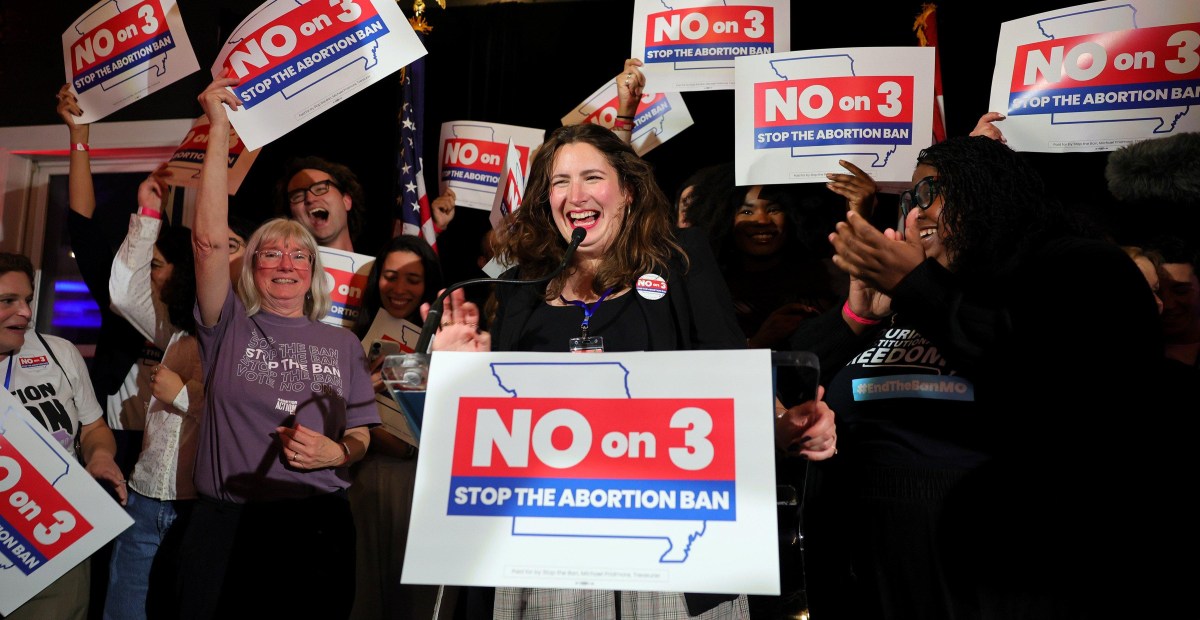
On Tuesday night, voters cast their ballots in favor of abortion access in Missouri, Nevada, and Virginia, reflecting the continued popularity of the issue across red, blue, and purple states, even as it fell out of the political conversation compared to other topics this cycle.All told, the abortion rights victories in this latest election will strengthen or preserve abortion protections for millions of women of reproductive age, as well as thousands of others traveling from more restrictive areas for care. With the latest results, there are now 14 states where voters have backed abortion rights in ballot referendums since Roe v. Wade was overturned in 2022.Abortion rights advocates saw their one big loss of the night in Idaho, where a citizen-led ballot initiative to challenge one of the nation’s strictest abortion bans failed. The measure aimed to legalize abortion up to the point of fetal viability (typically between 22 and 24 weeks of a pregnancy) and in medical emergencies. The Church of Jesus Christ of Latter-day Saints came out against the measure in September, while national reproductive rights groups largely avoided investing in the campaign.“We will see more doctors leave the state as a result of this election,” Melanie Folwell, executive director of Idahoans United for Women and Families, said in a statement. “And, most urgently, women will continue to suffer needlessly under one of the most cruel abortion bans in the nation.”The anti-abortion movement was not prepared to fight ballot measures that protected access in the 2022 midterm cycle, calling the five out of five losses they endured that night a “wake-up call.” In the 2024 cycle, anti-abortion leaders spent more money and leveraged new tactics, including in Florida, where Republican Gov. Ron DeSantis actively attacked the proposed ballot measure to reverse the state’s near-total abortion ban. He directed his state agencies to threaten local TV stations with criminal penalties if they aired ads in support.Still, seven out of 10 passed that year — and the latest results on Tuesday suggest there still is a significant group of voters who personally oppose abortion, or have reservations, but are unwilling to support sweeping bans and were comfortable with Roe v. Wade’s protections.The anti-abortion movement released statements acknowledging their “devastating” losses this cycle. “The pro-life movement must double down on our education and grassroots efforts so Americans can feel confident in rejecting abortion extremism, knowing women and the unborn are protected,” said Sarah Zagorski, a spokesperson from Americans United for Life.Ballot measures have become a key tool for abortion rights advocates since the Supreme Court overturned Roe. Where they’ve won, activists have turned around and used those victories to go after restrictions still on the books. In Arizona, a 2024 ballot measure win set advocates up to strike down the state’s 15-week ban the next year, and a February 2026 ruling cleared the way for abortion pills by mail and telehealth and ended mandatory counseling, ultrasounds, and waiting periods. In Colorado, where voters in 2024 lifted a decades-old ban on public funding for abortion, lawmakers followed up by extending coverage to Medicaid recipients and public employees.But the ballot measure strategy has limits. In many states with abortion bans or early gestational limits, for example, citizens have no way to put a constitutional amendment on the ballot at all; only the legislature can. And of the ban states that do allow it, just two, Arkansas and Oklahoma, haven’t yet voted on abortion. Oklahoma organizers abandoned their effort in late 2022, and Arkansas’s was thrown out in 2024 over how signatures were gathered.Even a ballot measure win isn’t permanent: Missouri lawmakers forced a repeal vote this year on the amendment voters passed in 2024, and while that effort failed this week, it revealed how even state constitutional protections can be reopened. Ballot measures have restored access where the rules allow it, but to restore access for everyone, Congress will need to take action.Here’s a closer look at what happened last night.The abortion rights ballot measures and their results1. Virginia: Question 1The measure established a new constitutional amendment for a right to reproductive freedom, defined as “the ability to make and carry out decisions related to one’s own prenatal care, childbirth, postpartum care, contraception, abortion care, miscarriage management and fertility care.” The state can still restrict abortion for women in their third trimester unless the fetus is deemed nonviable or a physician determines abortion is necessary to protect the life, mental health, or physical health of the mother.It passed.Know more: Abortion is already legal in Virginia through the second trimester, and third-trimester abortions currently require three physicians to approve an abortion, determining that continuing would “irremediably” harm the patient’s life or health. The new constitutional amendment will change that requirement to just one physician, which advocates say will help those who face emergencies in rural areas with fewer doctors. Certain life-threatening complications are only discovered, or only develop, later in a pregnancy. Opponents of Question 1 argued this change will reduce safety and have filed a lawsuit to challenge the amendment from being enforced.Activists say their new constitutional amendment will help ensure that Virginia stays a safe haven for access, even if the state turns back to Republican control in future years. Every Republican in Virginia’s legislature voted against putting Question 1 on the ballot. The number of abortions provided in Virginia increased by nearly 114 percent from 2020 to 2025, partly because so many people living in the South now travel there for care.2. Missouri: Amendment 3The measure would have repealed the constitutional right to reproductive freedom that Missouri voters approved in 2024, and barred gender transition surgeries and puberty-blocking drugs for minors. The measure would have also prohibited abortion except in cases of “medical emergency, fetal anomaly, rape, or incest” and only allowed abortions in cases of rape or incest prior to 12 weeks of gestation.It failed.Know more: Missouri, which was the first state to completely ban abortion after Roe fell, became the first state in 2024 to overturn that ban. On Tuesday, voters rejected Missouri lawmakers’ attempt to overturn that repeal. The measure drew protest from some anti-abortion activists too, who argued that it didn’t go far enough because it stopped short of criminalizing pregnant women. Lawmakers also paired the abortion ban with a prohibition on gender-affirming care for minors, a new tactic for the movement, which in past cycles has argued that abortion rights amendments would let young girls transition without their parents’ consent.This measure would have created a statutory right to reproductive freedom and privacy by establishing that the state can regulate abortion after the point of fetal viability, except in medical emergencies. The measure would have also clarified that the state can’t interfere with personal reproductive healthcare decisions, including childbirth, contraception, fertility treatment, miscarriage care, and abortion.It failed.Know more: National progressive groups did not invest as heavily in Idaho’s abortion rights ballot measure, with some groups like the ACLU reportedly steering clear because they did not think it went far enough to expand access. “ACLU national basically said, ‘We don’t like your policy. It’s not ambitious enough,’” the executive director of Idahoans United for Women and Families told the Spokesman-Review in September. (Asked for comment, Carolyn Ehrlich, the ACLU’s acting director of ballot measures, confirmed they did not back it. “Every campaign cycle, we carefully evaluate where the ACLU can make a meaningful difference,” she told me, adding that the group must “balance our vision for the future with our own limited resources and political analysis.”)In 2024, national groups including Planned Parenthood, the ACLU, and Reproductive Freedom for All also declined to invest in measures in Arkansas and South Dakota on grounds that the proposals did not go far enough.In 2025, 850 abortions were provided to Idaho residents via “shield laws” from telehealth providers in other states, while more than 1,600 people traveled out of state to end their pregnancies. Idaho lost more than a third of its 268 OB-GYNs practicing obstetrics between August 2022 and December 2024, according to a study published last year. While the ballot measure failed, roughly 25 percent of the more than 100,000 petition signers for Proposition 1 were registered Republicans.4. Nevada: Question 6The measure would establish a state constitutional right to an abortion, and for the state to regulate abortion after fetal viability, except when medically determined to “protect the life or health” of the pregnant patient.It passed.Know more: Abortion is already legal in Nevada until 24 weeks of pregnancy, but advocates wanted to lock that right in the state constitution, where it would be more difficult for lawmakers to undo. Voters approved this same measure in 2024 with 64 percent of the vote, but because Nevada requires citizen-initiated amendments to pass in two consecutive elections, they had to organize for it again. Supporters of the amendment massively outspent anti-abortion opponents.
Abortion rights weren’t the story of the midterms. They still won.
Full Article
Original Source
Read the full article at Vox →KhanList aggregates and links to publicly available news content. We do not host full articles from third-party sources. Always verify important information with original sources.