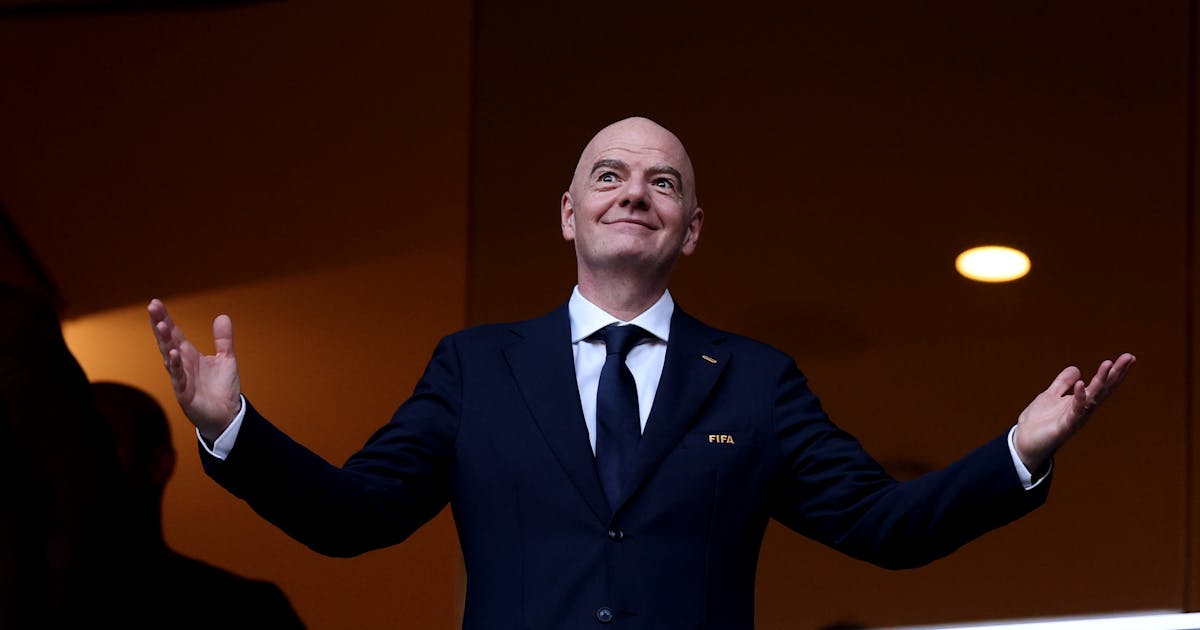
Picture this: It’s December 2033. Puerto Rico’s “Huracan Azul,” (“Blue Hurricane”), the national soccer team in a country better known for baseball, basketball, and boxing, face off against Scotland in the Deutsche Bank Men’s World Cup, brought to you by Fanatics—your home for World Cup swag. Until this winter, Puerto Rico had never qualified for a major tournament; Scotland, meanwhile, had never qualified for the knockout round in a World Cup. As the teams kick off play at Saudi Arabia’s NEOM, you idly watch, wondering if an upset will take place.It won’t; Scotland quickly score once, twice, three times. The score is 4–0 by the time the referee whistles for the Michelob ULTRA Hydration Break to take place. It’s 5–0 at halftime; Puerto Rico scores a consolation goal before the second hydration break, but the Scots hang three more in the final minutes as the game finishes 8–1. As the game ends, bored spectators streaming out, the camera briefly flashes on the luxury boxes. A grinning Gianni Infantino, the FIFA commissioner, mugs obscenely with the Saudi king and other potentates. History, of a kind, has happened.If you see nothing wrong with this, you’re probably either one of Infantino’s staffers or a blood relation. Certainly, Infantino thinks such a display would be amazing. According to The Times of London, the FIFA chief is working closely with Thrive Capital’s Joshua Kushner (brother of Jared Kushner!) and JP Morgan on a proposition that would all but radically transform the men’s and women’s World Cups as we know them, and not coincidentally shovel millions into his acquisitive little mittens. The proposal—now roundly condemned by virtually everyone who’s heard about it, including Britain’s new prime minister—involves creating a private company that would control the World Cups. Each of FIFA’s 211 national member associations would have a financial stake, estimated at around $20 million each. The Times estimates that the company would be valued at around $20 billion. The report makes for wild reading. Now, stop for a moment. Think of how quickly and quietly this whole thing went from “consultations” to a set of signed, nonbinding agreements. This isn’t an idle contrivance, set for a slow burn; banks like JP Morgan and people like Kushner don’t engage in that kind of deal. This is a fast-moving plan of action, set in motion before anyone outside of FIFA’s holiest of holies in Zurich even knew what was going down. Suffice it to say: It’s a spectacularly bad idea. The pressure to expand the World Cups, to play them every other year, or even annually, would be immense. The arm twisting to turn them into something that would make college bowl season look staid and decorous would be even greater. We already know this, because Infantino is not a creatively corrupt schemer. He’s running the same playbook from his failed 2018 SoftBank-Saudi deal. The reason he thinks he can pull this off now is because he thinks he’s suddenly obtained more room for success: a friendlier political environment, working with investors who are cozy with Trump and a compliant FIFA Congress of 211 federations full of staffers eager to get their hands on cash that’s dangled in front of them. Naturally, FIFA is no stranger to tawdriness. It closely resembles an international scandal factory with a sideline in soccer tournaments. This is hardly the first critique of the organization that’s been penned. But Infantino’s latest grift offers us the opportunity to do more than critique. Now is the perfect moment to imagine something better for international soccer than anything FIFA and its gang of thieving jabronis can offer the sport.Let’s be clear about what FIFA actually is: It may say it’s a tax-exempt Swiss nonprofit, squatting on around $15 billion in World Cup revenue, but it’s brazenly acting like a for-profit rights holder. This is why this cockamamie idea is even possible! FIFA wouldn’t be selling the tournaments themselves; they’re creating a subsidiary that would do that dirty work because it controls the tournaments’ commercial upside, thus giving Infantino and his cronies the cover necessary to pretend like they’re doing this for the good of the sport. Reading this—let alone writing it—makes anyone feel like they need a shower, which is why we need to talk about the sport-washing elements driving this scheme. Every mechanism that makes a privatized World Cup possible—and more profitable—is also one that FIFA uses to sanitize the reputations of some of the seamiest regimes imaginable. If you expand the tournaments, you increase the number of billion-dollar hosting rights up for auction. If you hold the World Cups every couple of years, or even annually, you’ve instantly multiplied your leverage. This isn’t a thought experiment: Infantino’s already said that a South American suggestion to expand the World Cup to 64 teams from this year’s 48 will “definitely” be considered. Shareholders who stand to reap a financial bonanza from this kind of expansion will always keep pushing for more, more, more, regardless of what it demands from host countries bidding for the action. We know what that cost looks like. Qatar’s 2022 World Cup was built on the bodies and blood of a horrific labor system that human rights groups say killed hundreds, if not thousands, of migrant workers. Under pressure, Qatar rolled out meager labor reforms, but Human Rights Watch’s global initiatives director said at the time that those changes came too late and were either too weak or too narrow and weakly enforced to help those workers. A year after the World Cup, Amnesty International found that even that pitiful progress had mostly stalled out. It wasn’t for a lack of money; FIFA had that. It had its haunches scooched on roughly $6 billion of World Cup revenue. It simply chose not to create a remedy fund, and turned its back on the misery its greed caused. This is not a resource problem, it is a priorities problem. FIFA will always prioritize money over morality, and privatization will not change that; it will simply add shareholders with hands out demanding that the priorities be ever more profitable. This is not limited to construction workers. For the last three years, FIFPRO, the global players’ union, has told FIFA ever more stridently that the playing calendar is physically unsustainable. A FIFPRO workload report found that 54 percent of the 1,500 players it monitored recently were burdened by excessive or high playing demands. Last year, the union recommended that playing seasons be capped at around 55 matches; this came in the wake of a growing group of elite players exceeding 69 or 70 matches in a single season. FIFA merely shrugged, expanded the Club World Cup to 32 teams, and played it in the punishing heat of an American summer. FIFPRO said that decision came without putting further player workload safeguards in place, showing a marked disregard for players’ mental and physical well-being, and in keeping with the fact that FIFA’s promised working group on player health had gone nowhere for years. FIFA’s disregard drove the union and some of Europe’s top leagues to file a formal complaint with the European Commission, arguing that the playing calendar violates competition law. Spain’s Rodri, the Golden Ball winner as the top player in this World Cup, said that players came close to striking over this. This is the same organization that wants to sell off stakes in the same tournaments driving that workload. Do you think investors are going to want fewer games? Of course not! And if you put the spotlight on the women’s game, it tells the same story from a different direction. “Everyone watches women’s sports,” according to a popular T-shirt, and it’s true: 50,000 people jammed into the 2024 Women’s Champions League to watch Barcelona beat Lyon 2-0; 38,000 saw Arsenal beat them the following year. You wouldn’t know it by the lack of investment that FIFA puts into the women’s game, coupled with the embarrassing, ham-handed objectification it routinely engages in during its ceremonies. Let’s be real: If FIFA won’t fund player safety or gender equity now, when it has $15 billion in its accounts, there’s absolutely no version of a privatized FIFA Forward Enterprise, accountable to Jared Kushner’s kid brother and JP Morgan rather than to the players and supporters, that funds them more. That’s not how this works. Investors don’t invest in properties to slow them down!This is why people are reacting like this, and why on Thursday morning, UEFA took the drastic step of pledging a World Cup boycott if this squalid enterprise moves forward. And if UEFA can boycott the World Cup, then we can imagine something even greater: a World Cup, and a sport, without this scabrous institution. Imagine this, instead: a restructuring of soccer’s finances around redistribution instead of extortion. In this world, wealthy federations like England and Spain help subsidize the sport’s development, using their cash from domestic broadcast revenues to underwrite federations that can’t afford academies, referee development, or basic youth infrastructure. Picture a virtuous cycle of money moving sideways inside the sport, instead of disappearing into the pockets of shareholders.Hosting and tournament-expansion decisions ought to carry stringently enforceable labor and human rights standards that have independent oversight, not the kind of tissue-thin pledges that Qatar made once we were all paying attention. And the sport needs a governing institution that has actual checks and balances, not a pathetically compliant assembly of 211 members eager to have their votes bought in exchange for their silence and complicity. There’s one thing worth protecting here; it’s not FIFA’s revenue stream, and it’s certainly not Gianni Infantino’s post-FIFA career. It’s what the World Cups do: getting a few billion people, for one glorious month, to care about players and countries that they’ve never thought about before. That’s beautiful beyond any price, and it has nothing to do with whether Thrive Capital has a piece of the action. Gianni Infantino and his minions want this decided in their sleazy fashion, by a Congress with every financial incentive not to ask questions, let alone disagree. The people who actually make the World Cups—and soccer—matter, players and supporters most of all, must have their say before this happens. Already, they are.In the name of all that matters, all that is beautiful about the simplest game, Gianni Infantino and FIFA have disgraced this sport for far too long. For the preservation of all that’s good about it, they must go.
Abolish FIFA
Full Article
Original Source
Read the full article at Newrepublic →KhanList aggregates and links to publicly available news content. We do not host full articles from third-party sources. Always verify important information with original sources.