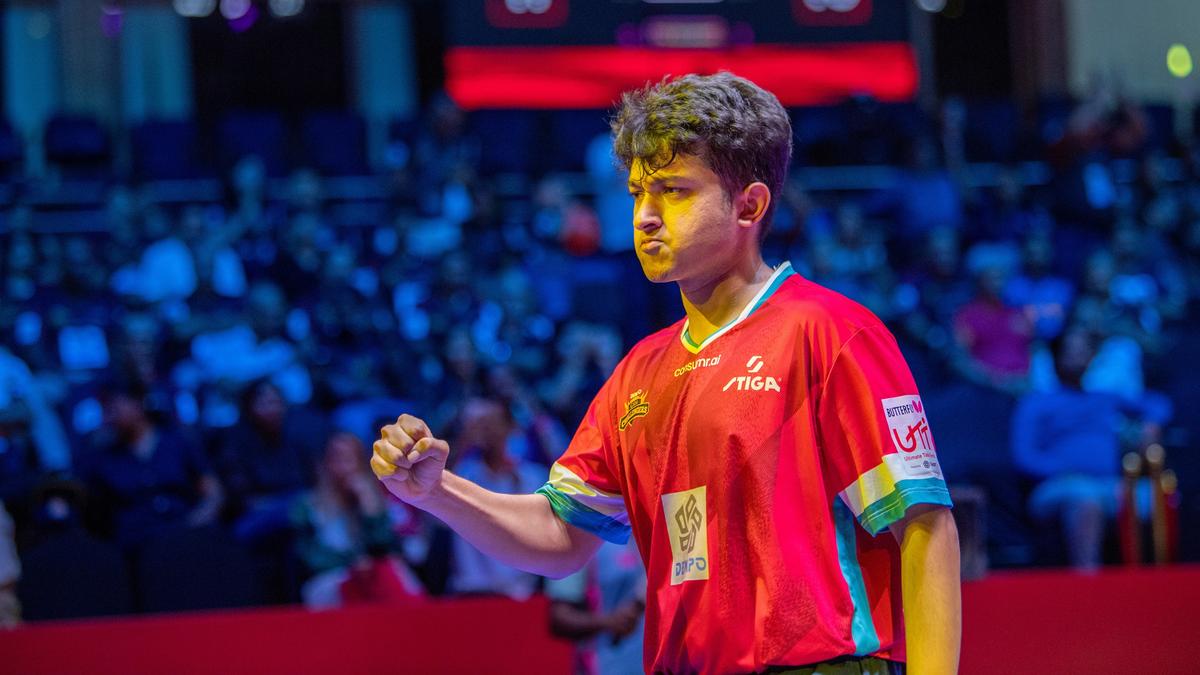
It was the grand inaugural match of Ultimate Table Tennis Season 7 in Panaji.The flashlights were bright sweeping across the indoor arena, and the official UTT anthem blared through the speakers.Amidst the maddening noise, the lights and the spectacle emerged two paddlers. There was, however, nothing particularly spectacular about the match-up on paper. One was ranked in the 200s, the other inside the world’s top 50.Upending the status quoBut what unfolded over the next few minutes was spectacular. P.B. Abhinandh, 18, representing Dempo Goa Challengers, was the challenger with everything to prove. Across the table stood defending champion U Mumba’s Lilian Bardet — a 25-year-old with deep runs in several WTT Pro Tour events and a silver at the 2024 World championships with the French men’s team.More than that, Bardet, the then World No. 42, is an uber-aggressive player on both wings, with the game and the experience to trouble anyone. Yet, the manner in which Abhinandh, then ranked 210, drubbed him in three straight games underlined the teenager’s growing prowess.The Chennai-based paddler served smartly, even if there weren’t too many variations. More often than not, he rushed Bardet with quick serves directed either to the extreme backhand or into the body, denying the Frenchman the time to settle into his attacking rhythm.The defining feature of the victory, however, was Abhinandh’s powerful forehand topspin. Time and again, he overpowered Bardet with ferocious forehand winners from behind the table. Whenever Bardet dropped the ball short or kept his serve short, Abhinandh was quick to pounce, either setting up the point with a deep push that forced Bardet out of position or finishing it outright with a clean winner, all without losing his balance over the table.The manner of victory thrust the spotlight firmly on the youngster. Under such unforgiving lights, many would have crumbled. Abhinandh didn’t.He continued to string together wins with the same fearless aggression and sharp tactical awareness, including one over Ankur Bhattacharjee — widely regarded as one of India’s brightest prospects. His unbeaten run ended against Egypt’s Omar Assar, UTT’s highest-ranked player at World No. 35. Yet even in defeat, Abhinandh left a lasting impression.The teenager starred in his team’s march to the final, where he again defeated Bardet in the opening match. U Mumba came back to win the title, but Abhinandh had done enough over the course of the tournament to be named Season 7’s Player of the League.Clearly, he is no ordinary talent.Ranked World No. 13 in the youth (u-19) category, Abhinandh is slowly beginning his transition to the senior circuit. In fact, he has competed in just three senior WTT tournaments this year and is expected to play a few more.What explains the transformation witnessed during UTT?Abhinandh says it is the result of a conscious change in approach after several discussions with his coach, Subin Kumar, at the Chennai Achievers TT Academy.“Compared to the standards at which I played in the WTT Youth and WTT Feeder events, there has definitely been a major difference in my game. Beating players like Bardet, Payas [Jain], Ankur and Youssef [Abdelaziz] doesn’t happen every day. WTT is a different atmosphere, while UTT, played at home, is played over the best-of-three format where anything can happen.“More importantly, there has been a shift in my mentality. I’m no longer afraid to go for my shots and back myself. I play without fear. Playing with seniors in UTT has certainly been beneficial,” Abhinandh says.The development debateOne of the common criticisms of many Indian juniors is that, under the guidance of their coaches, they continue to focus heavily on junior and youth events instead of making an early switch to the senior circuit. This, critics argue, often hinders their development.Abhinandh, however, disagrees with the notion that youngsters should abandon the junior circuit altogether. According to him, becoming a top-five junior in the world is an achievement of immense value and should not be dismissed. What matters, he believes, is ensuring that the transition to the senior ranks is well-planned.He cites examples to buttress his arguments. “Take Harimoto Tomokazu for example. He gradually quit playing in juniors after he won the ITTF World juniors at 13. China’s Ma Long was 16 when he won the ITTF World juniors in 2004. Ryuusei Kawakami, who won the World youth u-19 title last year, hasn’t played much in juniors. The shift should be gradual and if it is done abruptly it will affect the confidence of young players.”The teenager says his aim is to reach the top-4 in the youth section over the next year before shifting his attention to the seniors completely.Subin Kumar, an ITTF-certified coach who has worked with Abhinandh since the youngster was five years old, says the breakthrough did not come overnight.Crushing it! A striking feature of Abhinandh’s game is his powerful forehand topspin. | Photo Credit: Butterfly UTT “I started preparing him for a proper transition to the senior level, and there were plenty of ups and downs. We began working on his transition two years ago, focusing not just on his game but also on the mental and physical aspects. I always knew he was a big-stage player who loves competition, so what he has done in UTT hasn’t come as a surprise to me,” Subin says.The coach believes the next phase of Abhinandh’s development involves regular exposure to the senior international circuit.“He hasn’t played many senior WTT tournaments so far, but this year and next year he will compete in more senior events. The idea is that by the time he graduates from the youth circuit, the transition to the senior level will be much smoother. We are still working on his fitness and the mental side of the game,” he adds.Dempo Goa Challengers coaches Elena Timina and Parag Agrawal, who have watched Abhinandh closely, echo Subin’s assessment. They believe the teenager has the maturity to take responsibility for his own development.“He has his feet firmly on the ground, listens well and is a very clever boy. He has a clear idea of what he wants to do on the table. The main area he needs to improve is his physical fitness,” Timina says.Parag believes Abhinandh has struck the right balance between junior and senior competition. “He has planned his junior and senior careers well. He’s playing an adequate number of tournaments in both categories and is very disciplined,” he says.Ready for the next stepThe next two to three years will be decisive. He possesses the technical ability, tactical awareness and temperament to succeed at the highest level.A self-confessed admirer of former World No. 1 Fan Zhendong, Abhinandh appears ready to challenge the likes of G. Sathiyan, Harmeet Desai, Manav Thakkar and Manush Shah on the domestic and international circuits, besides testing himself against the world’s best paddlers.If his UTT performance is any indication, he will leave no stone unturned to prime himself for bigger battles, bigger stages and bigger medals.
Abhinandh flicks mental switch, lights up Ultimate Table Tennis
Full Article
Original Source
Read the full article at Thehindu →KhanList aggregates and links to publicly available news content. We do not host full articles from third-party sources. Always verify important information with original sources.