
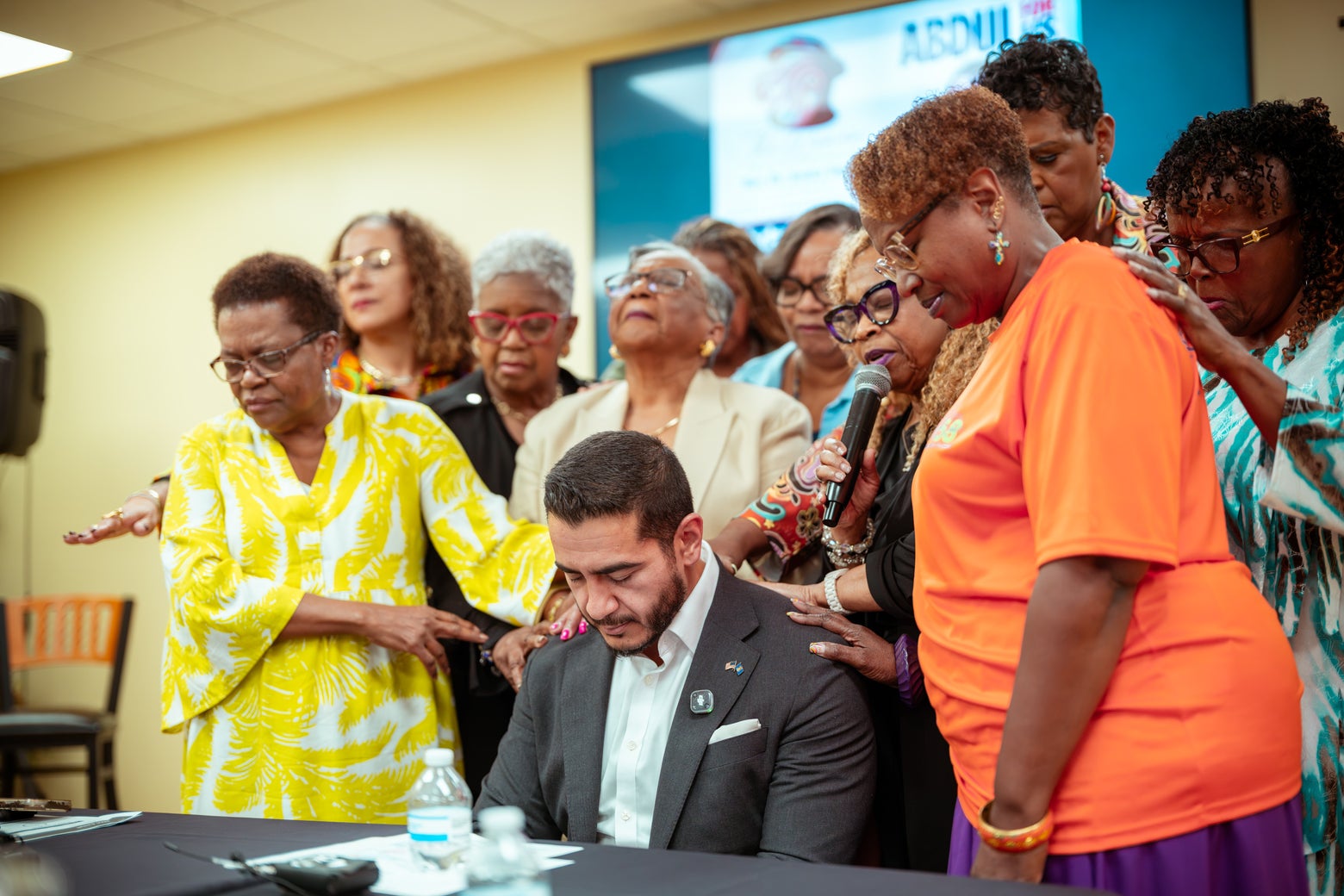
Politics The Black Voters Skeptical of Abdul El-Sayed In Michigan, the Senate candidate has been asked repeatedly about Jewish voters. Another constituency may be a larger obstacle. By Enter your email to receive alerts for this author. Sign in or create an account to better manage your email preferences. Unsubscribe from email alerts Are you sure you want to unsubscribe from email alerts for Aymann Ismail? Oct 06, 20265:45 AM Abdul El-Sayed campaigns in Detroit on Aug. 7. Bill Pugliano/Getty Images Sign up for the Slatest to get the most insightful analysis, criticism, and advice out there, delivered to your inbox daily. At 3 p.m. on a recent Saturday afternoon, in a conference room inside Fellowship Chapel in Detroit, Abdul El-Sayed looked different from the Senate candidate I had been watching at rallies around Michigan. He dipped his head. His voice seemed softer. This was not a room he commanded. Almost everyone in the room besides El-Sayed was Black. He quickly tried to make inroads. “Many folks in this room are people I worked with in the city of Detroit,” he said at one point. Then, turning toward one woman he knew from those years: “Ms. Pam, have I changed at all?” he asked her. “No.” “Still talking about the same things, right?” he asked, smiling. “Yes, sir,” she said. The women around El-Sayed belonged to the Woman Difference Collaborative, an invitation-only network of Black women faith leaders founded by the Rev. Jessica Ingram. Its members included senior pastors, first ladies, evangelists, and other women with constituencies of their own that travel far in a state like Michigan. The group began as a support system for women navigating leadership in the Black church, but its reach extended into politics. When Kamala Harris became the Democratic nominee in 2024, the collaborative organized a major gathering in support of her with only a few weeks’ notice. Some in the room already liked El-Sayed. But most had voted for his Democratic primary opponent, Rep. Haley Stevens. Before El-Sayed spoke, the moderator, Monica G. Anthony, had already indicated part of the reason why: his support for the “uncommitted movement” in 2024, which many Black Democrats believed had weakened Harris on her way to losing Michigan. Some Black Democrats experienced that campaign, which demanded an end to U.S. support for Israel’s assault on Gaza, as an attack on a historic candidate they desperately wanted to elect. (Last month, in an apparent effort to help mend the wound, Harris traveled to Michigan to campaign for El-Sayed.) Now questions still surround his campaign about whether he can win over the Black voters who largely rejected him in the primary. El-Sayed won the primary by a single percentage point. He lost in Detroit by 28 points; Stevens won the city handily. In nearly every major national interview with El-Sayed, he’s asked about the concerns of Jewish voters in Michigan, who make up about 1.5 percent to 2 percent of voters there. He’s rarely asked about the concerns of Black voters, who make up roughly 11 percent to 12 percent. Democrats traditionally do not have a plausible path to statewide victory without a strong Black voter turnout. And if a recent Washington Post poll is any indication, El-Sayed still has a lot of ground to make up with those voters. About 83 percent of Black voters said they wanted Democrats to control the Senate—but only 67 percent said they’d back El-Sayed. For some Black voters, the skepticism has to do with questions about El-Sayed’s progressive agenda. Others indeed cite the uncommitted movement. But the reluctance isn’t always necessarily ideological. Basil Smikle, a political strategist and professor at Columbia University, has argued that Black voters often vet candidates through a different lens than some other groups do. “The question is ultimately about familiarity, affinity, and allyship—not as symbolic gestures, but as evidence accumulated over years of shared political struggle. It is a proxy for trust,” he wrote. Stevens, many analysts noted, was a known commodity to many Black voters as a congresswoman. El-Sayed was not. By now, many Black Democrats have made clear that they intend on voting for him. (Recently, his campaign was endorsed by the Congressional Black Caucus.) But even among them, there’s voters who say they’re doing so for the sake of coalescing against El-Sayed’s Republican opponent. Detroit attorney and former mayoral candidate Todd Perkins said he’ll probably vote for El-Sayed despite grievances about uncommitted and what he saw as patronizing outreach to Black voters. “He engages the white construct in a way that’s intelligent and everything, and then I see this commercial where he’s sitting there playing Aretha Franklin and he’s dancing a jig,” he said. There was also a more complicated tension with the long and sometimes fraught relationship between Black and Arab communities in metro Detroit. Arab-owned gas stations, liquor stores, and other small businesses have for decades operated in predominantly Black neighborhoods, even as many of their owners lived elsewhere, producing what some Black Detroiters describe as a relationship that can feel extractive in a way that hurts their community. At a press conference in August in Detroit, an older Black man shouted, “He’s an Arab—he don’t care nothing about Black folks.” At a September roundtable with Black elected officials, Michigan state House candidate Kimberly Fisher warned that Black voters in her district brought up his race repeatedly. “Why would I vote for an Arab? Arabs don’t like us. He’s Egyptian, y’all. We don’t care. And when they see you, that’s what they see,” she said. “I’m fearful because I’m seeing more John James signs and Mike Rogers signs in the hood,” referring to El-Sayed’s Republican opponent in the Senate race. The solution, she proposed, was El-Sayed planting his feet on the ground in those areas and speaking out against the bad practices of Arab business owners in Black communities. To El-Sayed’s credit, he has since talked openly about that fraught relationship. He told WDET in a radio interview that Arab and Muslim Michiganders can’t object to racism against themselves while tolerating it against their Black neighbors. “Standing up against racism is about principle,” he said. In the church that afternoon, much of El-Sayed’s speech sounded familiar to me from his other campaign stops. But in this room, I noticed that he spent considerably more time on Black political history. After 9/11, one of the only Black teachers at his high school pulled him aside and told him, “You’ve got to learn your history, and not the history you’re going to learn in the classroom,” he said. The teacher took him to the library, where El-Sayed encountered writers like W.E.B. Du Bois, Alex Haley, Malcolm X, Frederick Douglass, and Fannie Lou Hamer. From there, he traced a line through the Civil Rights Movement and Black opposition to apartheid in South Africa. Then he brought it all forward to Gaza to explain his support for uncommitted. El-Sayed spoke about a friend who had lost 25 relatives to American-funded missiles. “Imagine watching your own tax dollars get used to annihilate your own cousins,” he said. Someone murmured, “Whoa.” He explained that he had backed uncommitted to force the Biden administration to confront what it was doing in Gaza. “A Democratic Party that says that it’s for human rights has got to be for human rights,” he explained. He noted that when Joe Biden quit the race, El-Sayed endorsed Harris the next day. I looked around the room and saw that the group did seem moved. The skepticism I had heard at the beginning of the afternoon had evaporated. By the end, nine of the women gathered behind El-Sayed’s chair, and each placed a hand on him as they bowed their heads in prayer. “We thank you for the people that you put on the Earth to make change,” one of them said. “We recognize that all of us are called to something.” Photo by Aymann Ismail He may have won the room, but El-Sayed still has to move a much larger electorate. The campaign appears to understand that this cannot be solved by simply assuming voters who usually back Democrats will eventually fall in line. Fellowship Chapel was one stop in a broader effort: The campaign says El-Sayed has visited more than two dozen Black churches and participated in more than 100 meetings and events with Black elected officials, clergy, community leaders, and organizations across the state. On Monday, former President Barack Obama announced he would travel to Detroit to stump for El-Sayed, a hard-won coup for the candidate. The afternoon I was there, El-Sayed had another campaign stop to get to, and soon his staff was moving him toward the door. I stayed behind. The room loosened into little clusters of women catching up and talking about what came next. I wanted to know whether the prayer and applause would translate into anything. Monica G. Anthony, the first lady of Fellowship Chapel and the wife of the Rev. Wendell Anthony, the longtime president of the Detroit NAACP, told me she had voted for Stevens in the primary and had entered the afternoon with questions about El-Sayed’s support for uncommitted. The point of bringing him into the room, she said, had been to make a judgment for themselves. “We reach a lot of people, and we need to see if you are that person,” Anthony said. “And then if you are the person, how do we make it happen to get elected?” By the end, she had made up her mind: “I think he is that person.” Nearby, LaToya Henry, another woman with deep ties to Black civic life in Detroit, said she had not voted for El-Sayed in the primary either and came because she wanted to hear him explain himself. “I didn’t just want my vote to be like, ‘Oh, I’m picking the lesser of two evils,’ ” she told me. After hearing him walk through the decision, she said, “Now my vote is definitely not a lesser of two evils.” Her parents had also not voted for El-Sayed. They were already having similar conversations with friends, and Henry now felt equipped to take what she had heard in the room back to them. The Rev. Patricia Coleman-Burns, a University of Michigan professor emerita who grew up in Detroit and has watched the region’s racial and political coalitions shift for more than 70 years, was a die-hard Stevens supporter. But she told me, after the primary, she began watching the political energy gathering around the man who had beaten her candidate. Hundreds turned out in Farmington Hills. Students lined up in Ann Arbor. Black clergy in Detroit came out for him. She saw similar enthusiasm in Grand Rapids, Muskegon, Battle Creek, Flint, and Saginaw. “I have seen people come alive,” she said. She had also begun feeding advice through people in El-Sayed’s orbit about how he talked to Black voters. Early in the campaign, she said, El-Sayed tended to speak broadly about people of color. Now he explicitly talked about Black people and Black communities. “He has evolved. Prior to the primary, it was a campaign,” she said. “Now it’s a movement, and it’s a movement because it’s beyond him.” Democrats Senate Black Americans Michigan Islam 2026 Midterms
Abdul El-Sayed Is Constantly Asked About Jewish Voters. That’s Not Who He Really Has to Worry About.
Full Article
Original Source
Read the full article at Slate →KhanList aggregates and links to publicly available news content. We do not host full articles from third-party sources. Always verify important information with original sources.