
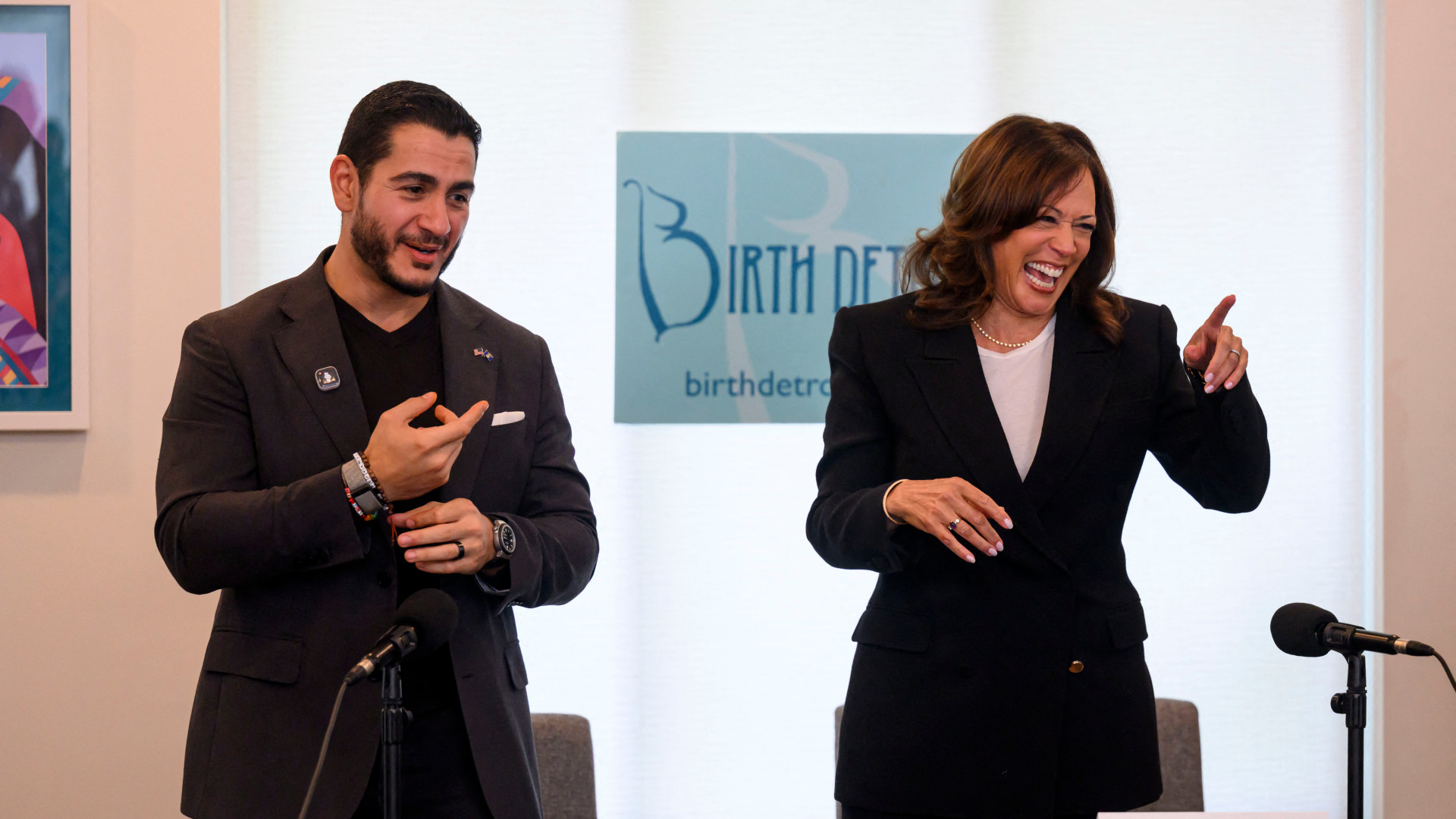
On Tuesday, Michigan Senate hopeful Abdul El-Sayed spent the day campaigning across Detroit with former Vice President Kamala Harris. This decision was a gut-punch to anyone who remembers the role the Biden-Harris administration played in the Gaza genocide, continued seamlessly by President Donald Trump and Vice President JD Vance. Harris's trip was reportedly the opening stop of a midterm campaign tour as she weighs a third run at the presidency. Under the Democrats' new nominating calendar, Michigan is slated to vote among the first six states in the 2028 presidential primary. Harris, who lost both Michigan and the presidency in 2024, follows Detroit with campaign stops in Georgia and Nevada in the coming weeks. She told the Detroit crowd that "28 won't matter if we don't get through 26". The El-Sayed-Harris partnership was predictable. In August, immediately after winning his primary, El-Sayed proudly touted Harris's endorsement on X, echoing her campaign message of lowering prices. New MEE newsletter: Jerusalem Dispatch Sign up to get the latest insights and analysis on Israel-Palestine, alongside Turkey Unpacked and other MEE newsletters That very week, a mass funeral was held in Gaza for 112 members of two families, recovered from under the rubble. They were killed in 2023 by bombs provided by the Biden-Harris administration. In 2024, when I attended a Philadelphia rally for Palestine and heard rival chants of "Kid Killer Kamala" and "Holocaust Harris", you couldn't have convinced me that a pro-Palestine political hopeful would express anything but scorn for the then-vice president. Yet El-Sayed, who urged Michigan Democrats to vote uncommitted in 2024 and beat Congresswoman Haley Stevens in a primary that largely centred on US military aid to Israel, is now helping to launch her rehabilitation tour. Salt in the wound El-Sayed, who has made clear his embrace of capitalism and condemnation of Palestinian resistance to settler colonialism, has always had the hallmarks of an establishment candidate. Nevertheless, embracing Harris so soon after his win was, for many, salt in the wound. Harris, at the height of the genocide, told the Democratic National Convention: "I will always ensure Israel has the ability to defend itself." 'How [can one] run against a genocide and then embrace one of the people who helped carry it out?' She refused to condition the flow of US weapons, and her campaign rejected calls for an arms embargo outright - reflecting her longstanding, self-proclaimed "unwavering" support for Israel. She has repeatedly appeared at Aipac events and posed for photo ops with Israeli leaders. At the time of the endorsement, Palestinian-American journalist Laila al-Arian questioned on X how one can "run against a genocide and then embrace one of the people who helped carry it out". Abubaker Abed, a journalist from Gaza, wrote that El-Sayed's statements since his primary win "have become more abysmal and disgraceful", calling him "someone who chases power and self-interest". He added: "From garnering génocidaires' support to writing off efficacious bills to end Israel's occupation and political clout in the US, he is just another microcosm, maybe inferior, of Mamdani." New York Mayor Zohran Mamdani, for his part, received a call from Harris over the summer. When asked about it and their potential to collaborate, he said that halting US military assistance to Israel is a baseline commitment, but that he "appreciated" Harris's phone call, adding that those who protested Harris at the DNC need to be able to call the Democratic Party "their home". Palestinian-American journalist Ali Abunimah added a pithy "Genocidaires out of politics", and Talia Jane, who covered the Gaza student movement, responded: "You don't need people who support and facilitate genocide. You're just doing image rehab for them." Professor Shabana Mir added: "She's irrelevant and you're trying to resuscitate her. Don't." Aipac's millions Public disruptions of pro-Israel figures have become a social media phenomenon in the US. Harris was interrupted by pro-Palestine protesters at a Detroit campaign rally in August 2024 and infamously retorted, "I'm speaking," shutting down the disruption. Journalist Sam Husseini, now a Green Party congressional candidate in Maryland, confronted Secretary of State Antony Blinken at his final Biden-era presser, only to be dragged out "like a potted plant" by security. Senator Bernie Sanders was disrupted at an April 2025 event in Bakersfield, California, for his then-refusal to call Israel's actions a genocide and for blaming the violence solely on Israeli Prime Minister Benjamin Netanyahu. Israel has lost the American people. The politicians are next Read More » It was in this climate that El-Sayed took to the campaign trail, calling Israel "pretty damn evil", labelling Netanyahu a war criminal and demanding an end to the US's unconditional military aid to Israel. Such views had also entered the mainstream among the Democrats he was courting. In June 2025, Mamdani won New York's mayoral primary, in a race widely read as a referendum on Gaza, over former Governor Andrew Cuomo. Cuomo, the favoured candidate of pro-Israel donors, had joined Netanyahu's legal defence against the International Criminal Court's arrest warrant for war crimes. Polling found that 62 percent of Mamdani's voters cited his advocacy for Palestinian rights as a reason for backing him. By August 2025, 77 percent of Democratic voters said Israel is committing genocide in Gaza, 75 percent opposed further US military aid, and, for the first time in 24 years of Quinnipiac polling, more US voters sympathised with Palestinians than with Israelis. Aipac-linked groups nevertheless spent tens of millions of dollars - more than $60m by El-Sayed's own count - to defeat him in the primary. Congresswoman Hillary Scholten said she would not campaign with him so long as he associated with Twitch streamer Hasan Piker, a vocal critic of Israel's genocide whose massive audience El-Sayed had courted throughout the primary. His Republican opponent, Mike Rogers, has openly appealed to Jewish voters over El-Sayed's sharp criticism of Israel. 'Mature politics' Since the primary, El-Sayed has made one concession after another, each a retreat from his criticism of Israel and its lobby. At the state party's convention in Lansing in late August, he vaguely referred to the money spent against him, but Aipac, "one of his most frequent targets during the primary", was "notably absent" from his remarks, CNN reported. When asked about Piker, he answered: "I don't want to have a conversation about a Twitch streamer in California. It's just not a serious conversation." To Jewish Democrats, he has promised that Michigan can "disagree agreeably on some of those issues having to do with what we do 6,000 miles away". Ahead of the Harris visit, Michigan Attorney General Dana Nessel, who had spoken publicly of Jewish Democrats' unease with his candidacy, endorsed him: "There is no choice." On Tuesday, he told reporters that his disagreements with Harris over Gaza are "clear", but that working together where they agree is "what a mature politics looks like". At the roundtable itself, Harris remarked, "I think we are at the point of our new relationship where I can call you Abdul." El-Sayed replied, "Perfect. For me, it's going to be Madame Vice President." "Spineless," responded British-Iraqi rapper and journalist Lowkey. And when a reporter asked at a Detroit press conference whether campaigning with Harris, after his own support for the uncommitted movement, might backfire with Arab American voters, El-Sayed turned on the questioner: "Is Vice President Harris the same as President Biden? Was Vice President Harris running for president at the time we were uncommitted? Answer the question... You're asking a question based on false premises, so I'm just getting you to clarify your premise... Thank you. Next question." Harris herself has answered his question. Asked on the US talk show The View in October 2024 what she would have done differently from Biden, she said: "There is not a thing that comes to mind... I've been a part of most of the decisions that have had impact." After President Joe Biden dropped out, the uncommitted movement took its demand for an arms embargo directly to Harris as the party's nominee. She never granted it. El-Sayed's response drew swift backlash on social media, with critics deriding the uncommitted movement as a scam and condemning his arrogant dismissal of the contradiction the reporter had raised. Lesser evils Americans, taught since grade school that voting enacts change, are desperate to cast a ballot for someone - anyone - on the right side of history. To many, El-Sayed's stance was invigorating. Yet one wonders, were his positions ever genuine? Or were they part of a wider trend of politicians of colour running for office to mollify outrage, as Palestinian surgeon Dr Ghassan Abu Sittah argued in March: These reformist characters that come along when the empire needs them to prevent the potential for real revolutionary change will betray you. That's their job. Because they accept the empire in its widest. And even more dangerous, they will tell you, 'We are the boundary of opposition... If you go beyond me, you'll fall off the edge of the earth.' So, this new generation of reformist... politicians of color are now offering the empire to sap up, like blotting paper, the consequences of the genocide and prevent real change. By allying with Harris, El-Sayed shows contempt for his supporters, many of whom backed him because they viewed him as a counterweight to Zionist influence in politics. Pro-Palestine voters have experienced this betrayal before. In the 1990s, Barack Obama, then a rising Chicago politician, dined with Edward Said and Ali Abunimah, giants in the American landscape of Palestine advocacy, only to become a stalwart defender of Israeli settler colonialism. In 2018, then-congressional candidate Alexandria Ocasio-Cortez called Israel's shooting of Palestinian protesters in Gaza "a massacre" and declared that "Democrats can't be silent about this anymore". Three years later, as fellow "Squad" members voted against $1bn in Iron Dome funding for Israel, she voted "present" and wept on the House floor, then apologised for the vote. By July 2025, deep into a genocide she had for months refused to name, she was voting against an amendment to cut $500m in Iron Dome funding. More recently, Colorado's Melat Kiros, who won her primary on a pro-Palestine platform, said in a high-visibility interview that her "greatest concern... is that the state of Israel is losing support across the political spectrum" - the implication being that the image of an ethnostate is worth preserving. (After an outcry, she scrambled to walk the remark back.) Less than two months after his primary win, El-Sayed is already on this path. REPORTER: “We know that you endorsed the uncommitted vote in 2024, and people might say that you’re now flip-flopping by having Kamala Harris come into your camp. Do you see this as a possibility that it might backfire for you among the Arab American vote?"EL-SAYED: "Can you… pic.twitter.com/WOLdeJBgOx— HOT SPOT (@HotSpotHotSpot) September 23, 2026 His supporters will say that he is still a lesser evil and, though imperfect, vastly superior to his opponents - Stevens in the primary, Rogers in the upcoming general election. El-Sayed made the same case for Harris. On Morning Joe the Friday before her visit, he recalled endorsing her the moment Biden dropped out in 2024 "because I understood that whether you saw this race from the eyes of a child in Detroit... or the eyes of a child in Gaza, that Donald Trump was going to be worse". In Detroit, Harris assured voters that it's "OK to not be in love with a candidate. It's OK to vote and ask everybody else to vote because this choice is better than that one." Yet his fans hardly regard him as a lesser evil. They put El-Sayed in celebratory Instagram reels and poster art, handsome and haloed - hardly a regrettable but necessary alternative to something worse. If lesser-evilists believed their claim, wouldn't they be reluctant, even grudging, in their support? These are recycled claims from defenders of an electoral system that Lara Sheehi has called a form of counterinsurgency. Critics like Abed, Al-Arian or Abu Sittah are accused of being "allergic to power", perhaps, or engaged in "purity politics" - arguments that might be worth considering had they not been trotted out and disproven time and again in prior cycles. Islamophobic attacks El-Sayed's victory has been met with racist attacks. Republican Congresswoman Nancy Mace, for instance, said that "Every single Muslim holding public office in America is a Trojan horse, and a threat to both national security and our republic." El-Sayed has been dubbed a radical Islamist and a terrorist, and President Trump has taken to calling him by his full name, Abdulrahman Mohamed El-Sayed, reminiscent of the emphasis on President Obama's Muslim middle name, Hussein - a transparent attempt to Islamicise and, thereby, demonise him. Such racism draws on a much older American Islamophobia. Muslim Americans are still reeling from the shooting at the Islamic Center of San Diego in May, which killed three worshippers, and several mosques have been on the receiving end of threats and vandalism. So, what's next? Biden's Secretary of State Antony Blinken invited to speak at Students for Justice in Palestine events? This should not interfere with a clear-eyed assessment of ascendant politicians' positions. President Obama, for his part, was the victim of extreme anti-Black racism, yet reigned supreme in an era of Black faces in high places. Even right-wingers like Vivek Ramaswamy or Condoleezza Rice have been on the receiving end of racist animosity, which hardly makes them worthy of our support. One of the dangers of identity politics stripped down, decontextualised, is that anyone who is targeted on the basis of their identity can command a cult of personality. To be clear: American anti-Muslim racism is fuelled and legitimised by the kind of foreign policy practices that receive full-throated support from the likes of Harris - a fact no amount of hijab-clad Harris staffers or interfaith programming can reverse. If democracy were ever to mean anything, historian Howard Zinn wrote, it "would not come, if history were any guide, from the top. It would come through citizens' movements, educating, organizing, agitating, striking, boycotting, demonstrating, threatening those in power with disruption of the stability they needed." Given the groundswell of "progressive" support for candidates like El-Sayed, one would expect some deference to this principle. Somehow, it is lost on his supporters. So, what's next? Biden's Secretary of State Antony Blinken invited to speak at Students for Justice in Palestine events? His press secretary Karine Jean-Pierre wearing a keffiyeh to a mosque fundraiser? Such scenarios may seem beyond the pale, but should they come to pass, one thing is certain: there will be many who defend them in the name of strategy and pragmatism. Recently, I encountered former Senator Joe Manchin at the Amtrak station. I shouted after him about his support for the elimination of entire bloodlines in Gaza. He walked along as if he hadn't heard me, and as I lost sight of him, I found myself wishing it had been someone else - Senator Cory Booker, perhaps, or AOC. Manchin, after all, was nothing if not consistent about his positions. It is much more costly, and revelatory, to direct one's agitation at the cynics who wish to have it both ways and, increasingly, the amnesiacs who allow them to. The views expressed in this article belong to the author and do not necessarily reflect the editorial policy of Middle East Eye.
Abdul El-Sayed helps launch the unforgivable rehabilitation of Kamala Harris
Full Article
Original Source
Read the full article at Middleeasteye →KhanList aggregates and links to publicly available news content. We do not host full articles from third-party sources. Always verify important information with original sources.