
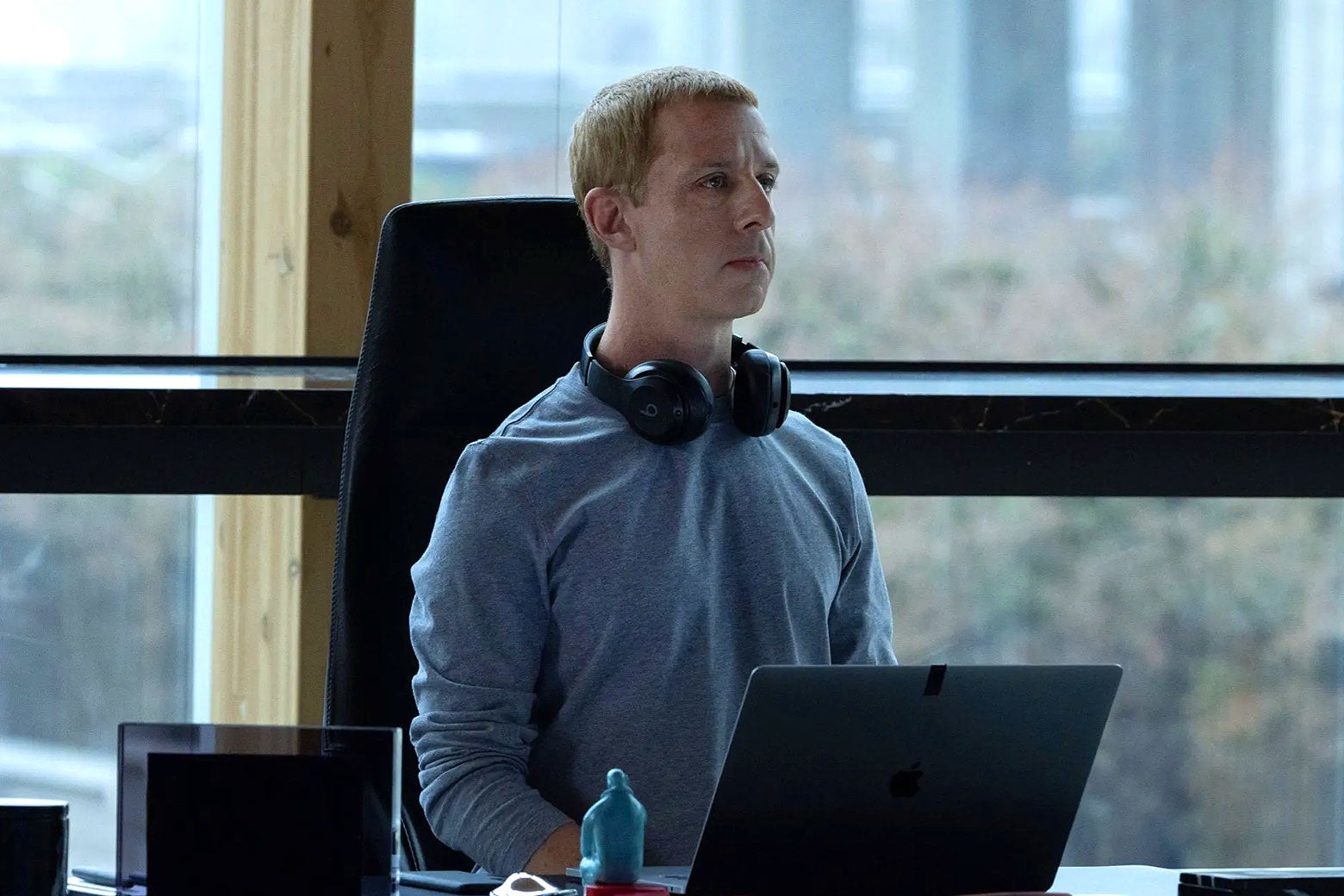
Movies Aaron Sorkin’s Sequel to The Social Network Thinks You Can’t Handle the Truth The Social Reckoning’s Mark Zuckerberg actually has more in common with the villain of an entirely different Sorkin movie. By Enter your email to receive alerts for this author. Sign in or create an account to better manage your email preferences. Unsubscribe from email alerts Are you sure you want to unsubscribe from email alerts for Sam Adams? Oct 08, 202612:39 PM Sony Pictures Releasing Sign up for the Slatest to get the most insightful analysis, criticism, and advice out there, delivered to your inbox daily. There’s a number Aaron Sorkin wants you to know so badly that he built an entire movie around it. That number, to get to the point somewhat more quickly than The Social Reckoning does, is 64: the percentage of users in extremist Facebook groups who, according to an internal report from 2016, were steered to them by the site’s own algorithm. I’m sure that precise figure is jotted down in my notes somewhere, but there’s no need to consult them, because it’s mentioned so often that by the time the movie is over it might as well be tattooed on the inside of your eyelids. There is, technically speaking, a story in The Social Reckoning—characters, even. But they’re not there to engage the audience on a conventional dramatic level, let alone to tease out larger issues in a way that forces us to question what we thought we already knew. They’re just there to give us something to look at while Sorkin tells us what he believes we need to know. When The Social Network was released in 2010, the idea of a feature-length character study devoted to the founder of a social media company seemed, at least to some, like more information than was strictly necessary. Sure, we knew who Mark Zuckerberg was; did we need to understand him? Sixteen years later, with Facebook boasting more than 3 billion users worldwide—more than five times the size it was when The Social Network was released—its significance is beyond question. But Sorkin is no longer so interested in understanding why Zuckerberg is the way he is. The question now is: What are we going to do about it? Reckoning’s chief interrogator is Jeff Horwitz (Jeremy Allen White), a newly installed correspondent for the Wall Street Journal who is so tech-unsavvy he doesn’t know how to use his rental car’s GPS. (The year is 2019.) He makes contact with Frances Haugen (Mikey Madison), a member of Facebook’s civic integrity team who turns out to be more faithful to the company’s stated ideals than the people who are actually running it. Haugen and her co-workers have already been warned to give the new guy on the Journal’s Silicon Valley beat a wide berth; the company’s spokesperson (Billy Magnussen) plasters Horwitz’s face across a 30-foot-high screen as he warns the assembled workforce that journalists are “megalomaniacs dressed up as truthtellers.” But Haugen keeps running into signs that the company she thought would change the world for the better is actually setting it on fire, and turning a profit off sharing pictures of the flames. The skeptical-but-softening relationship between Horwitz and Haugen gives Sorkin an opportunity to cram in a little human interest, not to mention some gratuitous eye candy. After making a big deal about how Frances suffers from a form of neuropathy that causes intense pain if she doesn’t keep her hands and feet insulated, he contrives to have Madison wear a series of skimpy outfits to their meetings in his hotel room, on the pretext that her comings and goings are less likely to attract attention if she dresses like a sex worker. (Sorkin also has Horwitz call the female Journal intern assigned to his investigation “girl intern,” and opine that women only use the word mansplain when they’re losing an argument—all in the apparent belief that being openly misogynistic will make him seem gruffly appealing.) But the pair has an equally critical function, which is to ensure that we never have to look at Jeremy Strong’s Mark Zuckerberg for more than a few minutes at a time. In The Social Network, Jesse Eisenberg’s Zuckerberg was a frustrated nerd desperate to ingratiate himself with the people who were where he wanted to be. You knew why Rooney Mara’s character broke up with him in the movie’s opening scene, but you also had at least a sense of why she might have fallen for him in the first place, or why Andrew Garfield’s Eduardo Saverin might have placed his trust in someone who seemed so obviously primed to screw him over. But in Reckoning, Strong plays Zuck as an unrepentant, and essentially unrestrained, sociopath, too powerful to need to win anyone over. He pays lip service to Facebook’s sense of global stewardship, but when a member of Haugen’s team tries to brief him on how making certain adjustments to the site’s algorithm could reduce the spread of misinformation by 38 percent while costing them only 1 percent of overall engagement—those numbers, too, are repeated often enough to stick—he doesn’t bother to soften his contempt. When you’re Facebook’s size, after all, even a single percent of its users comes out to tens of millions. Strong’s Zuckerberg couldn’t be the protagonist of a movie any more than you could make Jaws about the shark. If the first movie tried to get inside his skin, this one concludes there’s nothing in there but entitlement and rage. Strong gives an incandescently angry performance, one that makes you flinch when he turns anger toward others, like the crisis management specialist (Wunmi Mosaku) who’s helping prepare for the congressional hearing prompted by the publication of Horwitz’s article, but on some primal level you’re just glad he’s not turning it toward you. Imagine Jack Nicholson in A Few Good Men, stripped of the sly wit and movie-star charisma. It takes some sly timeline-hopping to even get Haugen and Horwitz in the same movie with Zuckerberg, and even with Sorkin’s fictional liberties, there’s no way to contrive to put them in the same room. But he does construct a persuasive chain of cause and effect, showing how Zuckerberg reacted to the threat of newer social networks by tweaking Facebook’s algorithm to favor rage-inducing content that would keep users infinitely scrolling. Sorkin doesn’t direct with anything like the visual mastery that David Fincher brought to The Social Network, and his love of people talking in rooms, be they hotel, conference, or chat, gives Reckoning an airless feel that blunts its alarmism about what Facebook is doing to the non-virtual world. But every once in a while its characters venture out in public long enough to overhear an offscreen character in the midst of regurgitating some hare-brained conspiracy theory, brushing off skepticism with “It’s all over Facebook.” The Social Reckoning does its best to end on a note of temporary triumph, but from our perch in the future, it seems like things have only gotten worse, and the story isn’t close to being over. Facebook Mark Zuckerberg Movies Social Media
Aaron Sorkin Is Back With Another Facebook Movie. I Did Not “Like” It.
Full Article
Original Source
Read the full article at Slate →KhanList aggregates and links to publicly available news content. We do not host full articles from third-party sources. Always verify important information with original sources.