
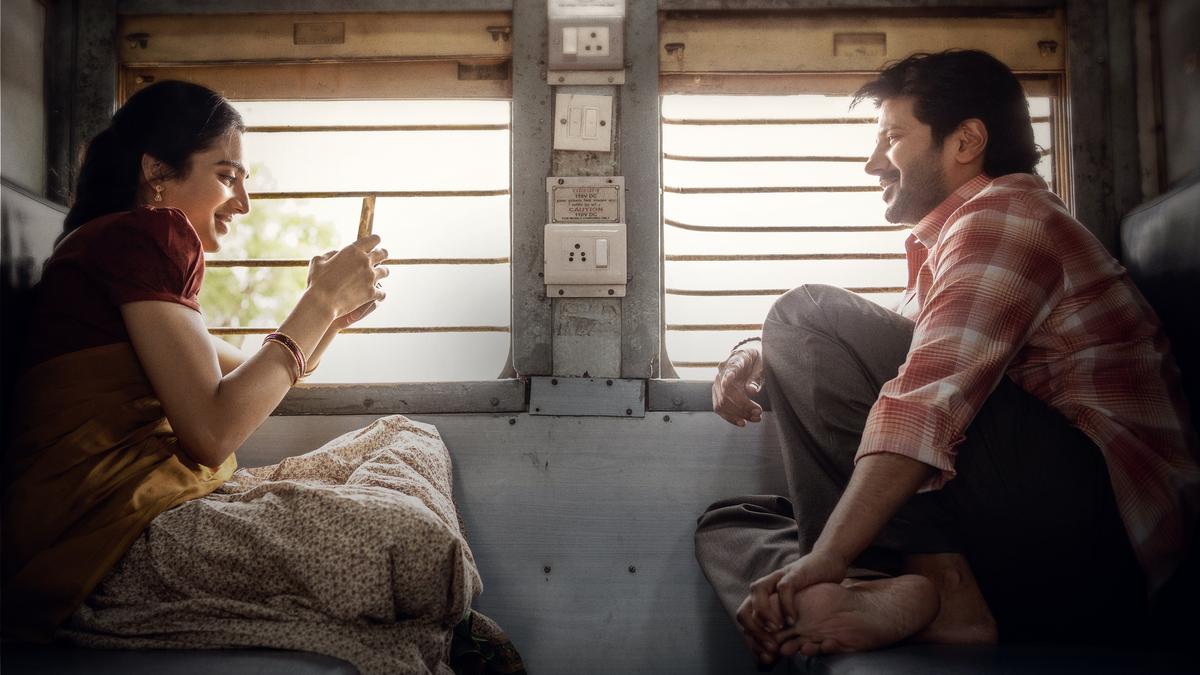
There are times when we yearn for a story of hope. Told well, it can take us back to the innocence of childhood, when we would not hesitate to dream. Aakasamlo Oka Tara (A Star in the Sky), written by Gunnam Gangaraju and directed by Pavan Sadineni, is one such story. Starring Dulquer Salmaan, newcomer Satvika Veeravalli and Shruti Haasan, this underdog tale is told with enough conviction to make us root for its characters rather than dwell on its predictability. The writing, performances and technical craft come together to deliver one of the best Telugu films in recent times.A non-descript van painted in the colours of the sky and adorned with images of the solar system drives into Palalanka village in Andhra Pradesh. An elderly man (Nasser) sets up a makeshift planetarium for a touring talkies show, little realising the impact it will have. A young girl named Kalpana (the film pays tribute to Kalpana Chawla, APJ Abdul Kalam and Rakesh Sharma) wanders into the tent and gazes wide-eyed at the stars and planets. The sequence captures the innocence of childhood and establishes the film’s intent to move away from larger-than-life mainstream tropes in favour of the joys of simple storytelling.Cinematographer Sujith Sarang quietly works his magic, often pulling back to capture wide vistas — from the village and the banks of the Godavari to the mines of Gujarat, and later college campuses and office spaces — mirroring Kalpana’s ambitions as she aims for the skies.Aakasamlo Oka Tara (Telugu)Director: Pavan SadineniCast: Dulquer Salmaan, Satvika Veeravalli, Shruti Haasan, Ruhani SharmaRuntime: 149 minutesStoryline: A girl from a village dreams of becoming an astronaut, despite the odds stacked against her. What does it take for her to reach the skies? The childhood portions establish Kalpana’s world: a father with a toxic streak and a mother who wants her daughter to break free. Patriarchy manifests in different forms, first through her father and later through the older sister of the groom chosen for her, Krishna (Dulquer Salmaan).An undercurrent of hope runs through the initial portions, highlighting what it takes to inspire someone to pursue their dreams, and how that inspiration can set off a chain reaction.When Krishna realises he has married someone much younger and asks Kalpana about her aspirations, he initially comes across as an archetypal saviour. But Gunnam Gangaraju, Vasanth Jurru and Pavan Sadineni, who have co-written the story and screenplay, gradually peel back the layers. Krishna's lack of toxicity and the reasons behind his sister's bitterness are revealed over time.Meanwhile, another young girl in the household quietly draws inspiration from Kalpana's academic achievements.The story of a husband helping his wife realise her dreams isn't new to mainstream Indian cinema. Those who grew up in the 90s might recall Suryavamsam, a blockbuster across Tamil, Telugu and Hindi. Shruti Haasan in the film | Photo Credit: Special Arrangement Aakasamlo Oka Tara presents Krishna and Kalpana's story with refreshing honesty, without the heightened drama of a masala entertainer. When Krishna works double shifts at a mine in Gujarat and narrates his story to Bijli (Ruhani Sharma), the moment feels earnest rather than cinematic, thanks partly to Sujith Sarang's visuals and GV Prakash Kumar's emotive score, but largely to the sincerity Dulquer brings to his character.The story beats may be familiar, but smaller screenplay nuances keep the narrative engaging. A newspaper clipping dismissed by one character catches the attention of another, changing the course of Kalpana's journey. There are several such moments. A small reveal towards the end credits adds further weight to a key character.Amid all this, Pavan Sadineni pays a subtle homage to Mani Ratnam through a passing mirror shot and a character making a wish on a fallen eyelash.The writers give the story room to breathe, tracing how Kalpana's journey unfolds alongside her relationship with Krishna. The intermission portion gets a tad cinematic, but it's a minor blip in the larger scheme of things.The later portions follow a familiar arc, with the protagonist hitting rock bottom before picking up the pieces and rising again. Thankfully, the new characters, Rohini (Shruti Haasan) and Shankar Narayana (Murali Sharma), bring a different flavour to the narrative. The brief appearances by Gautam Vasudev Menon and Chinni Jayanth also add to it.The second half evokes sports dramas in which characters enter a competitive arena only to face a new set of challenges. Here, those battles are technological. These portions also offer insight into what shapes Rohini and the hurdles she must overcome.The film also takes time to establish the rapport between Rohini and Krishna, both catalysts in Kalpana's journey. Their names carry significance, too: Krishna becomes Kalpana's charioteer, while Rohini is the star who appears at the right time.One of the film's biggest strengths is its performances. Satvika Veeravalli is a great find, convincingly portraying the innocence and ambition of a young woman from a rural background who is quietly weighed down by setbacks before finding her footing. In a few scenes, she barely speaks, yet her body language conveys her internal struggles.Dulquer is yet again spot on with his choice of Telugu script. He makes the good guy feel real and vulnerable, embodying a man who stands rock-solid by his partner without seeking credit.Shruti Haasan is equally at ease as a businesswoman born to rule, yet forced to prove time and again that she can hold her own in a cut-throat world.Production designer Shwetha Sabu Cyril, costume designer Pallavi Singh and art director Vamsi Krishna work seamlessly as the film moves from rural Andhra Pradesh to Kerala, Bengaluru and, later, the United States.The film isn't without rough edges. A scene in which a group of well-heeled women mock Kalpana's dreams sticks out like a sore thumb, and a few other moments feel stereotypical. But, on the whole, the film's heart is in the right place.Some of the setbacks and challenges faced by the young scientists are predictable, too. But towards the end, it's hard not to tear up when Kalpana looks at the Earth, particularly India. The film doesn't spell it out, but I was reminded of cosmonaut Rakesh Sharma's famous response when asked by then Prime Minister Indira Gandhi how India looked from orbit: “Saare Jahan Se Achha.”Aakasamlo Oka Tara is a refreshing breather, reminding filmmakers and audiences alike of the joy of stories brimming with hope. It also raises a toast to the girl child and everyone who inspires her to dream. What's not to love?
‘Aaksamlo Oka Tara’ movie review: Dulquer Salmaan, Satvika Veeravalli shine in a Telugu film about hope
Full Article
Original Source
Read the full article at Thehindu →KhanList aggregates and links to publicly available news content. We do not host full articles from third-party sources. Always verify important information with original sources.