
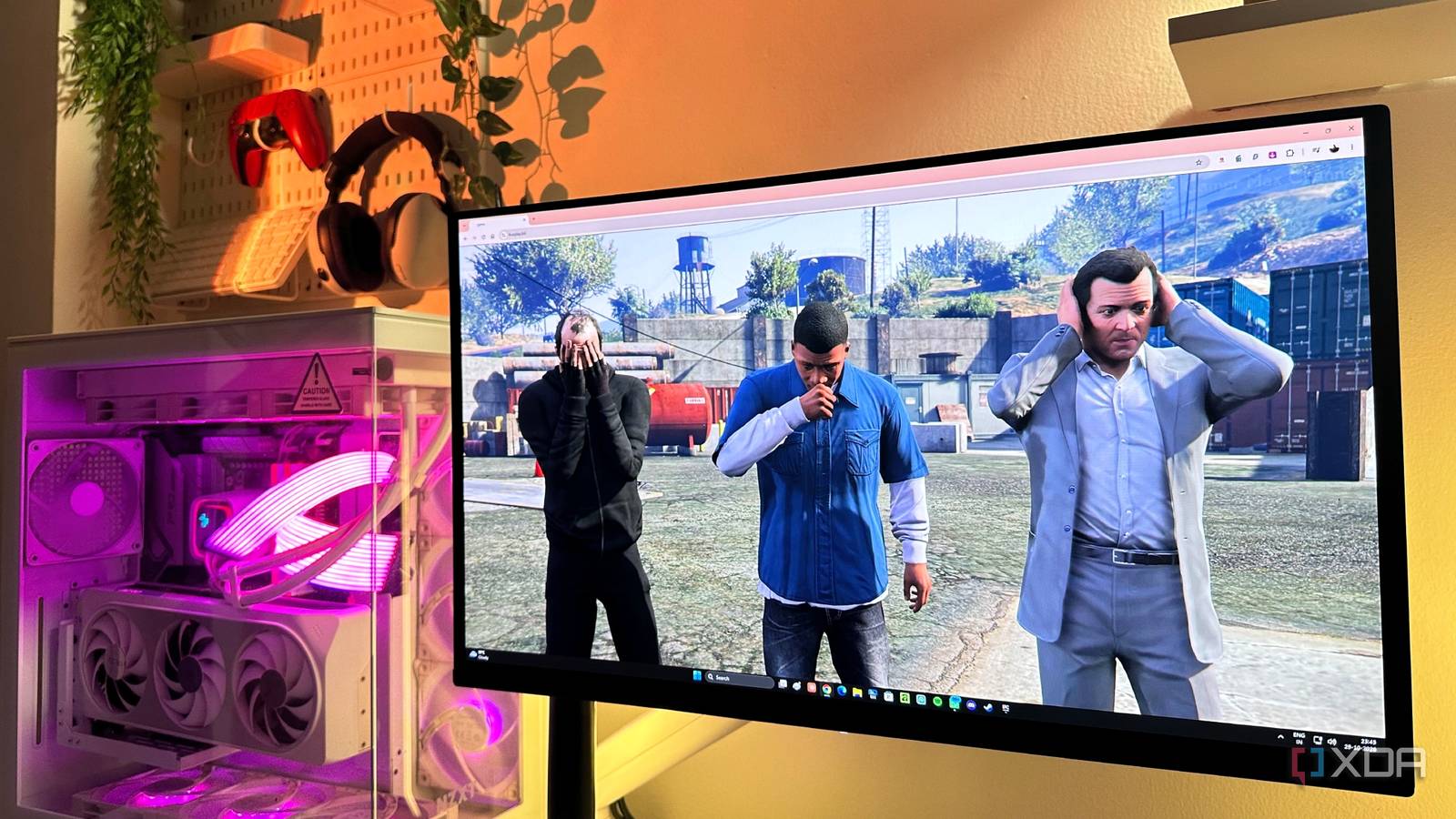
Published Oct 30, 2026, 6:00 PM EDT Gaming has been Samarveer’s greatest passion, and the Literature graduate in him takes immense joy in dissecting games for their themes, messages, and impact. Samarveer holds a deep appreciation of gaming, and considers the platform to be the most immersive and impactful across all media. He can be found engaging with gaming communities online, always ready to debate the finer points of ray tracing or itching to write an 8-page collegiate thesis on any game that impacts him emotionally. AAA games becoming free-to-play right inside Chrome couldn't possibly have been on anyone's 2026 bingo card, but this year continues to deliver more strange news on the gaming front. Now, games that you'd otherwise find in your Steam library are available right in your browser, bringing a whole new dimension to "browser-based games." Browser games used to mean quick, non-committal, and often low-polygon games that you'd play once in a while to take a break from work. Now, however, some of the greatest games from the sixth and seventh generation of gaming are making their way to Chrome and Firefox, and all you need to do to play them is open a new tab and get going. Full-blown AAA titles are running smoothly in-browser I never thought I'd see the day After an hour-long session of Call of Duty: Black Ops Zombies, I never thought that the way to close the game would be pressing Ctrl+W to close the tab in my browser window, yet here we are. Websites like ported2browser.com and wasm.rip are quite literally hosting major AAA titles, all a single click away. The projects don't take hours to download, either, as the assets stream quickly, as long as you have a fast internet connection. I tried out every single game I grew up on, including Need for Speed: Most Wanted and Underground 2, Tekken 5, Smackdown vs Raw, Pro Evolution Soccer 2011, and so many more. It's astonishing just how quickly these games run, and how smoothly they play right inside the browser. One would assume that since these are proper AAA titles running inside a browser, even if the coding at the back of house is sound, they would still stutter or run at 10 fps or less, but I got a consistent 60 fps experience throughout, every single time. Even the open-world games like Grand Theft Auto: Vice City and GTA III ran at a solid framerate, with medium-to-high graphics, all while only consuming about a gigabyte of my GPU VRAM and spiking GPU utilization by 10% or less. I may never have played Halo: Combat Evolved's original multiplayer when it came out, since I didn't even have a PC at the time, but there's a functional multiplayer version of the game online today, complete with a server browser as well. Even the entire campaign is ported to this web version, meaning I can play the game from start to finish, and all I need to do for that is open a new tab and get started. Cyberpunk 2077 and GTA V ran at remarkable frame rates, too The entirety of the GTA V campaign took a minute to load and start While I was pleasantly surprised at just how smoothly the likes of genre-defining titles Resident Evil 4, Tekken 5, and Need for Speed: Most Wanted ran on my Chrome web browser, two games in particular caught my eye in the list of all the 285 titles on ported2browser.com. I couldn't possibly contain my shock at seeing Cyberpunk 2077 and Grand Theft Auto V both listed as playable, although the former did come with a note about being a work-in-progress with potential game-breaking bugs. I started with GTA V, of course. Was it legal for Rockstar's entire game to be ported over to a web browser as a free-to-play game. Absolutely not. Was it absolutely shocking for the entire campaign to be up and running smoothly within a couple of minutes? Even more so. In fact, the game ran at a perfect 60 fps at graphics that looked like they belonged on a PlayStation 4 or even a PS4 Pro. Of course, my own GPU, the RTX 4070 Ti, was doing plenty of heavy lifting for the game, since GTA V in the browser required around 6–7 GB of VRAM, although utilization remained just 17%. When the time came for Cyberpunk, the initial character creation menu bugged out with my character's face caving inwards and never fixing itself, but the moment I started the campaign, things were right as rain. Cyberpunk ran a little worse for wear, though, and I didn't manage to get a smooth 60 fps experience in CDPR's open-world RPG. Regardless, the game ran, and it ran well enough for Night City to look exactly like it did on my RTX 2070 Super PC all the way back in 2020, which, ironically, I'd built for that very game. AI is making reverse-engineering a whole lot easier Developers have more help today than ever before So how is any of this becoming possible all of a sudden? We're not talking about stripped-down demos or cheap knock-offs, either — no "Call of Battlefield" or "Grand Auto Larceny" here. We're seeing genuine and legitimate attempts to bring entire commercial games, complete with their original gameplay systems, levels, and mechanics, to a platform they were never designed to run on. The secret sauce here, of course, is AI-assisted reverse engineering. Solo developers are using coding agents like Claude Code and OpenAI's Codex to analyze compiled game code, reconstruct its underlying logic, and write replacement engines to replicate how the original games work. With AI agents accelerating the work and doing the heavy lifting, the open-source community is flooding the internet with reverse-engineered game versions. In fact, they're even going a step further and decompiling titles from other platforms and rebuilding them to run natively on PC, creating ports and remasters we simply never thought would exist. WebGPU and HTTPS developments are making this possible, too All the right pieces are maturing at the same time AI isn't doing all the heavy lifting from scratch, though. There are years of community-led decompilation projects and open-source engine reimplementations behind this, and they have already laid much of the groundwork. The final piece of the puzzle that's making all of this possible is the maturation we're now seeing in WebAssembly. It lets developers run decompiled C and C++ code inside browsers, alongside web graphics technologies that handle rendering. Put that together with a deconstructed game engine, and that's how you get decade-old AAA games running in browser tabs without requiring an original console or a traditional PC installation. There's also the fact that most of the world's browsers have become considerably stronger gaming platforms. The gradual adoption of WebGPU gives developers access to more modern graphics capabilities, making it easier to render demanding scenes without relying on traditional game installations. Meanwhile, on-demand asset streaming over HTTPS means players don't necessarily have to download 20, 30, or even 50 GB of game files before getting started. Instead, compatible projects can fetch the assets they need over the internet as gameplay progresses. For players with fast, stable connections, this can dramatically reduce the wait between opening a browser tab and jumping into a game. Are these browser-based game ports even legal? Reverse-engineering isn't the same as piracy This is where we enter the grey, murky waters of legality. Speaking strictly in technical terms, reverse-engineering a game isn't illegal, and there are certain jurisdictions in the world where the laws permit it (under specific circumstances). However, copyright protection still applies to the original game's code, artwork, audio, and other assets. That's why the decompilations of projects like P.T. and Bloodborne are completely legal, since they require you to supply your own game files that you bought and dump them from your own console(s). These web-browser-based AAA games, though, do infringe upon copyright law, and can be subject to DMCA takedowns from game developers and publishers any time. Of course, that doesn't change the fact that these games are compiled into tiny, lightweight WebAssembly packages, meaning that clones of the game will show up faster than the devs can play whack-a-mole with them. The browser is the new console It's downright astonishing how dramatically AI is changing the economics of game preservation. For years, recreating a game's engine was a monumental undertaking, reserved only for the most dedicated developers willing to spend months and years, sacrificing any touch of grass. Now, the barrier to entry is dropping fast, and games that seemed destined to remain trapped on aging hardware are finding entirely new ways to reach players. What's truly fascinating here isn't the legal mess, though. It's that our browsers are quietly turning into gaming platforms in their own right. Without any storefronts or lengthy installations (or even expensive hardware upgrades required), all you need is just a URL and a decent internet connection. The legal battles will continue, but the technical capability is already here, and there's no putting that genie back in the bottle. Gigabyte GeForce RTX 5070 Ti Eagle OC Ice SFF
AAA games are now playable in web browsers, and AI-assisted reverse engineering is the secret sauce
Full Article
Original Source
Read the full article at Xda-developers →KhanList aggregates and links to publicly available news content. We do not host full articles from third-party sources. Always verify important information with original sources.