
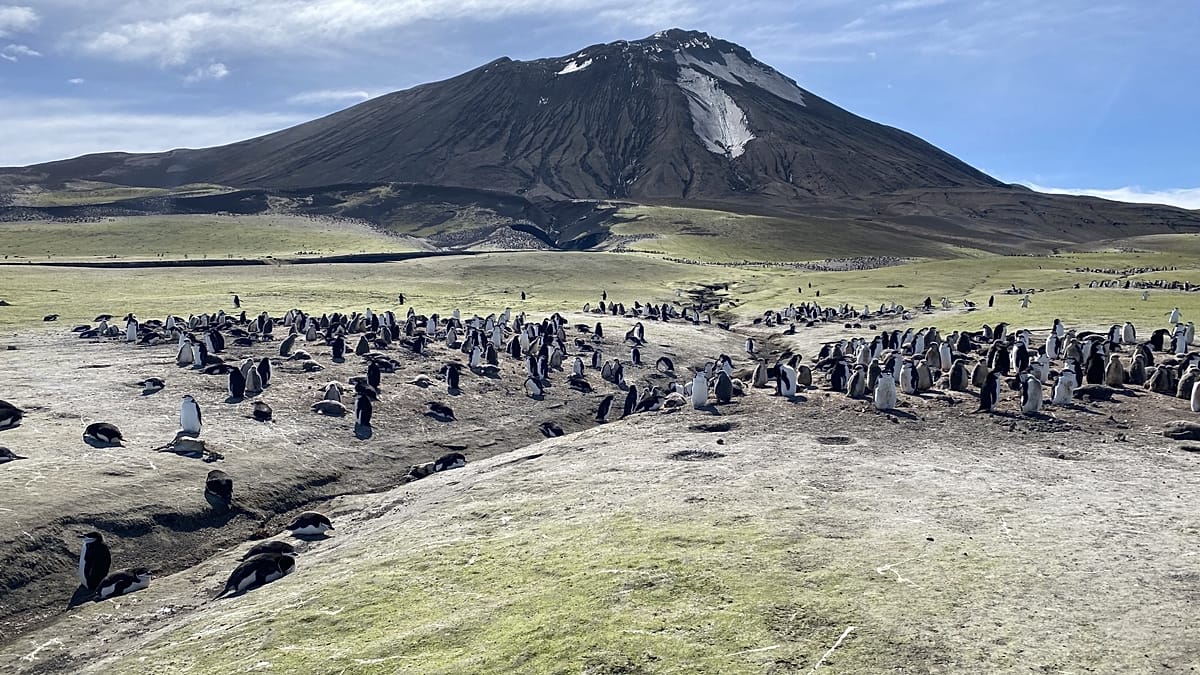
A volcanic island near Antarctica no longer homes the largest penguin colony in the world, as scientists warn that “even the most remote parts of the planet” are not immune to climate change. ADVERTISEMENT ADVERTISEMENT Located in the South Sandwich Islands, Zavodovski Island is considered one of the most remote and extreme places in the world to undertake fieldwork – distanced some 2,000 kilometres away from the nearest permanent human settlement. It took researchers from the British Antarctic Survey (BAS) more than a fortnight to sail across stormy seas to reach the rugged cliffs of this volcanic island, which is around twice the size of Gibraltar. Using a combination of drone surveys, aerial photography and tracking devices fitted to penguins, scientists uncovered the loss of more than half a million chinstrap penguins. This loss represents more than a quarter of the island’s penguins, whose numbers are made up almost entirely of chinstrap and macaroni penguins, and cedes the island's title of world's largest penguin colony to Cape Adare in the Ross Sea. Why are chinstrap penguin populations plummeting? For years, Zavodovski Island appeared to buck the trend of widespread chinstrap penguin declines that have been reported across Antarctica and the surrounding islands. Now, researchers warn that it has the highest rate of chinstrap population decline in the world. By comparing aerial surveys with satellite records, the BAS team found a 63 per cent decline in occupied chinstrap nests from 2011 to 2025, the cause of which can be inferred from the satellite tracking data of individual penguins. The steady loss of the penguins suggests the island’s volcanic eruption in March 2016, which deposited smoke and ash over the lower slopes of the volcano, is not to blame. Instead, scientists warn that climate-driven changes to the Southern Ocean are disrupting the penguins’ food supply. “This is a worrying decline for chinstrap penguins, which have specialist diets and specific ocean temperature preferences,” says penguin ecologist Professor Norman Ratcliffe, who led the research. Ratcliffe explains that chinstrap penguins prefer to forage in cooler waters to the northwest of the island. This is where they would expect to find Antarctic krill, the prey that make up the bulk of their diet. “The problem is, with waters warming, the krill have moved southwards into the Weddell Sea,” he says. “Sea-ice cover to the south and a lack of suitable islands for nesting prevents chinstraps from following the food.” Why macaroni penguins are faring better on Zavodovski Island While the chinstrap population had been declining, the population of macaroni penguins on the island increased – by 28 per cent from 2011 to 2016, where it has remained stable since. Researchers say this can also be attributed to the penguins’ dining habits. Unlike chinstraps, macaroni penguins have a broader diet and can switch to alternative prey such as fish and crustaceans when krill become less abundant. Tracking data showed them predominantly foraging in warmer waters northeast of the island, where they were “likely supplementing their diets” with these alternate food sources. “Our data shows that the cold-adapted Antarctic chinstrap species are no longer thriving beside their sub-Antarctic neighbours,” Ratcliffe adds. “It’s the biggest change in community composition ever observed at a single location in Antarctica, which provides further evidence of how rapid warming in the Antarctic is impacting unique and sensitive ecosystems.” The researchers ruled out other explanations for the change, such as competition for nesting space between the two penguin species, or krill fisheries in the region. This is mainly due to the availability of breeding habitat on the island and the ban of krill harvesting in the Marine Protected Area (MPA) surrounding the island. However, researchers say it is “unclear” how krill fishing in areas connected by currents to this MPA may be affecting wider food availability. Climate change reaches the most ‘remote’ parts of the planet The research team is now concerned that such large changes to the chinstrap and macaroni populations could cause wider disruption to marine food webs in the region. But it's the state of our ecosystems in a changing world that concerns them the most. The South Sandwich Islands are home to 30 per cent of the world’s chinstrap population. The declines here, coupled with those seen elsewhere in Antarctica, may tip chinstrap penguins into the 'Endangered' category on the IUCN Red List of Threatened Species. Earlier this year, Emperor penguins were declared an endangered species due to sea ice loss triggering massive population declines in Antarctica. Dr Peter Fretwell, a BAS researcher who specialises in remote sensing of penguins, says the study is yet another example of a “warming climate impacting even the most remote parts” of the planet. “The South Sandwich Islands are far from any humans, home to almost a third of the world’s chinstrap penguins – but not even they can escape the impacts of climate change.”
‘A worrying decline’: Why penguins are vanishing from this volcanic island 2,000km from humans
Full Article
Original Source
Read the full article at Euronews →KhanList aggregates and links to publicly available news content. We do not host full articles from third-party sources. Always verify important information with original sources.