
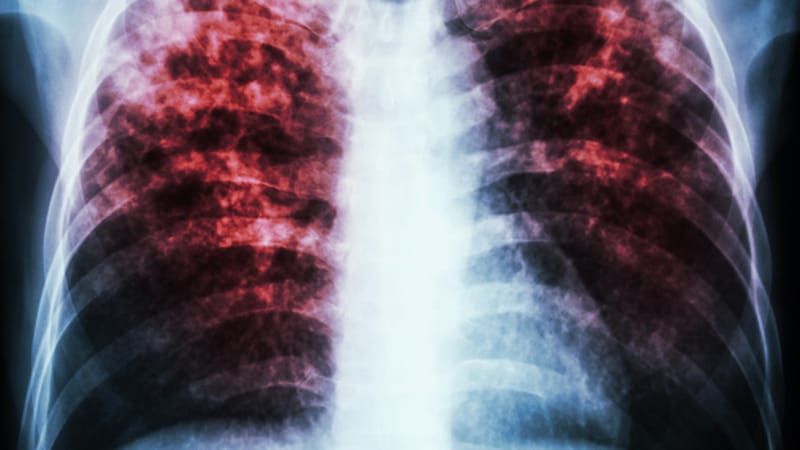
A 71-year-old woman receiving ruxolitinib for polycythemia vera (PV) developed disseminated tuberculosis that mimicked metastatic cancer. Although initial interferon-gamma release assay (IGRA) results were negative, the diagnosis was confirmed by bone biopsy and sputum polymerase chain reaction (PCR). This case highlights that ruxolitinib may cause false-negative tuberculosis screening results and increase the risk for active, including disseminated, tuberculosis. It also shows that tumor markers such as soluble interleukin-2 receptor (sIL-2R), neuron-specific enolase (NSE), cancer antigen 125 (CA-125), and CA15-3 may be elevated in tuberculosis, complicating the differential diagnosis. Careful infection screening and follow-up are recommended during treatment and for up to 3 years afterward.Patient and Her Medical HistoryThe patient with JAK2 V61F mutation-positive PV, diagnosed 9 years prior, presented to the municipal hospital in Uwajima, Japan, with bilateral edema of the lower extremities. She had been treated with hydroxyurea until 1 year prior, when it was discontinued due to distal leg ulcerations. She was subsequently treated with ruxolitinib for 9 months. No contact with tuberculosis patients could be identified.FindingsVital signs: SpO2 97% on room air, body temperature 36.2°C. Physical examination: Pitting edema of the lower legs bilaterally, no other abnormalities. Laboratory: Leukocytosis (33,170/μL), hemoglobin (10 g/dL), thrombocytosis (827,000/μL), and negative T-SPOT.TB (IGRA) results. Serum tumor markers were elevated, including sIL-2R(8106 U/mL), carcinoembryonic antigen (8.7 ng/mL), CA 125 (597 ng/mL), and CA-15-3 (58.1 ng/ml), carbohydrate antigen 19-9 (78.2 ng/mL), and NSE (32.6 ng/mL). Noncontrast CT of the thorax and abdomen: multiple cavitary pulmonary nodules, mediastinal lymphadenopathy, peritoneal thickening, ascites, increased density of the mesenteric adipose tissue, and osteolytic lesions of numerous vertebral bodies. MRI of the spine: showed hypointense signals in the vertebral bodies at T6-T8, T10, L1, and L3-L5 and in the corresponding spinous processes on T1-weighted images. Esophagogastroduodenoscopy: No signs of malignancy. FDG-PET/CT: Increased fluorodeoxyglucose uptake in the same regions of interest as seen on the CT scan described above. Bone biopsy of the osteolytic lesion at L1: Nuclear abnormalities of polymorphonuclear leukocytes consistent with PV, with no histologic evidence of malignancy. Mycobacterium tuberculosis PCR from sputum: Positive. Histopathology: Ziehl-Neelsen staining of the bone biopsy revealed numerous acid-fast bacilli within granulomatous tissue. TreatmentInitially, based on the combined findings described above, metastases with an unclear primary tumor were suspected. Since further investigations failed to provide evidence of malignancy, disseminated tuberculosis was considered in the differential diagnosis; this was subsequently confirmed by sputum PCR and Ziehl-Neelsen staining of the bone biopsy specimen.The patient received a four-drug antituberculosis regimen consisting of isoniazid, rifampin, pyrazinamide, and ethambutol, following which both the clinical and radiologic findings improved.DiscussionPV is a myeloproliferative neoplasm (MPN) characterized by clonal overproduction of blood cells in the bone marrow, leading to polycythemia. Affected individuals have an increased risk for infection and associated mortality. JAK2 mutations are associated with this condition, making treatment with the selective JAK1/JAK2 inhibitor ruxolitinib indicated as a second-line therapy for patients with polycythemia who are intolerant of or resistant to hydroxyurea. It resulted in higher complete remission rates, a reduction in spleen volume, and decreased the risks for major thrombosis, bleeding, malignant transformation, and mortality.However, inhibition of the JAK-STAT signaling pathway can impair innate and adaptive immune responses by suppressing numerous cytokines. Opportunistic infections such as hepatitis B virus reactivation, cryptococcosis (Cryptococcus neoformans pneumonia), toxoplasmosis (Toxoplasma gondii retinitis), disseminated tuberculosis, infections caused by atypical mycobacteria, progressive multifocal leukoencephalopathy, and herpes zoster have occurred in patients with myelofibrosis treated with this drug.Only three of the 35 cases of tuberculosis among patients with MPN treated with ruxolitinib were associated with PV. The affected patients had a mean age of 64 years, and twice as many were men. Primary myelofibrosis accounted for 72% of the cases, and tuberculosis primarily affected the lymph nodes (63%), followed by pulmonary tuberculosis (59%) and the disseminated form (50%), which account for only 1%-5% of typical tuberculosis cases and 18.2%-34% of cases involving immunosuppression. The mortality rate was 29%. Manifest tuberculosis infection occurred after an average of 5 months, ranging from 3 weeks to 38 months.ConclusionTherefore, appropriate screening and monitoring for infectious diseases are necessary early on during ruxolitinib treatment and for up to 3 years afterward. It should be noted that ruxolitinib can lead to false-negative IGRA results due to immunosuppression and may complicate tuberculosis diagnosis. Conversely, certain tumor markers such as sIL-2R (T-cell activation) or NSE may be elevated — possibly due to macrophage activation in tuberculous granulomas — CA 15-3, as well as CA 125, may be elevated in cases of involvement of the pleura, pericardium, or peritoneum.Miliary tuberculosis can mimic malignancies. In cases of small, millet-seed-like lesions on a chest x-ray and when attempts to detect the pathogen in sputum prove difficult, a bronchoscopy with histologic sampling should be performed; urine samples or organ biopsies are also possible. The consolidation phase with isoniazid and rifampicin lasts 10 months, as with Central Nervous System tuberculosis.This article was translated from Univadis Germany, part of the Medscape Professional Network.
A Woman on Ruxolitinib Had TB That Mimicked Metastases
Full Article
Original Source
Read the full article at Medscape →KhanList aggregates and links to publicly available news content. We do not host full articles from third-party sources. Always verify important information with original sources.