
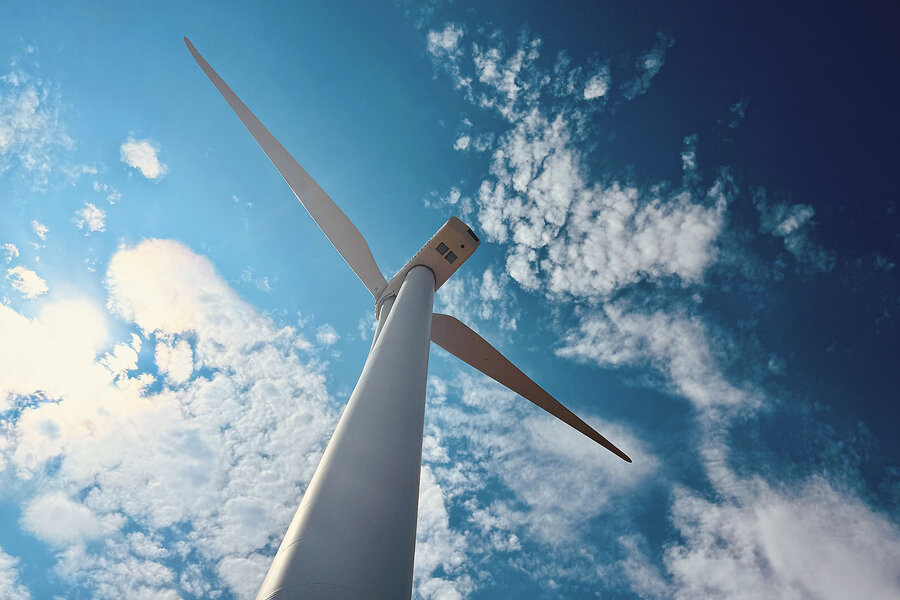
Tucumcari, New Mexico | Sept. 28, 2026, 12:01 p.m. ET | 7 min read Outside the wind research and training center at Mesalands Community College, a full-size turbine rises more than 260 feet into the New Mexico sky.It’s conspicuous, the only three-bladed modern windmill visible in the arid landscape here. Drive less than an hour east or west and dozens of white turbines will be turning, with a gentle wide-winged elegance, producing electricity in New Mexico’s corner section of the Great Plains.The single turbine here, however, is a training facility that Mesalands officials sometimes call, with exaggeration, “the highest classroom in the world.” Soon, Issa Legaspi will don a wind technician’s equipment and climb, via a series of narrow ladders, to the top. Today, however, at the start of the fall semester, she has to pass a climbing test.Ms. Legaspi is the only woman in a class of six on a warm August morning in Tucumcari. There are two aluminum ladders on the wall, and students have 12 minutes to climb up and down 10 times. She’s easily the most nimble and the fastest. On the second day of classes, she’s passed the first test.Across the broad middle of America, turbines now rise from cattle country, wheat fields, and high desert, converting the same abundance of open wind-swept space that once defined the western road trip into a source of electricity. Harry Bruinius/The Christian Science MonitorNathaniel Alexander, an instructor for the wind energy technology program at Mesalands Community College in Tucumcari, New Mexico, stands next to the turbine nacelle and hub module in the college’s training hangar, Aug. 19, 2026. Four of the five states that generated the most wind power last year – Illinois, Kansas, Oklahoma, and Texas – are Route 66 states. Together with Iowa, they produced close to half of all the wind-generated electricity in the United States. Nationwide, wind supplied about 10% of utility-scale electricity in 2025, up from roughly 6 billion kilowatt-hours of generation in 2000 to 464 billion last year. Few places have seen the roughly $160 billion industry expand as dramatically as New Mexico. Wind produced about 36% of the state’s electricity in 2024 – nearly seven times as much as a decade earlier.But New Mexico has a lot of wind, and new infrastructure is being built to provide other states with power, too. This summer, the immense SunZia project became fully operational in central New Mexico: 916 turbines capable of generating 3,650 megawatts, connected to a 550-mile transmission line carrying much of that energy toward the growing states of Arizona and California. The project nearly doubled New Mexico’s wind capacity, to about 7,650 megawatts, and now accounts for roughly 45% of the state’s electricity-generating capacity.Mesalands sits on the eastern edge of a state at the heart of that changing energy landscape. Its wind program trains the technicians who climb inside these increasingly large and sophisticated machines to maintain the electrical, hydraulic, and mechanical systems that keep them turning.And on this August morning, Ms. Legaspi is learning the first requirement of that trade: how to get to the top.■ ■ ■ Not long ago, she was a photographer in Houston, driving as much as an hour or two to photograph children from kindergarten through high school. Then she went home to a recreational vehicle parked behind a gas station. She liked the work. What she could no longer envision was affording a home there: She was priced out, she says.So she went looking for somewhere else. What she found was Tucumcari, an old Route 66 town of about 5,000 people, where she could afford a mobile home sitting on a couple of acres. She bought the property without much thought about what sort of career might await her there.Ms. Legaspi spent most of her life in cities. She is an artist and illustrator. Her father worked as an engineer in the petroleum industry. In Houston, energy meant refineries and petrochemical plants. Wind turbines were not part of the landscape she knew.Then she came to Tucumcari. “Desert, desert, desert,” she recalls thinking as she looked around.She also noticed the town’s visual centerpiece. “Ooh, a wind turbine, that’s cool.” The turbine belonged to Mesalands. Ms. Legaspi looked up the college, discovered that it trained wind technicians, and enrolled.■ ■ ■At Mesalands’ sprawling wind-training center, Nathaniel Alexander and Terrill Stowe can teach much of how to work on a wind turbine without ever leaving the ground.They are standing next to a complete turbine nacelle and hub that sits in the middle of the high training bay – the machinery normally perched at the top of a tower, brought down to eye level. Here students can get inside it, learn where things fail, and practice how to fix them.Outside the building, Mesalands’ full-size training turbine rises as tall as a 40-story high-rise. The blades are connected to a commercial-scale General Electric 1.5-megawatt engine. Students eventually climb inside the tower and upward through it, carrying the tools and safety gear required to work where the machinery actually lives.Even the first platform gives a sense of the difference. From outside, a wind turbine can look austere. Inside, students discover an industrial machine – confined spaces, ladders, cables, and equipment stacked vertically in a steel tower. Mr. Alexander knows it from both sides. Just 10 years ago he was a student here, learning from Mr. Stowe, before spending years working on turbines around the country. Now he is teaching students how to navigate machines that once gave him a way out of Tucumcari – and, eventually, a way back.Mr. Alexander first came here from Clovis when he was about age 12, taken in by an older brother. By his later teenage years, he was largely on his own. When he enrolled at Mesalands, he says, the college classified him as homeless.A good student, he imagined going to Texas Tech, perhaps studying architecture or mechanical engineering.“I didn’t have the money,” he says. “I didn’t have the grants. I didn’t apply for the scholarships because nobody told me about the scholarships.” Harry Bruinius/Christian Science MonitorStudents in the wind energy technology program at Mesalands Community College work to pass the climbing test at the start of the fall semester, Aug. 20, 2026. Students have 12 minutes to climb up and down the test ladders 10 times. He could afford Mesalands’ wind program, and he enrolled in 2015.That was at the beginning of another economic transition here. Tucumcari has spent much of its history adapting to economic change. The railroad founded it. Route 66 filled it with motorists, motor courts, and neon. Interstate 40 kept the traffic flowing west, though increasingly without requiring travelers to enter the old commercial strip.Today, Tucumcari is largely a service and institutional center for a vast, thinly populated region – a place of truck stops and motels, schools and healthcare, government offices, and Mesalands. Beyond town lie ranches, cattle, and increasingly, turbines. Wind seemed to offer Mr. Alexander, and other career-seekers like him, something different: a skill whose value did not depend on the fortunes of one small town. Still, after completing his first short wind certificate, he couldn’t find work close to home.So he returned to Mesalands for more training, widened his search, and “got work right away.” Eventually he came back to his alma mater, bought a house, got married, and started a family.As a wind turbine service technician, he had joined what is now the fastest-growing occupation in the country, according to the Bureau of Labor Statistics. The agency expects the workforce to grow nearly 50% between 2024 and 2034, from about 13,600 technicians to 20,500, with some 2,300 openings each year. Median pay was $62,580 in 2024.From tiny Tucumcari, Mesalands feeds workers into that much larger labor market. Students can earn a basic certificate in 16 weeks, continue for a one-year certificate, or stay for a two-year associate degree.When Mr. Stowe began teaching here in 2010, he says, employers were more interested in the longer degree. Increasingly, they want entry-level technicians sooner. “There’s more of a demand for them nowadays,” he says. “They need the hands.”The industry’s expansion faces a strong political headwind, however. President Donald Trump has repeatedly criticized wind power, and on his first day back in office, directed federal agencies to stop issuing new or renewed permits, leases, rights-of-way, as well as loans and other approvals for onshore and offshore wind projects. At Mesalands, however, the immediate problem is more concrete. Thousands of turbines already stand across the plains and high desert. Whatever happens to the industry’s politics, the demand for workers will not wane anytime soon.■ ■ ■Ms. Legaspi may eventually face the same choice Mr. Alexander did. After years in Houston, the appeal of this place was precisely that she could afford to put down roots. Now she is training for an occupation whose jobs can be scattered across hundreds of miles of wind country. Deepen your worldviewwith Monitor Highlights.Politics with respectGet political stories with respectful analysis.There‘s a world of new ideas in everyBooks newsletter.There‘s more to life, enrich yours withCulture & Learning weekly.Follow humanity‘s discoveries withScience & Nature stories in your inbox.Gain a spiritual perspectivefrom the stories in your inbox.Want to understand the deeper impact of critical events? Learn the Monitor‘s insight.Already a subscriber? Log in to hide ads. It is another unexpected turn for someone who came to Tucumcari not because she was chasing the next boom, but because she wanted something the booming city she left behind had made difficult to obtain: a place of her own, and perhaps a life that required less moving.“People don’t move out to the middle of nowhere unless they kind of want to move out to the middle of nowhere,” she says. “I knew what I was signing up for and I got what I wanted.” ALREADY A SUBSCRIBER? LoginReal news can be honest, hopeful, credible, constructive.The Christian Science Monitor was founded in 1908 to lift the standard of journalism and uplift humanity. We aim to “speak the truth in love.” Our goal is not to tell you what to think, but to give you the essential knowledge and understanding to come to your own intelligent conclusions. Join us in this mission by subscribing.
A windy corner of New Mexico becomes a launch pad for America’s fastest-growing job
Full Article
Original Source
Read the full article at Csmonitor →KhanList aggregates and links to publicly available news content. We do not host full articles from third-party sources. Always verify important information with original sources.