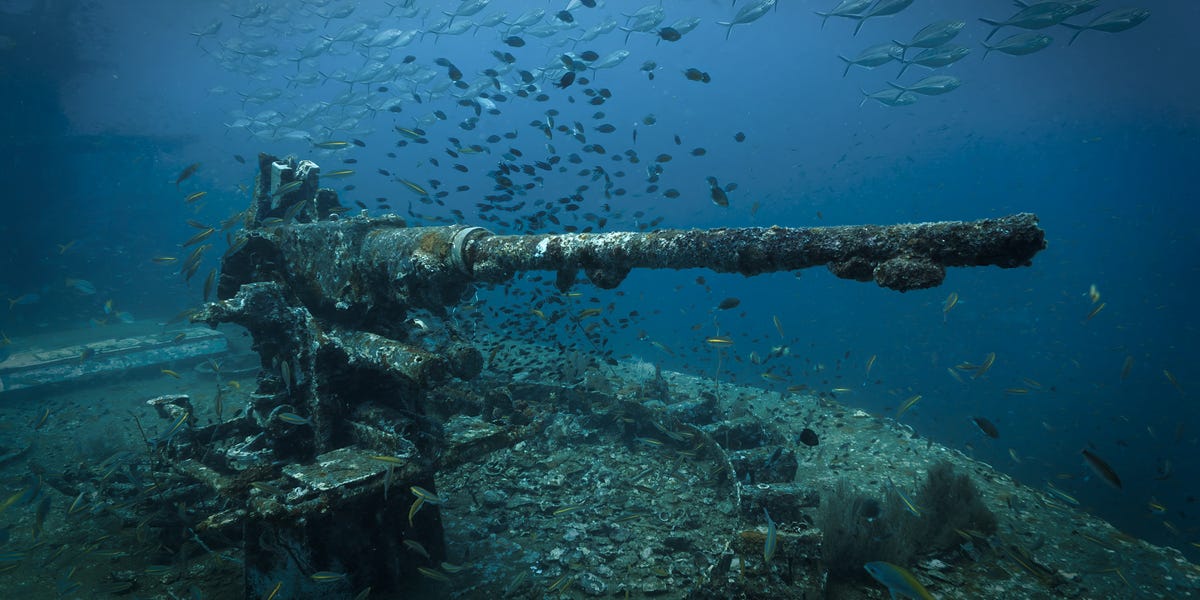
3 min readHere’s what you’ll learn when you read this story:In 1908, two British Royal Navy ships collided during a training mission in the English Channel, sinking the HMS Tiger. After over 118 years of searches by the Royal Navy and shipwreck hunters, a team from ProjectXplore discovered the wreck split in two sections 200 feet below the water’s surface. Inspection of the two-part wreck answered questions about the tragic 1908 collision that claimed the lives of at least 35 sailors. On the night of April 2, 1908, a British Royal Navy torpedo destroyer called the HMS Tiger set out from Portsmouth to participate in a training exercise in which relatively small destroyers would simulate night attacks on much larger British cruisers and battleships near the Isle of Wight. But for unknown reasons, during the exercise, the Tiger maneuvered directly in front of the cruiser HMS Berwick in the darkness.At 400 tons, the Tiger was no match for the 10,000-ton Berwick. The Berwick struck the Tiger directly amidships, splitting the destroyer in half. The Tiger’s bow sank almost immediately into the English Channel, while the other half of the ship continued floating for just three minutes before it sank, too. The disaster killed 35 of the Tiger’s 57 crew members, and the ship’s remnants were never located for more than a century despite searches by the Royal Navy and shipwreck hunters.Now, a team led by ProjectXplore has finally located the wreck 200 feet below the surface of the English Channel after a five-year search, solving the mystery of the Tiger's final resting place, and finally answering lingering questions about the 118-year-old disaster.During their search, the ProjectXplore team combed through historical archives to narrow down the wreck’s likely location, then used sonar to pinpoint the site before diving to examine it firsthand. According to the team’s report, two key pieces of evidence indicate the Tiger made no attempt to avoid the collision.Divers discovered that control dials on the ship that were mechanically linked to the rudder stock were set to between five and 10 degrees toward starboard, suggesting that the Tiger “had not altered course to avoid Berwick immediately prior to the impact,” according to the written report.Finding the stern engine offered another key piece of evidence. The glass dial showing the engine speed remains clearly visible, with white lettering atop a sapphire blue background and the speed positions of full, half, slow, stop, slow, half, and full all legible in capital letters. “The indicating arrow on the face of the dial was still showing full,” the team wrote. “This confirmed one of our first major factual findings about the events of 2 April 1908, namely that Tiger had not reduced speed to avoid collision with Berwick.”The remains of the 35 sailors killed in the 1908 likely still rest in the two severed sections of the ship, which lie about 450 feet from each other on the seafloor.When the tragedy took place 118 years ago, it was national news, dominating the front pages of English newspapers and prompting King Edward VII to send a telegram of sympathy. Efforts to find the wreckage in the aftermath of the collision—and for over a century afterward—proved futile.The discovery of the HMS Tiger comes roughly one year after ProjectXplore’s discovery of the World War I shipwreck HMS Nottingham in the North Sea. “We sincerely hope that our work will ensure that HMS Tiger, her story, and the memory of those connected with her endure for future generations,” according to a statement from ProjectXplore co-leaders Leo Fielding and Dan McMullen published by the BBC.“To find the wreck of the HMS Tiger, when I’m approaching the end of my chartering career, is a wonderful finale to all those years of diving and research, and I couldn’t have finished on anything better,” said Dave Wendes, skipper of the diver charter boat Wight Spirit, according to the ProjectXplore report. “It rates as the absolute cream of the crop.”Tim Newcomb is a journalist based in the Pacific Northwest. He covers stadiums, sneakers, gear, infrastructure, and more for a variety of publications, including Popular Mechanics. His favorite interviews have included sit-downs with Roger Federer in Switzerland, Kobe Bryant in Los Angeles, and Tinker Hatfield in Portland.
A Warship Sank After a Training Exercise 118 Years Ago. Divers Just Found Its Ominous Wreckage.
Full Article
Original Source
Read the full article at Popularmechanics →KhanList aggregates and links to publicly available news content. We do not host full articles from third-party sources. Always verify important information with original sources.