
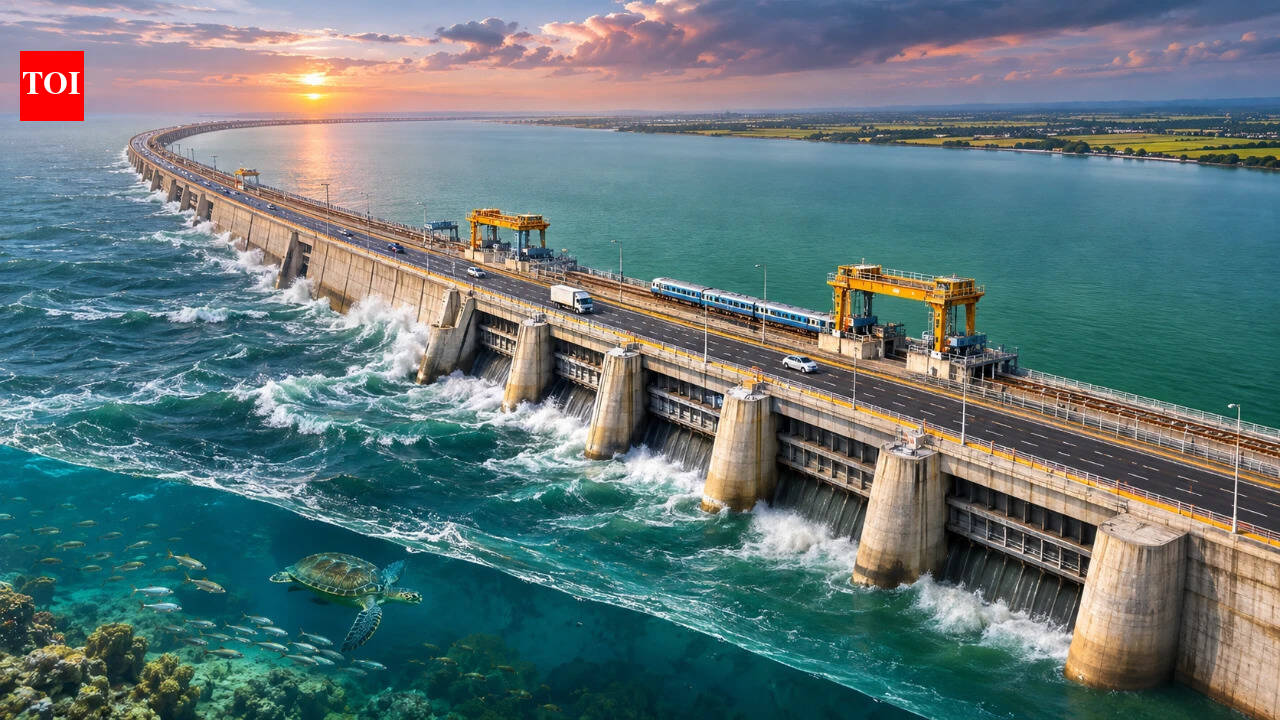
Gujarat is planning to build a 60.13-km barrier across the Gulf of Khambhat to create a freshwater reservoirImagine building a massive wall across the sea, stretching for kilometres, with powerful tides crashing against it, strong ocean winds sweeping across its surface and an entire marine ecosystem thriving beneath it. Now imagine turning the vast stretch of seawater trapped behind that wall into a freshwater reservoir.What sounds like an extraordinary engineering challenge is at the heart of Gujarat's ambitious Kalpasar project, which proposes building a dam across the Gulf of Khambhat. But can such a massive structure withstand the forces of the sea, and what happens to the marine ecosystem when nature's tidal movements are restricted?The proposed Kalpasar project envisages constructing a 60.13-km-long barrier, including a 26.7-km stretch across the Gulf of Khambhat, to create a freshwater reservoir spread over approximately 1,600 square kilometres.The project aims to use runoff from the Sabarmati, Mahi and Dhadhar rivers, supplemented by water conveyed from the Narmada, while also developing road and rail connectivity across the structure.With an estimated cost of Rs 1.33 lakh crore in a 2026 project filing, it is among Gujarat's most ambitious infrastructure proposals.However, turning a tidal stretch of the Arabian Sea into a freshwater reservoir presents a complex set of engineering, hydrological and environmental challenges.What exactly is Gujarat planning to build?The Kalpasar project is not simply a conventional dam built across a river. It envisages a massive barrier across the Gulf of Khambhat, creating an enclosed water body that would eventually function as a freshwater reservoir.The proposed structure is designed to incorporate water-regulating mechanisms to control the movement of water into and out of the reservoir.River water flowing into the enclosed area would gradually help replace the saline water, while regulators would play a crucial role in managing water levels and preventing unwanted seawater ingress.The project also envisages a road and rail corridor along the barrier, potentially connecting the Saurashtra region with mainland Gujarat. This makes Kalpasar a combination of water-storage infrastructure and a major transport project.However, the exact engineering configuration, including the regulator design, construction methodology and operational arrangements, needs to be established from the latest detailed project report rather than assumed from earlier proposals.Government's fresh push and the Netherlands connectionAfter decades of studies and delays, the Gujarat government has renewed efforts to move the Kalpasar project towards implementation, turning to the Netherlands for technical expertise in tackling the engineering challenges of building a massive barrier across the sea.The project gained fresh momentum during Prime Minister Narendra Modi's visit to the Netherlands in May 2026, when India and the Netherlands signed a Letter of Intent on technical cooperation.PM Modi also visited the Dutch Afsluitdijk, a 32-km-long barrier that separates the Wadden Sea from the freshwater IJsselmeer lake, to understand the country's experience in water management and coastal engineering.The collaboration took a further step on September 24, 2026, when the central water commission, Gujarat's Kalpasar department and Dutch knowledge institutions Deltares and Delft University of Technology (TU Delft) signed two tripartite memoranda of understanding (MoUs).According to the ministry of jal shakti, the partnership will bring Dutch expertise in hydraulic and hydrological modelling, coastal and structural engineering, salinity management, sediment movement and climate resilience into the project's planning and design.A team of Indian officials had also visited the Netherlands in July to study flood-protection infrastructure, sluice and pumping systems, barrier technologies and ecological solutions.The Centre informed the Rajya Sabha on July 27 that the Detailed Project Report (DPR) was at an advanced stage of finalisation. The government has also proposed an integrated hybrid renewable energy capacity of around 2,470 MW on reclaimed land that is presently submerged during high tide, with the generated power intended to support, among other uses, the pumping of freshwater for irrigation in Saurashtra.The DPR is expected to incorporate engineering measures and salinity-management strategies to address the risk of seawater ingress.What Gujarat stands to gain from KalpasarAt the heart of the Kalpasar project is Gujarat's ambition to address the water needs of its drought-prone Saurashtra region.The proposed reservoir is expected to use runoff from the Sabarmati, Mahi and Dhadhar rivers, supplemented by water conveyed from the Narmada.The project envisages irrigation benefits across large parts of Saurashtra, where water scarcity has long affected agriculture and regional development. By providing an additional source of freshwater, the state hopes to reduce dependence on groundwater and existing water-transfer arrangements.However, Soumya Dutta, an environmentalist and co-convenor of the South Asian People's Action on Climate Crisis (SAPACC), questioned whether the water would actually reach farmers, citing the experience of the Sardar Sarovar project.“Most of the water from the Narmada has gone to industries rather than agriculture. Farmers in Saurashtra and Kutch have not received the water, while industries in Sanand and other areas have benefited from the supply,” Dutta told TOI.He argued that large water infrastructure projects have often been promoted in the name of farmers, while industries have also benefited from the resulting water supply. Citing the Sardar Sarovar project, he questioned whether Kalpasar would deliver on its stated promise of providing water to agricultural communities.Beyond water security, Kalpasar is also being projected as a major connectivity and energy infrastructure project.The proposed road and railway links across the gulf could significantly reduce travel distances between Saurashtra and mainland Gujarat, improving access to markets and industrial centres.According to the Centre, the proposed corridor could reduce the travel distance between Bhavnagar and Surat by approximately 179 km, from 356 km to 177 km.The project also envisages around 2,470 MW of hybrid renewable energy capacity, combining solar and wind power. Together, these components are intended to make Kalpasar more than a water-storage project, with the potential to reshape the region's agricultural, industrial and transport landscape.However, the extent to which these benefits can materialise will depend on the project's final design, water availability and economic viability.Can the Gulf of Khambhat be turned into a freshwater reservoir?One of the biggest questions surrounding Kalpasar is how the government plans to convert a large stretch of seawater into a freshwater reservoir and maintain its quality over the long term.The proposed reservoir is expected to use runoff from the Sabarmati, Mahi and Dhadhar rivers, supplemented by water conveyed from the Narmada. However, the challenge lies in gradually flushing out the seawater trapped within the enclosed area and preventing salinity from returning.The process would depend on the volume of freshwater entering the reservoir, the efficiency of water regulators, seepage through the seabed and barrier, and evaporation. The balance between freshwater inflows and saline water entering the reservoir would be crucial in determining how much usable water can ultimately be stored.Dutta warned that restricting freshwater flows could also increase the risk of saline water entering coastal land and groundwater, potentially affecting agricultural fields and freshwater sources."Freshwater flow from upstream creates pressure underground and keeps saline water from moving inland. But if you stop the freshwater flow, the saline water has higher pressure and saline intrusion takes place," he said.Citing a study he said he had conducted downstream of the Sardar Sarovar Dam on the Narmada, Dutta said freshwater wells in areas around Bharuch had become more saline after the flow of freshwater declined.He warned that a similar situation could emerge around the proposed Kalpasar project, affecting not just agricultural land but also freshwater wells, tube wells, ponds and other water bodies.Water quality is another concern. Rivers feeding the proposed reservoir pass through several urban and industrial areas, raising questions about pollution and the suitability of their water for drinking and irrigation. The government would also need to account for seasonal variations in river flows, particularly during years of weak monsoons, when freshwater availability could decline.Dutta also flagged the possibility of pollutants accumulating within the enclosed reservoir instead of being carried out to sea."Instead of letting it flow out into the sea and spread over a much larger area, you are creating a much smaller enclosed water body where pollution and toxic substances will accumulate," he said.The proposed reservoir's storage capacity alone, therefore, would not determine its usefulness. Its long-term success would depend on whether the project can maintain acceptable salinity levels and ensure a reliable supply of freshwater for Saurashtra's drinking, agricultural and industrial needs.A freshwater dream, but at what cost to the sea?While the Kalpasar project promises to transform Gujarat's water security, restricting the natural movement of seawater across the Gulf of Khambhat could have far-reaching ecological consequences.The gulf is a dynamic marine environment where powerful tidal movements regulate water circulation, sediment transport and the health of coastal habitats. Altering these natural processes through a massive barrier could change the ecological conditions that sustain marine life along the coastline.One of the major concerns is the potential impact on marine biodiversity. Changes in tidal patterns and salinity could affect fish migration, breeding grounds and the availability of suitable habitats for marine organisms.Dutta warned that restricting the natural exchange of freshwater and seawater could disrupt the ecological balance of the gulf, affecting the variety of marine life it supports."If you are blocking that, you are keeping one part as freshwater ecology and isolating the saline-water ecology. The mixing and the variety of life goes down," he said.He explained that estuaries support different forms of biological life because they contain varying levels of salinity, ranging from freshwater to brackish and more saline conditions. Restricting this natural mixing, he argued, could reduce the diversity of life sustained by these interconnected ecosystems.Mangroves and intertidal mudflats along the gulf could also be affected by changes in water levels, sediment deposition and the natural exchange of seawater. These ecosystems play an important role in supporting coastal biodiversity and protecting shorelines.The movement of sediment is another critical factor. The Gulf of Khambhat receives sediment from several rivers, while its strong tidal currents redistribute it across the coastline.Restricting this circulation could alter sediment deposition, potentially changing coastal erosion patterns and affecting nearby estuaries and wetlands. The extent and location of these changes would need to be established through detailed hydrodynamic and sediment modelling.The potential consequences could extend beyond the marine ecosystem to fishing communities dependent on the gulf.Changes in fish habitats, breeding cycles and fishing grounds could affect fish availability and traditional livelihoods. The project's environmental assessment will therefore need to examine not just the immediate area around the proposed barrier but also its wider impact on the gulf and surrounding coastline.Questioning the economic and environmental rationale behind such a massive infrastructure project, Dutta argued that decentralised water-storage systems closer to agricultural areas could offer a less expensive alternative."Creating a network of distributed water storage and distribution systems would have been far less expensive and far less destructive," he said.He suggested that such systems could be managed through local institutions, including gram panchayats and zila parishads, giving communities greater control over water distribution.He also pointed out that since the proposed reservoir would be located downstream, water would have to be pumped to farms further inland, adding to the project's energy requirements and operational costs.Kalpasar's biggest test: Turning ambition into realityDespite renewed government efforts and technical cooperation with the Netherlands, the Kalpasar project faces several hurdles before it can move towards implementation.The final Detailed Project Report will be crucial in establishing the project's engineering design, construction methodology, water-management mechanisms, financial requirements and long-term operational costs.The project will also require the necessary environmental and statutory clearances, backed by detailed assessments of its impact on marine biodiversity, coastal ecosystems, fisheries and surrounding communities.With an estimated cost of Rs 1.33 lakh crore in a project filing submitted in May 2026, it is among Gujarat's most ambitious infrastructure proposals.Ultimately, Kalpasar's viability will depend on whether Gujarat can overcome the engineering challenges of constructing a massive barrier across a tidal gulf, maintain a dependable freshwater supply and address the environmental risks.For now, the project represents an ambitious attempt to reshape the Gulf of Khambhat, but translating that vision into reality will require scientific evidence, technical certainty and careful environmental assessment.
A wall across the sea: Inside Gujarat's ambitious Kalpasar project
Full Article
Original Source
Read the full article at Timesofindia →KhanList aggregates and links to publicly available news content. We do not host full articles from third-party sources. Always verify important information with original sources.