
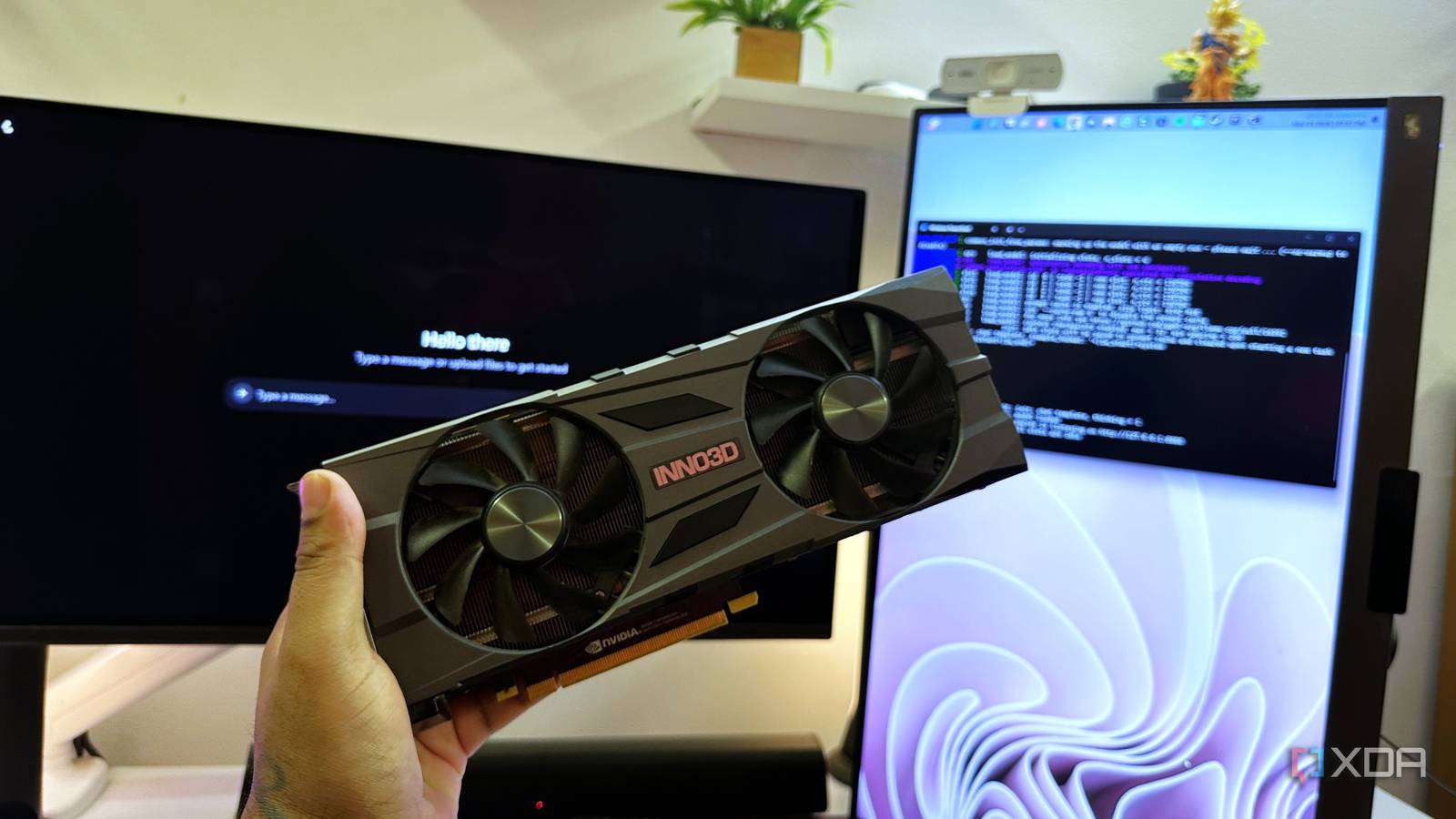
Published Nov 23, 2026, 12:00 PM EST After a 7-year corporate stint, Tanveer found his love for writing and tech too much to resist. An MBA in Marketing and the owner of a PC building business, he writes on PC hardware, technology, and Windows. When not scouring the web for ideas, he can be found building PCs, watching anime, or playing Smash Karts on his RTX 3080 (sigh). When you're putting together a home server, gaming-oriented priorities like raw power and ray tracing performance often take a backseat to VRAM capacity and memory bandwidth. A current-gen graphics card may provide you with better FPS and a modern feature set. However, a home server running local LLMs, self-hosted applications, and virtual machines needs to focus on memory capacity and hardware encoding support without costing a bomb. This is why the 5-year-old RTX 3060 12GB still beats most newer GPUs when it's at the heart of a home lab. The PC hardware market right now has made it nearly impossible to get good value from brand-new GPUs. The pre-owned market, despite being inflated as well, still allows you to get a 12GB card for nearly half the price of a new 8GB model. And it won't disappoint you where it matters the most. 50% more VRAM makes a ton of difference for local AI From barely enough to surprisingly decent The RTX 3060 12GB isn't a particularly special gaming GPU. It's slower than the ancient GTX 1080 Ti in terms of raw performance and doesn't even support the full DLSS feature set. If not for its 12GB VRAM capacity, it would have been forgotten in a sea of overpriced and underequipped graphics cards. The proliferation of local AI workloads, however, has resurrected this humble Ampere GPU, as evident from Nvidia's 2026 relaunch of the card. If you're running LLMs locally on your home server instead of renting cloud compute, you need a generous amount of fast VRAM on your GPU. The RTX 3060's 12GB framebuffer may be far from that, but it can still run lightweight models like Qwen2.5-14B at 4-bit quantization with 25–30 tokens/second. Mixture-of-experts (MoE) models can enable the card to reach parameter counts of around 17B (with quantization), providing decent performance. In contrast, something like the RTX 5060 with only 8GB of VRAM can only manage smaller models like the Gemma 4 E4B or really old ones like the DeepSeek R1 Distill Llama 8B. While you can still run some workloads on an 8GB card, the upgrade to 12GB truly widens your horizons. It's the difference between short prompts and light image generation versus holding long conversations and running heavier models without offloading to system RAM. More headroom makes multitasking much more comfortable Your home server isn't a one-trick pony Credit: Running local LLMs is just one memory-intensive job you can run on your home server. Most people building home labs want to self-host services, run home security and media servers, and tinker with multiple virtual machines. When you're pushing your home server with simultaneous workloads, having extra VRAM capacity always comes in handy. Most users' self-hosting journey starts with apps like Immich and Jellyfin. While Immich doesn't stress the GPU beyond the initial media processing, having a GPU can still benefit during new uploads. Jellyfin's performance can improve noticeably with GPU-powered hardware transcoding. For those hosting massive collections of high-res movies and shows, leveraging a discrete graphics card is ideal. Then, there are NVR (network video recorder) systems that you can set up for surveillance. Apps like Frigate benefit from the RTX 3060's decent VRAM capacity and NVENC support for motion detection, video analytics, and transcoding. Running multiple VMs in parallel is also significantly smoother on a 12GB card compared to an 8GB model. The latter can also multitask, but having more memory never hurts. Newer 8GB GPUs cost almost double for less performance It isn't gaming performance I'm talking about Perhaps one of the strongest arguments in favor of buying an old pre-owned GPU is the upfront cost. The RTX 3060 12GB can be spotted for a little over $300 on eBay, whereas an RTX 5060 8GB will cost you over $500 for a brand-new model. The older card in this scenario is weaker in some departments, but that rarely matters for a home server. The RTX 3060 hits big where it counts: 12GB of VRAM, decent memory bandwidth, and NVENC support. 1080p gaming might still be possible on an 8GB card, but local AI workloads alongside all your self-hosted services and virtual machines can be too much. When a cheap used GPU packs more memory than a current-gen card, its value-per-dollar becomes significantly better. The RTX 3060 isn't even that old if you want to factor in raw performance, feature set, and power efficiency. The overall package is what makes it an attractive buy in this market. Your home server deserves the best value, not the newest attraction Some users are hesitant when buying older cards on the pre-owned market. As long as you're covered by buyer protection, you should actively seek out the best deal on the market. Newer GPUs are wildly overpriced right now, and used GPUs are offering the same or better performance on the cheap. Home lab owners who need more VRAM should seriously consider the RTX 3060 12GB before dropping over $500 on a new 8GB card.
A used RTX 3060 with 12GB is still the card I'd put in a home server instead of a newer 8GB GPU
Full Article
Original Source
Read the full article at Xda-developers →KhanList aggregates and links to publicly available news content. We do not host full articles from third-party sources. Always verify important information with original sources.