
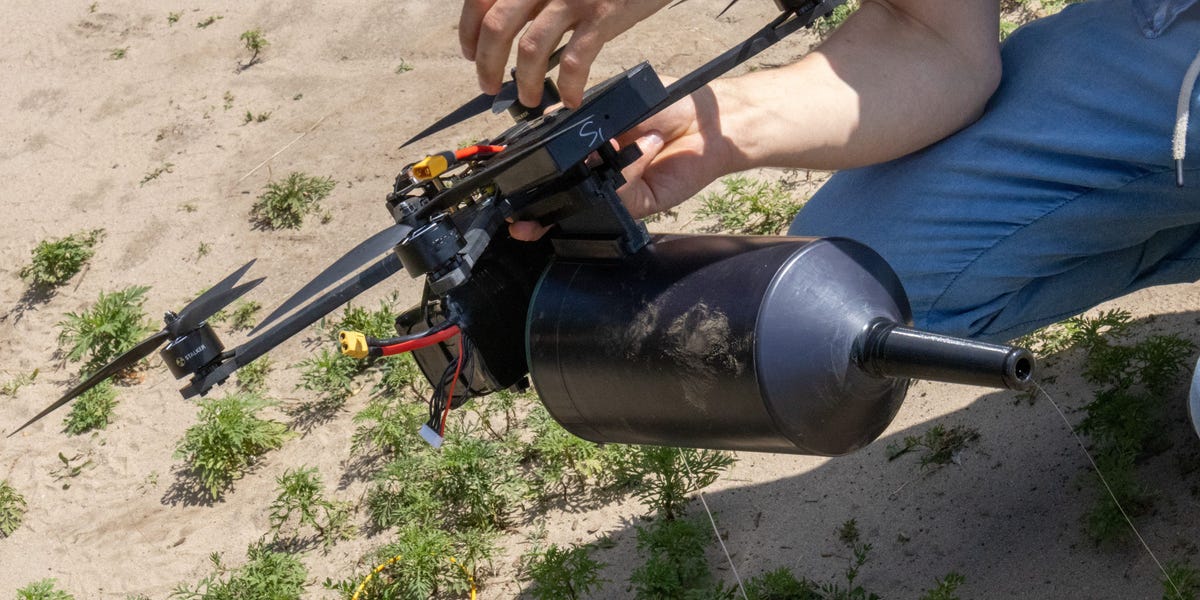
A Ukrainian drone maker explains why letting soldiers swap parts and mix models is crucial in a rapidly changing war Ukraine's drone operators want gear that they can repair, adjust, and modify easily, and industry is building with that in mind. Pavlo Bahmut/Ukrinform/Sipa USA via Reuters Connect For an edge in the drone fight, soldiers in Ukraine are pushing for equipment that they can easily modify and repair on the battlefield. A Ukrainian drone maker talked to Business Insider about how it's designing its drones to meet that need.Interchangeable parts can be swapped between different models, and the result, drone maker TechEx said, is that soldiers can be creative and combine different parts to create what is effectively a new type of drone to do what's needed."Sometimes it comes to that," said Olha, a TechEx representative. Other times the situation might be a little more basic.Maybe a unit has two different drone models, but one has a part that no longer works. "You can replace them with a pretty simple guidance from our technical teams," explained Oleg, another TechEx executive. Both representatives asked to be identified only by their first names for security reasons."We want to keep the product as cheap as possible and as easy as possible both to assemble and to operate with," he said. "So you want all the parts to be interchangeable."Alter and repairSoldiers want equipment they can quickly modify and repair near the front lines, and manufacturers are responding. Companies have introduced quick-release batteries and modular designs that allow soldiers to easily swap weaponry, reducing the time they spend in dangerous positions while keeping drones and robots in action longer. Ukrainian soldiers modify, repair, and repurpose gear for the battlefield and want industry to make gear that's designed for that to be done easily. Carlo Bravo/Anadolu via Getty Images David Roberts, the CEO of ARX Robotics UK, the British arm of the German defense technology company of the same name, told Business Insider that his company's robots, some of which are in Ukraine, are designed so that it takes "literally seconds" for soldiers to swap out parts. Soldiers can easily switch between a logistics setup and a communications setup, or add casualty-evacuation gear.TechEx says its designs deliver interchangeable parts across the company's different drone models, allowing soldiers to combine parts from multiple aircraft. Its drones also allow for easy payload changes to suit different missions.Ukraine has been working to ensure that its equipment works together, and there's a growing push for universal and interchangeable parts. Oleksandr Yabchanka, head of robotic systems for Ukraine's Da Vinci Wolves Battalion, told Business Insider that his unit often assembles its robots differently for each mission, saying the setup works a lot "like Lego sets" rather than having specialized robots for each type of mission."We are moving toward universalization and interoperability," Yabchanka said. "This does not mean there should be a single 'all-purpose' robot for every scenario. Rather, the goal is for platforms to be capable of performing various tasks, and for modules to be compatible with different types of platforms."Ukraine's military and industry encourage soldier creativity and experimentation as they race to adapt to changing battlefield demands. Soldiers sometimes modify equipment in ways that surprise manufacturers. Those innovations are then incorporated into future designs. Ukraine's soldiers and drone operators often surprise manufacturers with how they use their gear. Serhii Mykhalchuk/Global Images Ukraine via Getty Images Oleg said soldiers have surprised TechEx with how they use its gear, including how much explosive weight they manage to put on its drones.Ukraine's industry works closely with soldiers and units to make rapid changes, and TechEx relies on constant testing and feedback, Oleg said, adding that its products change weekly.He said that if a company doesn't make changes, "within three months, it will be outdated and nobody will use it."TechEx also makes custom drones at the request of units. It might add three cameras to a drone, for example, or add some other feature without putting the customized version into mass production.Building in wartime conditionsInterchangeable parts also give TechEx more flexibility when supply chains are disrupted, be that because of defective parts, shortages, or export restrictions. Modularity also allows for faster design upgrades."There's no single point of failure" in the system, Olha said. The company tries to diversify its supply chain to prevent dependency from becoming a vulnerability.TechEx, like other companies in Ukraine, is seeking ways to maintain and increase production amid Russian attacks on factories and supply-chain disruptions. Western officials say Ukraine has demonstrated a strong ability to build quickly and cheaply while rapidly innovating, offering NATO lessons to learn."Each and every day or week, we are facing another level of threats from Russia trying to hit the factories," Oleg said. The threat forces the company to adapt its production methods and take precautions, including relocating operations every few months.He said that the company is often asked how it's able to produce at scale under these conditions. His response is simply that "we have no other choice." Read next Business Insider tells the innovative stories you want to know Business Insider tells the innovative stories you want to know Business Insider tells the innovative stories you want to know Business Insider tells the innovative stories you want to know Sinéad Baker is a Military and Defense Correspondent based in Business Insider's London bureau, writing about Russia's invasion of Ukraine and NATO actions.Sinéad most often covers soldiers' experiences, military strategy, battlefield developments, weapons systems, the defense industry's response, and the impact on NATO and European security, and geopolitical decisions that surround the Ukraine war. She has reported from NATO’s frontlines and around Europe, has interviewed multiple prime ministers and defense ministers, has appeared on BBC News and The Guardian's politics podcast, and has been cited by Congressional hearings.Sinéad has also extensively covered US politics and previously led Business Insider's breaking news coverage from London.Sinéad previously completed a master's degree in investigative journalism at City, University of London, and has written for The Guardian, The Observer, and TheJournal.ie. Sinéad is the former editor of the multi-award-winning The University Times in Dublin.ExpertiseExperiences of soldiers in Ukraine, including battlefield developments and tacticsWestern military responses to the war, and lessons they should learnNew weaponry built for and in response to the war Email Sinéad at sbaker@businessinsider.com or find her on X. Ukraine Drones
A Ukrainian drone maker explains why letting soldiers swap parts and mix models is crucial in a rapidly changing war
Full Article
Original Source
Read the full article at Businessinsider →KhanList aggregates and links to publicly available news content. We do not host full articles from third-party sources. Always verify important information with original sources.