
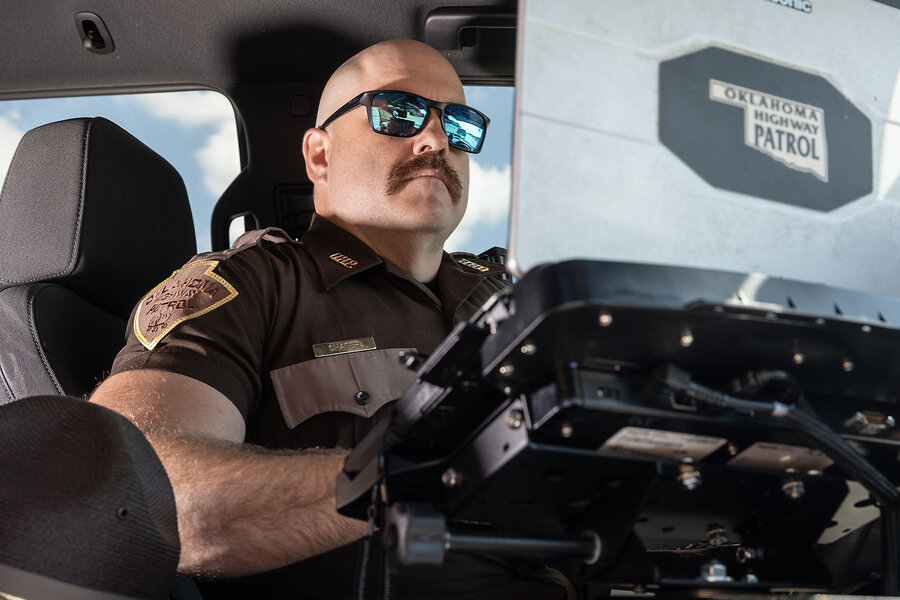
“How’s my driving?” the back of a semitruck asks in Spanish. On a recent afternoon in eastern Oklahoma, a state trooper is more interested in the driver. The trooper can stop commercial vehicles like this for random safety inspections. Why We Wrote This U.S. Immigration and Customs Enforcement has agreements that effectively deputize state and local law enforcement to also work as immigration officers. The force multiplier is allowing the agency to continue increasing its immigration arrests. It’s scorching hot outside. From his air-conditioned car, laptop open, the trooper inspects the driver’s credentials and digital log of hours worked. The man from Mexico speaks good English – and apparently has a visa, the trooper says.No safety violations are apparent. But the trooper calls the driver’s information into a contact at Immigration and Customs Enforcement. Soon after, ICE tells the trooper the driver is lawfully in the United States. An Oklahoma State Trooper stops a semitruck with Mexico and Texas license plates for an inspection on Highway 69 on Sept. 3, 2026, in Eufaula, Oklahoma. Red-blue flashing lights flick off. The trooper drives on.One in three people live in a state where state law enforcement can act as immigration officers through an agreement with the federal government known as 287(g), a Monitor analysis found. Immigration law is federal law. But the Trump administration has significantly expanded these partnerships as it ramps up arrests, fueled by billions of dollars from Congress.In Oklahoma, around 730 highway patrol troopers are ICE-credentialed, according to the state agency. That’s the vast majority of the force. The Monitor joined two Oklahoma troopers on patrols on a day in early September. In addition to withholding their names for safety reasons, the highway patrol asked the Monitor not to photograph faces of federal agents or arrestees.Most troopers need some traffic violation to justify pulling over drivers – like speeding or expired tags. But once pulled over, they can question people about their immigration status and coordinate with ICE on potential arrests. Oklahoma State Troopers process detainees, suspected of being in the country illegally, before handing them to ICE at the McIntosh County Sheriff's Office on Sept. 3, 2026, in Eufaula, Oklahoma. Supporters of the policy say public safety is the goal. The new immigration authority is one more tool for troopers to keep law-abiding citizens safe, the state agency says.Immigrant advocates say these expanded authorities cause fear and lead to racial profiling. Oklahoma in WashingtonIn Washington, D.C., an Oklahoman leads the U.S. Department of Homeland Security, which includes ICE.Secretary Markwayne Mullin is a former senator from the Sooner State. President Donald Trump’s pick for the next ICE chief, Lance Schroyer, is a former major at the Oklahoma Highway Patrol credited with aiding the state’s 287(g) rollout. Mr. Schroyer then became a senior adviser to the Homeland Security secretary. Since the state signed a 287(g) agreement in February 2025, a month after Mr. Trump’s return to office, the Oklahoma Highway Patrol says it has apprehended around 2,200 unauthorized immigrants.“We want to make sure that drivers are trained, drivers are vetted to be here, we know what their intentions are,” says Lt. Mark Southall, a spokesperson for the patrol. “There’s nobody, no state, that knows more about what a truck bomb can do.” In 1995, a U.S. citizen detonated a truck bomb in Oklahoma City that killed more than 160 people.The agency stresses that its troopers don’t decide who to detain for ICE. If troopers suspect someone is in the country illegally, they can call ICE for a determination on whether to make an arrest, and the troopers follow through. But those state officials have significant discretion over whom to stop when, especially commercial vehicles. Oklahoma State Trooper Lt. Mark Southall speaks to the Monitor at the McIntosh County Sheriff's Office on Sept. 3, 2026, in Eufaula, Oklahoma. “We don't decide to hold somebody,” he says. “We just work on behalf of ICE.”Detained individuals are either brought to an ICE facility or to a county sheriff’s office that collaborates with ICE. The federal government reimburses the state for the time troopers work through the 287(g) program.The Trump administration has revived what’s known as the Task Force Model within the 287(g) program, which ICE ended more than a decade ago. In 2012, ICE announced it would stop renewing task-force agreements under 287(g), after the Justice Department found some local ICE partners engaged in discriminatory policing, including racial profiling. ICE requires participants to have at least two years of law enforcement experience and undertake a 40-hour training course online. Topics include immigration and civil rights law, ICE’s use-of-force policy, detention procedures, a complaints process, and “cross-cultural awareness,” says Sarah Loicano, an ICE spokesperson, in an email. Some random stops justifiedOutside the McIntosh County Sheriff’s Office in Eufaula, where the Monitor’s ride-along began, three men sit silently on metal chairs, hands and feet bound. One bounces his leg restlessly, jostling a chain. The Monitor was not allowed to speak with the detainees. The men wait in the sticky heat to be processed. Eventually, an ICE agent with Homeland Security Investigations leads one of the men away. Men suspected of being in the country illegally wait after being detained by Oklahoma State Troopers. After processing, they are handed over to ICE at the McIntosh County Sheriff's Office on Sept. 3, 2026, in Eufaula, Oklahoma. Ms. Loicano, the ICE spokesperson, identified by name one of seven people arrested during the Sept. 3 operation: a Mexican man whom ICE says it previously removed four times. A criminal complaint for unlawful reentry filed six days later in the U.S. District Court for the Eastern District of Oklahoma says a trooper pulled the man over after observing a defective taillight and speeding. After the driver presented his Mexican consular ID card, the trooper contacted ICE.Some arrests result from a routine safety inspection carried out by “size and weights” troopers with a U.S. Department of Transportation authority. That power predates the new immigration authority by decades.Troopers certified to perform these federal safety inspections are legally allowed to stop commercial vehicles even if the driver follows all the road rules. Forty-eight troopers have this authority in addition to their ICE credential, according to the highway patrol.Partnerships vary Troopers aren’t the only ICE-credentialed law enforcement in Oklahoma, where the federal agency has inked more than 100 agreements. Yet how that plays out on the ground can vary from county to county. An ICE officer walks a person, detained by state troopers for suspicion of being in the country illegally, into the McIntosh County Sheriff's Office on Sept. 3, 2026, in Eufaula, Oklahoma. In Tulsa County, out of 300-plus sheriff’s deputies, nine were tapped for the Task Force Model this summer. Those chosen interdict drugs or pursue other crimes. Tulsa County Sheriff Vic Regalado already had a jail-based agreement with ICE that typically allows officers to identify deportable immigrants. But he’s resisted assigning immigration authorities to patrols.“It’s counterproductive to strike fear in a community, any community, from calling us. … We have to have that trust,” says the Republican sheriff, a son of immigrants. “We serve everybody, regardless of whether you’re here undocumented.”Immigrant advocates raise longstanding concerns about the 287(g) program prompting unlawful targeting of suspects by race. Funding from the federal program “is a trap for agencies, which will be drawn into racial profiling and other abuses that put them at risk of costly lawsuits,” the American Civil Liberties Union writes in a report.Lieutenant Southall says Oklahoma troopers stop people “from all over the globe.” Not one specific group.“We’re not using racial profiling,” he says. “We’re simply stopping cars.”Many stops don’t amount to much. An Oklahoma State Trooper conducts a vehicular stop on Highway 69 on Sept. 3, 2026, in Eufaula, Oklahoma. “Be safe”Another trooper cruises down U.S. 69 with an energy drink. Tucked into the sun visor, a tiny figurine of Jesus watches from above. On the dashboard, radar whines – tilting higher in pitch the faster cars go.Without quotas to meet, the trooper says he personally tries to stop some 10 to 15 cars a day. Troopers don’t typically ask about immigration status, he says. But certain indicators – like lack of an ID – can prompt those questions.The trooper spots a white Nissan Rogue and accelerates. That car was following another too close, he says.“You’ve got to be 200 feet – two car lengths behind,” he tells the driver, paused on the side of the highway.The driver leaves with a warning. No immigration suspicions.“Be safe, OK?” The trooper drives on.
A traffic stop could lead to much more, as ICE deputizes local law enforcement
Full Article
Original Source
Read the full article at Csmonitor →KhanList aggregates and links to publicly available news content. We do not host full articles from third-party sources. Always verify important information with original sources.