
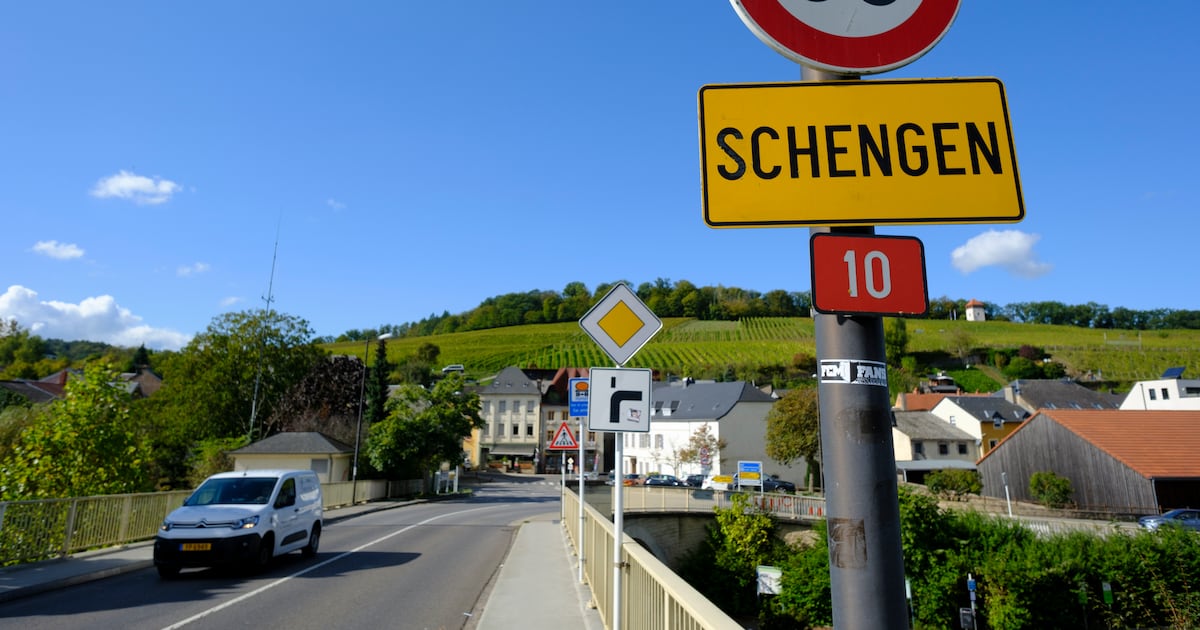
Nicolas Ruppert, a 10th-generation winemaker, is chatting to me in his uncle’s vineyard on a small hilltop in the town of Schengen in Luxembourg. A bridge across the river below brings you to the spot where the German and French border come together. It would take you two minutes to spin between the three European countries in a car. The exact “tripoint” where Luxembourg, Germany and France meet is in the middle of the Moselle river. It was near this point, aboard the MS Princesse Marie-Astrid, that France, Germany, Luxembourg, Belgium and the Netherlands signed the Schengen agreement in 1985, committing to remove checks when crossing borders within the five countries. The pact created a European common travel area, or as it’s commonly known, the Schengen area. READ MOREThe village of Schengen, Luxembourg, is seen from the Schmitt-Weber vineyard in Perl, Germany. Photograph: Chris Ratcliffe/Bloomberg via Getty Images The Ruppert family vineyard is spread across 24 hectares of land, split two to one between Luxembourg and neighbouring France. Before the agreement workers transporting grapes or wine could be held up in queues at the border waiting “for hours”, Nicolas says. The Schengen zone, which did away with the need to flash a passport, expanded over the years. Today it includes 29 countries; all European Union members (bar Ireland and Cyprus), plus Norway, Iceland, Switzerland and Liechtenstein. Border controls still obviously apply to people entering the Schengen zone from countries outside of it. For a long time the agreement served as a concrete example of the practical benefits closer European integration could bring to the lives of ordinary people, when political squabbling was set aside. Nicolas, who is 28 and helps his uncle Henri manage the vineyard, grew up in a Europe where seamlessly driving or flying between most countries was the norm, until recently anyway.Germany reintroduced police checks at all land borders in September 2024, in an attempt to show it was cracking down on illegal immigration. The restrictions followed the Solingen terror attacks, where a Syrian national who was refused asylum stabbed three people to death at a German street festival. The man, who had ties to the Islamic State group, was convicted and is serving a life sentence. Spot checks had been in place along Germany’s eastern borders since 2023, a move that had prompted Poland to start checking Germans heading in the other direction. The “temporary” restrictions have been rolled over every six months. Germany has justified the controls by claiming high levels of irregular migration pose a threat to public security and order. France followed suit and introduced spot checkpoints on its land border crossings two years ago. Giorgia Meloni, Italy’s hard-right prime minister, took things a step further in response to the Ceuta “crisis” this summer, imposing passport checks on people travelling by boat and plane from Spain to Italy. More than 70,000 migrants crossed from Morocco into Ceuta, the tiny Spanish exclave on the north African coast, over two days this summer, although nearly all later returned to Morocco. Spanish soldiers block access to the beach for people crossing from Morocco into Ceuta. Photograph: Antonio Sempere/AP The chaotic scenes sparked panic in European capitals about a sudden spike in arrivals of asylum seekers. Rome and others took pot shots at Spain’s left-wing prime minister, Pedro Sánchez, some going as far as calling for Spain to be suspended from the Schengen travel area for a time. Relations between Rome and Madrid have been tense since, exacerbated by the fact Meloni and Sánchez are both facing elections soon. However, it seems a detente is in the offing to stand down the Italian checks. The Dutch government, traditionally another hardliner on immigration, has privately been advocating for greater co-ordination between Schengen countries on border management. The idea would be modelled on the Eurogroup format that brings finance ministers from EU states who share the euro currency together once a month, to compare notes. “We always make the comparison to the Eurogroup, which was created after the financial crisis. If one [member] doesn’t perform that has consequences for the others,” one diplomat said. This is not the first time border stops have been unilaterally thrown back up between countries inside the Schengen zone. Germany, Denmark and several other EU states started checking passports and papers at internal Schengen borders during the 2015 migration surge, when more than one million asylum seekers crossed to Europe, putting particular pressure on countries along the EU’s external southern border. National reception systems are not under anywhere near the same pressure. In fact the number of people applying for refugee protection in the EU is at its lowest point in five years. But many governments are under huge electoral pressure from populist, far-right parties gaining unprecedented support in Germany, France and elsewhere, on the back of promises to fight illegal immigration and keep asylum seekers out. Police are seen performing checks at the German border. Photograph: Jaap Arriens/NurPhoto via Getty Images In Schengen town, the police checkpoints on a busy motorway between Luxembourg and Germany are a real inconvenience for the large numbers who travel back and forth every day. “People here, they are pissed,” says Nicolas, the young winemaker who makes the journey daily. The irony of border checks taking place at Schengen was not lost on a group of politicians from Luxembourg’s social democrats, who were on a bus heading across the bridge last month to meet their SPD sister party in Germany’s Saarland region. The bus was pulled over and inspected by German police, according to parliamentarians who were on board. “It could hardly be more symbolic: social democrats from Luxembourg and the Saarland are meeting to discuss cross-border co-operation and a strong Europe, and are being checked at the very place where, over 40 years ago, the foundation was laid for a Europe without internal borders,” the two political parties said in a joint statement afterwards. Ulrich Commerçon, who leads the SPD in the Saarland state parliament, said the holdup his colleagues from Luxembourg faced was “not merely symbolic”, but something that undermined the spirit of cross-border co-operation. “The European ideal is increasingly falling by the wayside,” he said.SPD politician Ulrich Commerçon: 'The European ideal is increasingly falling by the wayside.' Photograph: Jean-Christophe Verhaegen/AFP/Getty Images Luxembourg is one of Europe’s smallest countries and almost half of its workforce commutes in from neighbouring Belgium, France and Germany. Out of the 20 staff employed in the Ruppert family vineyard, only Nicolas and his uncle are originally from Luxembourg. French is spoken front of house, German in the cellars, and English can often be the common denominator between workers who don’t have both. “I think [that] is a particularity of Luxembourg and also of Schengen that you have a lot of external workers,” Nicolas says. Luxembourg’s wine region, Moselle, is best known for producing whites. It is unusual because it’s recognised as a “transnational” wine region that stretches from Luxembourg into French and German territory too. “The Romans brought wine to Luxembourg 2,000 years ago,” Nicolas says.The area is good for viticulture because the river locks in the heat of the summer sun, making the temperature along its banks warmer than other parts of the country, he says. The steep slopes traditionally gave a good angle for the rows of vines to catch the sun for longer throughout the day. “Today we are looking to plant areas with a bit less sun ... because of climate change,” he says. Beyond making or tasting wine, there isn’t a huge amount to do in Schengen. Walking along the small town’s main street you’ll pass by a beaten-down Chinese restaurant, a petrol station, a pub and not much else. There is a small castle. And a museum dedicated to the history of the Schengen travel area. The ship where the agreement was signed, the Marie-Astrid, is docked outside for visitors to have a look around. Schengen village, Luxembourg. Photograph: Thierry Monasse/Getty Images The ship had been sold to Germany in the early 1990s, but not too long ago the local council bought it back, with financial help from the government. It was restored as a sort of floating memorial in Schengen, where it’s been for the last year. In the four decades that have passed since it hosted the signing ceremony the boat has held up well. The same cannot be said about the Schengen travel area itself and the concept of doing away with border checks between European countries.
A town called Schengen: After decades of seamless travel, European borders checks are back
Full Article
Original Source
Read the full article at Irishtimes →KhanList aggregates and links to publicly available news content. We do not host full articles from third-party sources. Always verify important information with original sources.