
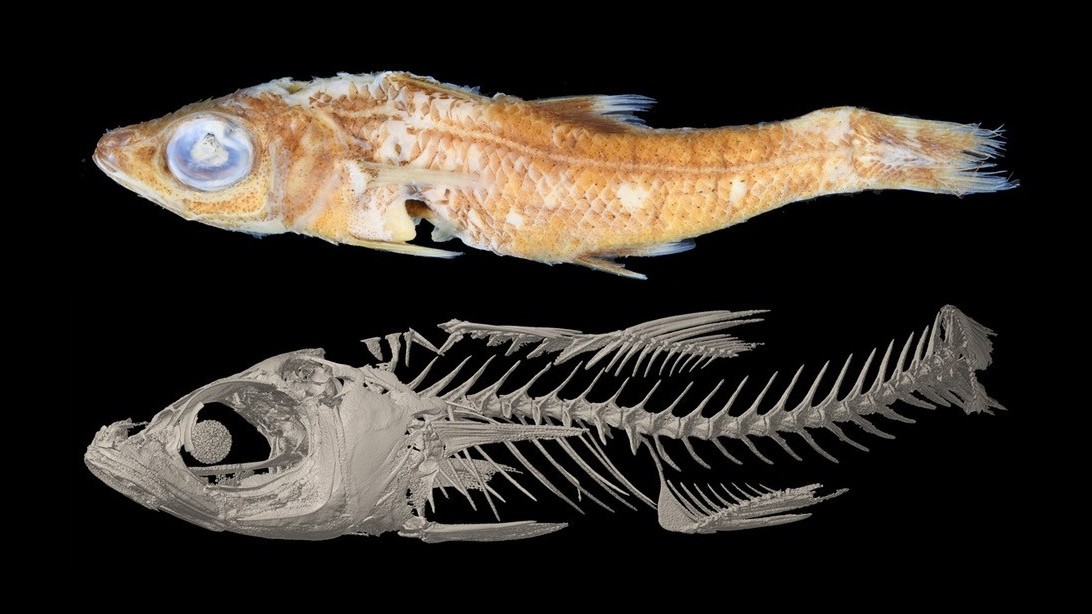
A new-to-science species of deep-sea fish has been described from a single specimen found in the stomach contents of a predatory fish that ate it in 1984. The specimen sat in a Tokyo museum collection for 42 years until it was examined by museum staff and volunteers. The newly described deepwater cardinalfish (Epigonus masamunei) has large eyes, which is common for fish that live in the dark waters of the deep sea, and measures about 8 centimeters (3 inches) from snout to tail base. The species’ name comes from Masamune, a medieval Japanese swordsmith, because the curve of its spine resembles the swords he made. “I was extremely excited,” Makoto Okamoto, the study’s author and a fish taxonomist at the Japan Fisheries Research and Education Agency, told Mongabay by email. “The moment of discovering a new species is always fresh and thrilling.” No one has ever seen the species alive, and so no one knows what color it is either, Okamoto said. The predator was a beardfish (Polymixia japonica), another, larger, deep-sea fish that commonly grows to about 20 cm (8 in) long. In July 1984, a research vessel caught the beardfish at an estimated depth of 370-450 meters (1,210-1,480 feet) off Kita-iwo Island, in Japan’s Ogasawara Islands in the western Pacific Ocean, according to museum records cited in the study. The beardfish may have vomited the cardinalfish back up, as the specimen’s belly, skin and the tips of some fin spines were damaged. “It is rare for new species of deep-sea fish to be discovered through a process like this,” Okamoto said. “The fact that a specimen, which had been in storage for 42 years, turned out to be a new species really highlights the importance of natural history collection.” The rocky seabed around the Ogasawara Islands makes it difficult to collect deep-sea fish, and earlier surveys there had never recorded the genus Epigonus, the study says. The genus is otherwise a diverse group of fish found across the Pacific, Indian, and Atlantic oceans. There are now 45 known species in the group, eight of them found in Japanese waters. According to the study, the development of remotely controlled submarines makes more discoveries in the genus “highly likely” in the future. Epigonus fragilis, a species from the same genus, photographed in shallow Japanese waters. Images © A. Kotani (top) and A. Daoulas. “The Ogasawara Islands are a Natural World Heritage site, yet their deep-sea environments remain largely unexplored,” Okamoto said. “The fact that a new species was discovered within the stomach contents of another fish suggests that a great number of unknown species still exist in the deep sea.” In August 2026, an expedition to unexplored underwater mountains in the Indian Ocean reported 149 previously unknown species, including several fish. Banner image: The only known specimen of Epigonus masamunei. Image courtesy of Makoto Okamoto. Credits Topics
A tiny deep-sea fish eaten 42 years ago has now been named a new species
Full Article
Original Source
Read the full article at News →KhanList aggregates and links to publicly available news content. We do not host full articles from third-party sources. Always verify important information with original sources.