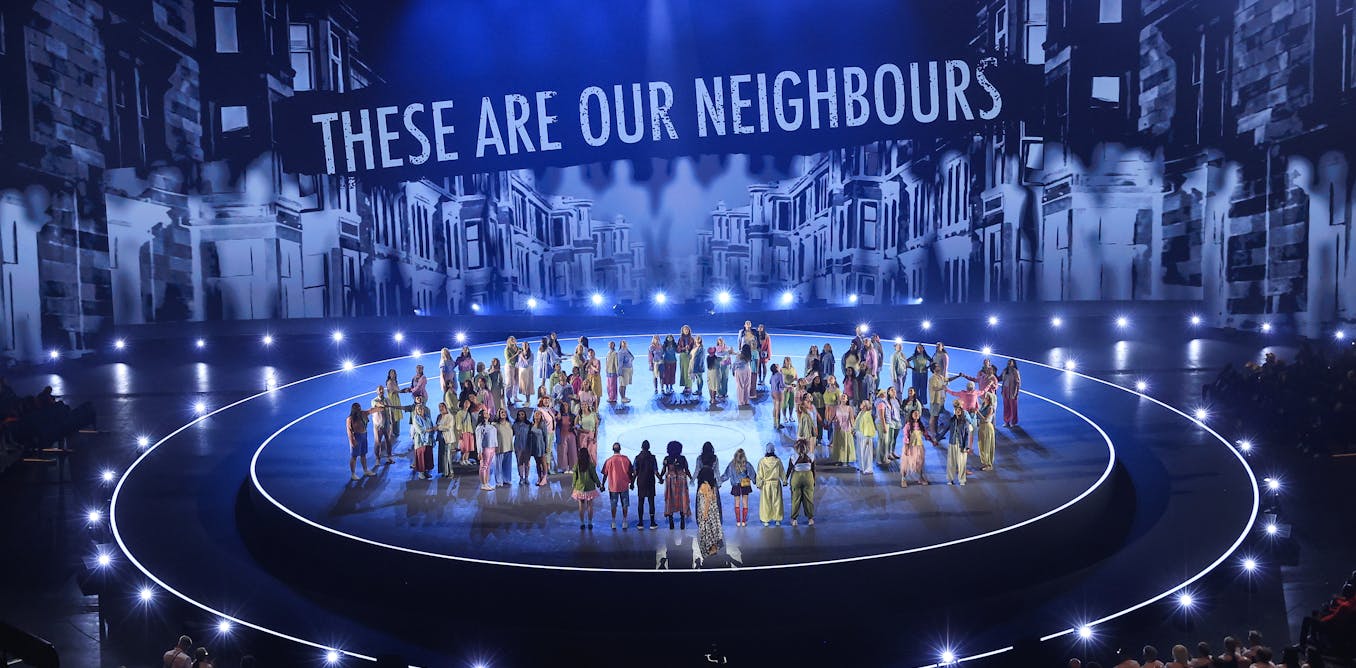
The Commonwealth Games has always been a competition shaped by its history as well as its sport. Previously known as the “British Empire Games”, the competition is perhaps viewed by many as the “Olympics-lite”, a place where smaller nations and territories get their time to shine (although Australia, England and Canada dominate the medal table). For others, it is a perpetual reminder of the presence of colonisation on our shores, a place where the damaging and violent histories of the British Empire are set aside for the “greater good” of sporting glory. This year’s games staged its opening ceremony entirely indoors for the first time since the games began in 1930. And despite being “stripped back” in comparison to more lavish years – and fresh debate on the place of the Commonwealth itself – it proved a vivid “re-imagining” of established tradition. De-centering the monarchy The move indoors is partly a practical response for a scaled-back edition of the games, but it is also symbolic of an event that is continuing to redefine itself after years of uncertainty. This year, Glasgow becomes the third city to host the games twice (along with Edinburgh and Auckland), after the Australian state of Victoria pulled out of hosting in 2023. This indoor ceremony likely won’t make headlines in the same way the last Glasgow games opening did in 2014, following actor John Barrowman’s defiant kiss of a male dancer – a powerful statement against the roughly 42 out of 53 Commonwealth nations where homosexuality was criminalised. But this year’s ceremony did something else that was really special. Each participating nation bore a custom baton adorned with symbols of its culture. These were collected and planted in a lush, green garden in the centre of the stage — a symbolic garden of nations. It felt like an exercise in uplifting the mana (authority and status) of these countries. Each is unique, reflected and respected. It’s clear Commonwealth Sport, the organisation that runs the games, is trying to re-contextualise the place of the British monarchy in the games. Seeing a wave of black jackets circled the stage, I felt a strange pang of pride as New Zealand athletes waved and took selfies. The commentators highlighted Aotearoa’s successes at the games, and the enormous privilege for athletes of wearing the silver fern, an important symbol of our national identity. It arguably made getting up at the crack of dawn worth it. Triteness and time travel Aside from the national pride embedded in the ceremony, there were some moments of genuine spectacle. Many of these moments played up both the mythology and theatricality of Scotland’s history. There was an appearance from the famous Loch Ness monster, “Nessie”, in an awe-inspiring moment with visuals akin to a production from the late director Robert Wilson. A rendition of Scotland’s unofficial anthem, Flower of Scotland, accompanied this moment, with bagpipe music pulsing through the screen. I can only imagine how evocative it would have been in person. Other moments erred on the side of triteness. At one point, comedian Greg McHugh and cycling legend Sir Chris Hoy journey through Scotland in the TARDIS from Doctor Who, before stopping at Balmoral to pick up King Charles and Queen Camilla. Sure, it was lovely to see a cameo from Doctor Who actor Sylvester McCoy, but in the grand scheme of things, there are surely some more iconic Scottish ways of getting around. (500 miles, anyone?) There were plenty of fun moments, with the entire ceremony ending with a giant Tunnock’s teacake – a much more palatable Scottish delight than others such as haggis and black pudding, and a great throwback to when Glasgow last hosted in 2014. Emphasising the collective What I appreciated most about this ceremony was the commitment to put other nations, and the game, first. This did not need to be, nor was it, a showing-off of the rich culture of Scotland. Rather, it highlighted the interconnectedness of the 76 participating nations and territories. Donald Rukare, President of Commonwealth Sport, put it aptly: “tonight, every flag here is equal”. The games are not just a competition, but also a place of connection. As the sun rose here in Aotearoa, and I watched this kaleidoscope of countries unite to compete, I thought about the nature of this event – and how wonderful it would be if nations could unite through the arts the way they do through sports. While I long for a day when Aotearoa is independent from its colonial ties, it felt great, for a moment, to be part of the collective.
A time-travelling king and visit from Nessie: inside the Commonwealth Games opening ceremony
Full Article
Original Source
Read the full article at Theconversation →KhanList aggregates and links to publicly available news content. We do not host full articles from third-party sources. Always verify important information with original sources.