
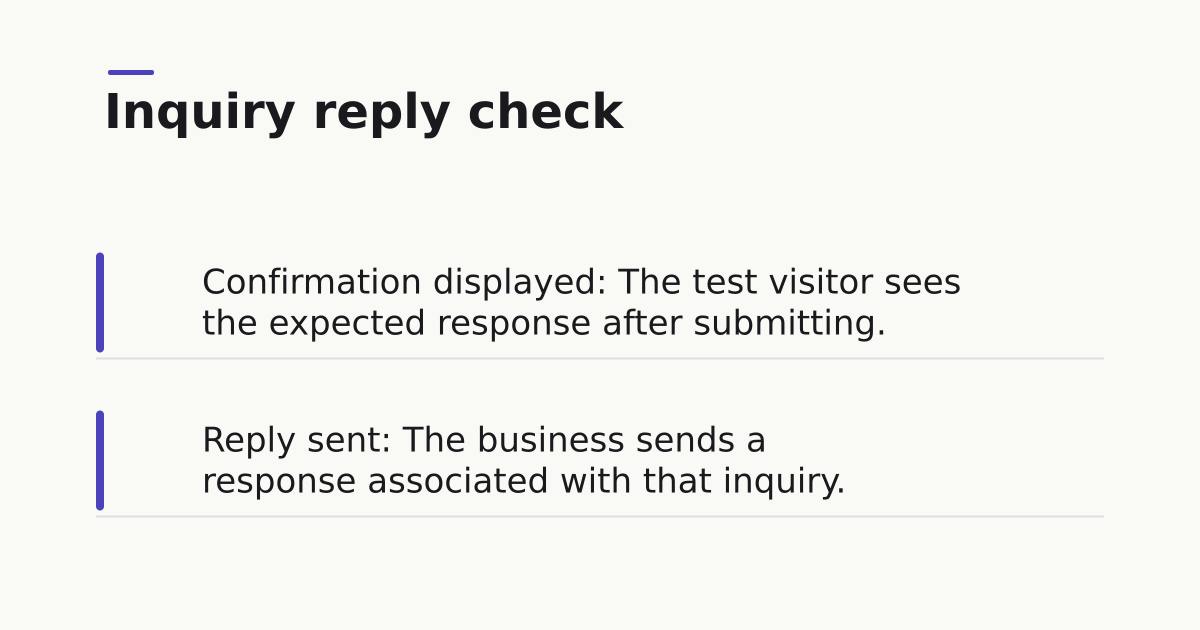
A visitor submits a contact form and sees “Success.” What has the website owner learned?Only that the visitor-facing page displayed a confirmation. The owner has not yet established whether the corresponding inquiry can be found where the business expects to receive it, or whether anyone can reply to it. Treating those as separate checkpoints makes a contact-form test more precise without requiring a guess about what might have gone wrong.The distinction is not merely theoretical. In one Shopify community report, contact-form submissions appeared to succeed but did not arrive by email. That individual report does not indicate how often the problem occurs. It does show why the displayed result and the business-side result should be checked independently.Model the inquiry path as observationsFor testing purposes, define three observable states:Confirmation displayed: The test visitor sees the expected response after submitting.Inquiry located: The business finds an inquiry that corresponds to the test at its expected destination.Reply sent: The business sends a response associated with that inquiry.These are observations, not interchangeable definitions of success. The first describes the interface. The second describes what the business can locate. The third describes an action taken after receipt. Even the third checkpoint has a boundary: sending a reply does not, by itself, verify that the recipient received or read it.This model is useful because it prevents an incomplete test from looking complete. A screenshot of a confirmation establishes the first state, not all three. Conversely, if a business finds an inquiry but has not tried to answer it, the test has established receipt without testing the reply step.You do not need to know the underlying cause of a gap to record it accurately. The point of the model is to make the gap specific enough to investigate.Design a test that can be matched at both endsConsider a labeled test submission on an existing site. Put a distinctive phrase in the message, such as “Inquiry path test 2:15,” and note the address entered and the time of submission. The phrase is simply a way to recognize this test later; it is not a claim about any special form capability.Before submitting, decide where the business will look for the inquiry and who will perform that check. Then submit the form as a visitor would and record exactly what appears on screen. At the expected destination, look for the distinctive phrase and compare the inquiry found with the details you submitted. If it is located, send a reply associated with that test inquiry.The result can be recorded as a short trace:CheckpointQuestion to answerExample test recordConfirmationWhat did the visitor-facing page display?Confirmation displayedReceiptWas the matching inquiry located at the expected destination?Matching inquiry locatedReplyWas a response sent for that inquiry?Reply sentThe example column describes a hypothetical completed test, not an observed outcome from a real website. For an actual test, record what happened rather than filling in the expected answers.A distinctive phrase matters because it connects the visitor-side observation to the business-side check. Without a way to match them, finding an inquiry does not necessarily establish that the particular test inquiry was found. The matching step is the technical heart of this diagnostic: it turns two separate observations into a trace of one submission.Record uncertainty instead of flattening it into pass or failSuppose the confirmation appears, but the person checking the expected destination cannot find the test inquiry. The defensible result is: “Confirmation displayed; matching inquiry not located during this check.” It is not yet a diagnosis of the cause.That wording preserves two important limits. First, the on-screen result and the receipt check disagree. Second, “not located during this check” describes the scope of the observation. It does not claim that the inquiry could not exist elsewhere or that a particular component failed.The same discipline applies when a checkpoint has not been tested. If no matching inquiry has been found, mark the reply checkpoint “not tested,” rather than reporting a failed reply. If the inquiry is found but nobody sends a response, record that the reply step was not exercised. These distinctions may look fussy, but they keep the test record useful when someone investigates or repeats the check.One compact notation is:Observed: The checkpoint was checked and its result was recorded.Not located: The expected item was sought but not found in the stated check.Not tested: No check was performed for that checkpoint.Attach the relevant detail to each entry: what was displayed, where the inquiry was sought, or which test inquiry received a reply. A bare green check mark loses the information needed to interpret the result.Set a narrow acceptance criterion“The contact form works” is too broad an acceptance criterion for a single test. A more testable version is: “For this labeled submission, the visitor-facing confirmation appeared, the matching inquiry was located where the business expected it, and a reply was sent for that inquiry.”That statement does not promise that every future submission will behave the same way. Nor does a test with an unlocated inquiry establish how many other inquiries, if any, have been affected. It says what this test actually covered.If a change is made after an unsuccessful check, use a new labeled submission and run the checkpoints again. Otherwise, a change in settings or workflow can be mistaken for evidence that the inquiry path has been verified. The verification comes from observing the new test, not from making the change.For an existing website owner, this is a practical diagnostic rather than a demand for an elaborate testing system. Start with one traceable inquiry. Keep the interface result, business receipt, and reply as separate entries. When the evidence stops at one checkpoint, let the conclusion stop there too.
A Three-Checkpoint Framework for Testing Website Contact Forms
Full Article
Original Source
Read the full article at Hackernoon →KhanList aggregates and links to publicly available news content. We do not host full articles from third-party sources. Always verify important information with original sources.