
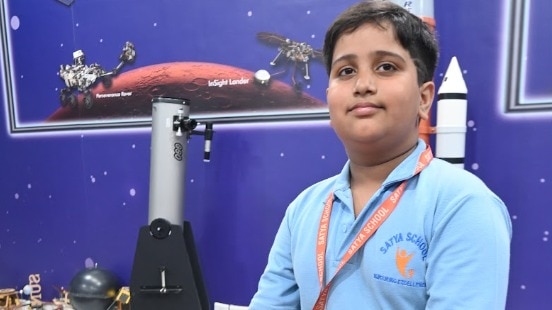
Class 6 student, Atharv Sood of Satya School, has been credited with three preliminary asteroid detections in the All-India Asteroid Search Campaign 2026. The recognition reflects how school-led training and sustained curiosity turned skywatching into hands-on scientific work.From Marvel to the stars: How an 11-year-old found 3 possible asteroidsFor 11-year-old Atharv Sood, looking at the night sky began as a fascination with planets, stars and distant galaxies. Today, that curiosity has taken him beyond simply observing the skies. As part of Satya School’s Young Scientist Programme, Atharv recently participated in the Phase I of the All-India Asteroid Search Campaign (AIASC) 2026 and was credited with three preliminary asteroid detections.The experience also earned him recognition from the International Astronomical Search Collaboration (IASC), with Atharv listed as part of Team SPACE Scanners 1. The International Astronomical Search Collaboration (IASC) certificate awarded to Atharv in the May–June 2026 All India Asteroid Search Campaign FROM A BACKYARD TELESCOPE TO A REAL ASTEROID SEARCHHis interest in astronomy had been growing for some time, but a telescope gifted by his parents on his last birthday brought the subject closer to home.“I have enjoyed observing the Moon, Jupiter and other objects. Seeing them with my own eyes made space feel much closer and more real to me,” Atharv said. At Satya School, astronomy and space science are part of the learning experience through its Space Lab and Young Scientist Programme. It was through the school that Atharv got the opportunity to take part in the asteroid search campaign, where students work with actual astronomical data rather than simply studying space from textbooks.Before beginning the search, the students underwent training organised by SPACE India in collaboration with IASC. They learnt to use Astrometrica, a software used to analyse astronomical images, and were trained to identify objects that appeared to move across a sequence of images. “We were actually getting the chance to take part in a real asteroid search,” Atharv said.The task required patience. Students were given astronomical images captured at different times and had to compare them frame by frame. While stars appeared to remain fixed, a possible moving object could shift slightly between images.For Atharv, spotting that tiny movement was the most exciting part. Atharv in his school library ‘MAYBE I HAVE FOUND SOMETHING’“I was carefully comparing the astronomical images when I noticed something that appeared to be moving. My first reaction was excitement, but I knew I had to be careful because it could have been something else. I checked the images again and thought, ‘Maybe I have found something!’” he recalled.His parents say the achievement was the result of an interest that had been steadily deepening rather than a sudden fascination.“Atharv's interest in space developed gradually. He has always been fascinated by the scale of the universe and would often ask questions about planets, stars and what lies beyond them,” his parents said.After receiving the telescope, they noticed that his curiosity did not fade after the initial excitement. He continued observing the sky, reading about space and returning with questions about what he was seeing.“We have mainly tried to give his curiosity room to grow,” they said, adding that they encourage him to read, watch educational content and explore subjects that genuinely interest him.His teacher at Satya School said Atharv’s curiosity was evident even during classroom discussions.“He wasn't satisfied with simply knowing the facts. He would ask questions about how celestial objects move, how astronomers map the sky and how phenomena in deep space are studied,” the teacher said.During the asteroid search, his attention to detail and persistence stood out. The teacher said Atharv would revisit images, check potential candidates and ensure he was confident before proceeding.For Atharv, however, the three detections are less about the recognition and more about what the experience has taught him.“The recognition was rewarding, but what stayed with me the most was the sense of curiosity it sparked, encouraging me to learn more about astronomy,” he said.His fascination with space was also fuelled by something far removed from scientific research. The Marvel universe. Its fictional worlds, galaxies and black holes made him curious about what might actually exist beyond what humans currently understand.He is particularly intrigued by questions surrounding black holes, the evolution of galaxies and the possibility of life beyond Earth.“I am not completely sure yet what I want to become, but I know that I enjoy science, technology and space,” Atharv said.An ISRO visit planned through Satya School is another experience he is eagerly awaiting. He hopes to see the facilities, understand how scientists work with space technology and get a glimpse of what happens behind the scenes.His parents, meanwhile, are in no hurry to decide what his future should look like.“We don't have a fixed career path in mind for him. We're excited to see where his curiosity and interests lead him in the years ahead,” they said.For now, Atharv’s IASC certificate sits alongside his other trophies and accolades in his room. But perhaps more significant than the certificate is the habit behind it. Looking closely, asking questions and being willing to look again.“I would love to work with telescopes or explore space someday, perhaps at an organisation like ISRO or NASA,” he said.“This experience has encouraged me to keep asking questions, learning and exploring what lies beyond our planet.”- EndsPublished By: Mridusmita DekaPublished On: Aug 21, 2026 17:52 IST
A telescope, curiosity, hours of patience: How this 11-year-old found 3 asteroids
Full Article
Original Source
Read the full article at Indiatoday →KhanList aggregates and links to publicly available news content. We do not host full articles from third-party sources. Always verify important information with original sources.