
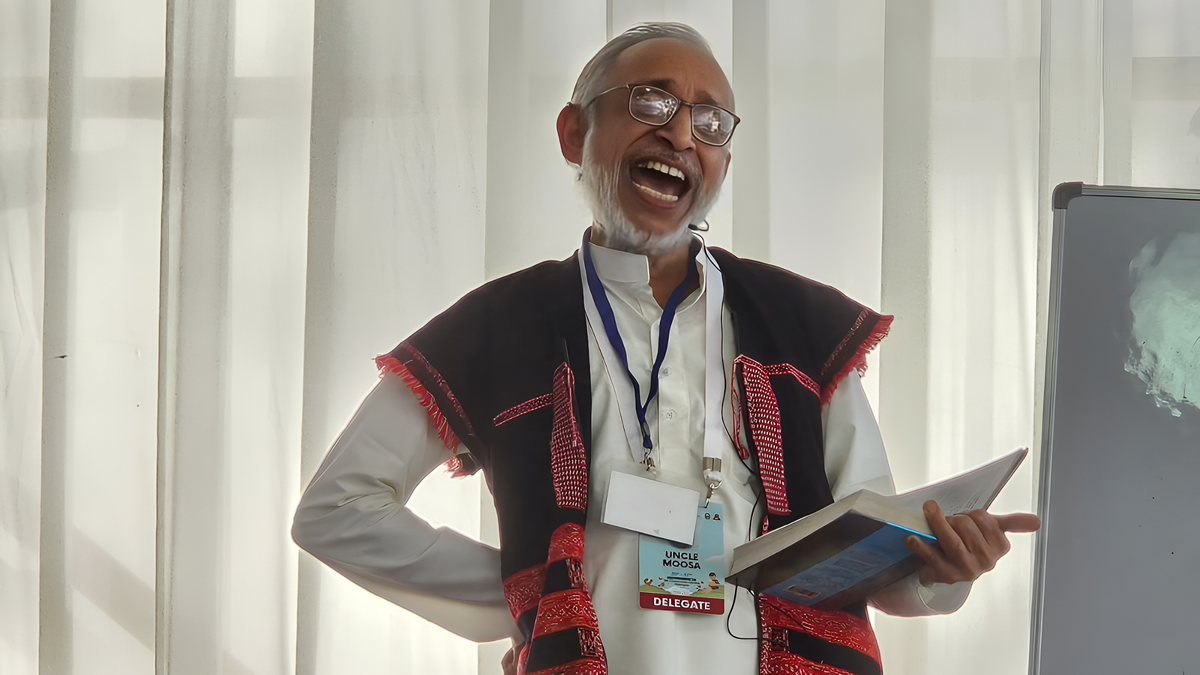
Before he became “Uncle Moosa” to generations of children in Arunachal Pradesh, Sathyanarayanan Mundayoor was a young boy with a simple reading habit: grabbing a copy of The Hindu and turning to the cricket page.“I was in Class 2,” he recalls. “I used to grab The Hindu and try to read the cricket news on the last page.”That early curiosity stayed with him. Reading became a source of joy, learning and discovery — something he wanted other children to experience too.Today, after more than four decades in Arunachal Pradesh, Mundayoor continues to work towards that goal, taking books and the joy of reading to young people who have limited access to them.A journey without a fixed destinationIn 1979, Mundayoor left a secure job in Mumbai and travelled to Arunachal Pradesh. He was not looking for an adventure or even planning a career in education. A newspaper announcement about Vivekananda Kendra Kanyakumari inviting volunteers to help start schools for first-generation learners caught his attention.“I thought this is a very interesting experiment in which I can definitely contribute something,” he says.When he arrived in December 1979, he simply wanted to work with the people. Within weeks, he realised that schools could be a meaningful way to connect with young people.He had no formal qualification in education, but he believed learning should be “free and open-ended,” and give children the freedom to explore.Looking back, he has no regrets about the decision. More importantly, it shaped his understanding of what education should be: not merely completing a syllabus, but finding joy in discovering something new.“We came because work [was] an act of love,” he says. “If it can give the joy of living, joy of learning, joy of growing up to the young people, that is the work.”The teacher who became a learnerMundayoor arrived in Arunachal hoping to contribute to the education of young people. Instead, he soon discovered that the children had plenty to teach him too.“My best teachers have been the Arunachali children,” he says.Their lessons did not always come from books. Children taught him how to care for gardens, work with materials from nature, do everyday tasks better and, most importantly, be sensitive to another person’s difficulties.“These were all beautiful lessons,” he says. “They have been always teaching me how to become a better human being.”This shaped his idea of what an educator should be. A teacher, he believes, cannot simply stand above students and expect them to listen. Learning has to work both ways.“A teacher is a learner,” he says.Perhaps that is why he chose to become Uncle Moosa, rather than fit into the conventional image of a teacher.“I would rather love to be someone who is a close friend of the children,” he says.For him, learning can happen under a tree, in a library or on a veranda. What matters is the relationship between the learner and the person guiding them.From schools to librariesFor Mundayoor, getting children into school is only one part of education. A child may learn to read for an examination without ever discovering the joy of reading.That is where libraries became central to his work.His library efforts eventually grew into the Lohit Youth Library Movement in 2007, taking books closer to young people in rural and reading-deprived communities. These were not simply places to store books. They were spaces where children could choose a comic, discover a story, read science or explore something simply because it interested them.“Schools can produce systems, products of systems, but it cannot produce education,” he says.The movement also relies on young volunteers, whom Mundayoor calls “reader activists”. Their job is not only to read, but to help someone else discover reading.“Readers today have to build up tomorrow’s readers,” he says.That idea puts teenagers at the centre of education rather than treating them only as recipients of it.Has Indian education changed?Mundayoor has seen education become more accessible over the decades. There are more schools, greater exposure to information and many more reading and digital resources.But accessibility, he points out, does not automatically mean equality.His experience in Arunachal Pradesh has shown him how different education can look depending on where a child lives. A school in a district headquarters may have electricity, water, connectivity and better access to teachers, while a remote village may struggle with basic facilities.The digital divide became particularly visible during the COVID-19 pandemic. Not every family had a smartphone, reliable electricity or internet access.“Even if you have a smartphone, it is just like another piece of plastic” in places without connectivity, he says.He believes this uneven access remains one of India’s biggest educational challenges. The opportunities available to a child in a city cannot simply be assumed to exist for one in a remote village.But there is another gap that concerns him: the difference between schooling and education.He feels schools can become too focused on producing students who fit a system, leaving both teachers and students with little freedom to decide what, how or why they learn.“A true education should be very open-ended,” he says.For him, community libraries can help fill that gap by giving children the freedom to choose what they want to read and learn.Learning beyond the textbookMundayoor also wants Indian schools to give greater importance to learning by doing.He points to simple activities such as changing a bulb, repairing a leaking tap, washing one’s own cup or taking care of one’s room. These tasks teach children to solve problems and work with their hands — something he describes as “thinking with hands.”A child in a village may know how to collect firewood, grow vegetables or work with materials from nature, while a highly educated student may struggle with basic repairs.“We must go back to the Gandhian thing that, yes, I must do my own work,” he says.He also believes education must protect knowledge carried through mother languages. In Arunachal Pradesh, he has seen how closely language is linked to culture and community.He wants greater importance to be given to India’s smaller and marginalised languages, so that children can learn about the wider world without losing their connection to where they come from.“If he is strongly founded in his mother language,” he says, learning other languages can become easier.Books or screens?Mundayoor does not see the smartphone simply as the enemy of the book.For one, not every child has equal access to smartphones or the internet. But where smartphones are easily available, he has noticed a decline in reading habits — and says this affects adults and teachers too.A teacher who loves reading, he believes, is more likely to introduce students to books. A teacher absorbed in a smartphone may pass on a very different influence.So the question is not simply books versus screens. What matters is whether young people have access to meaningful knowledge — and someone who can help them discover it.What should teenagers read?Mundayoor does not believe there is one perfect book for every teenager. What appeals to a young reader depends on their language, interests and background.But he recommends inspiring biographies, non-fiction, history and stories from different parts of India.He particularly wants young people to discover books about lesser-known communities and regions, including the Northeast, and to explore translations that introduce them to cultures beyond their own.“Before we think about foreign countries, we should also know more about the smaller, less-known parts of India,” he says.What keeps Uncle Moosa going?After more than four decades, his answer is simple: he wants to pass on something he was fortunate enough to receive.As a child, reading gave him knowledge, curiosity and joy. He feels these were gifts from his parents, elders and surroundings — and therefore something he has a responsibility to share.“So, it’s my duty to share it with someone else,” he says.He no longer sees his work simply as a job. “Work as an act of love,” he says.The people of Arunachal have also become an important part of that journey. The Mishmi community calls him Ambong, meaning uncle, and their affection has made him feel like a member of their families.“I feel so much attached to them because of that quality of love, of unconditional love which they have poured on me,” he says.And there is still plenty left to do. There are young people who have not yet discovered the joy of reading, and Mundayoor believes he has a responsibility to reach them.Your turn to pass it onMundayoor’s work may have begun with taking books to children, but he hopes it will continue through them.His message to teenagers is simple: you do not need to travel to a remote village or start a library. Look around you. There may already be a younger child, friend, neighbour or even an adult who needs help discovering books.“Become a reader activist in your neighbourhood,” he says. “Make a team, go around, find things, share the joy of reading with them.”If every reader helps create another reader, the movement can continue from one generation to the next.For Uncle Moosa, perhaps that is the real lesson: education does not end when someone teaches you something. It grows when you pass that joy on.
A teacher is also a learner
Full Article
Original Source
Read the full article at Thehindu →KhanList aggregates and links to publicly available news content. We do not host full articles from third-party sources. Always verify important information with original sources.