
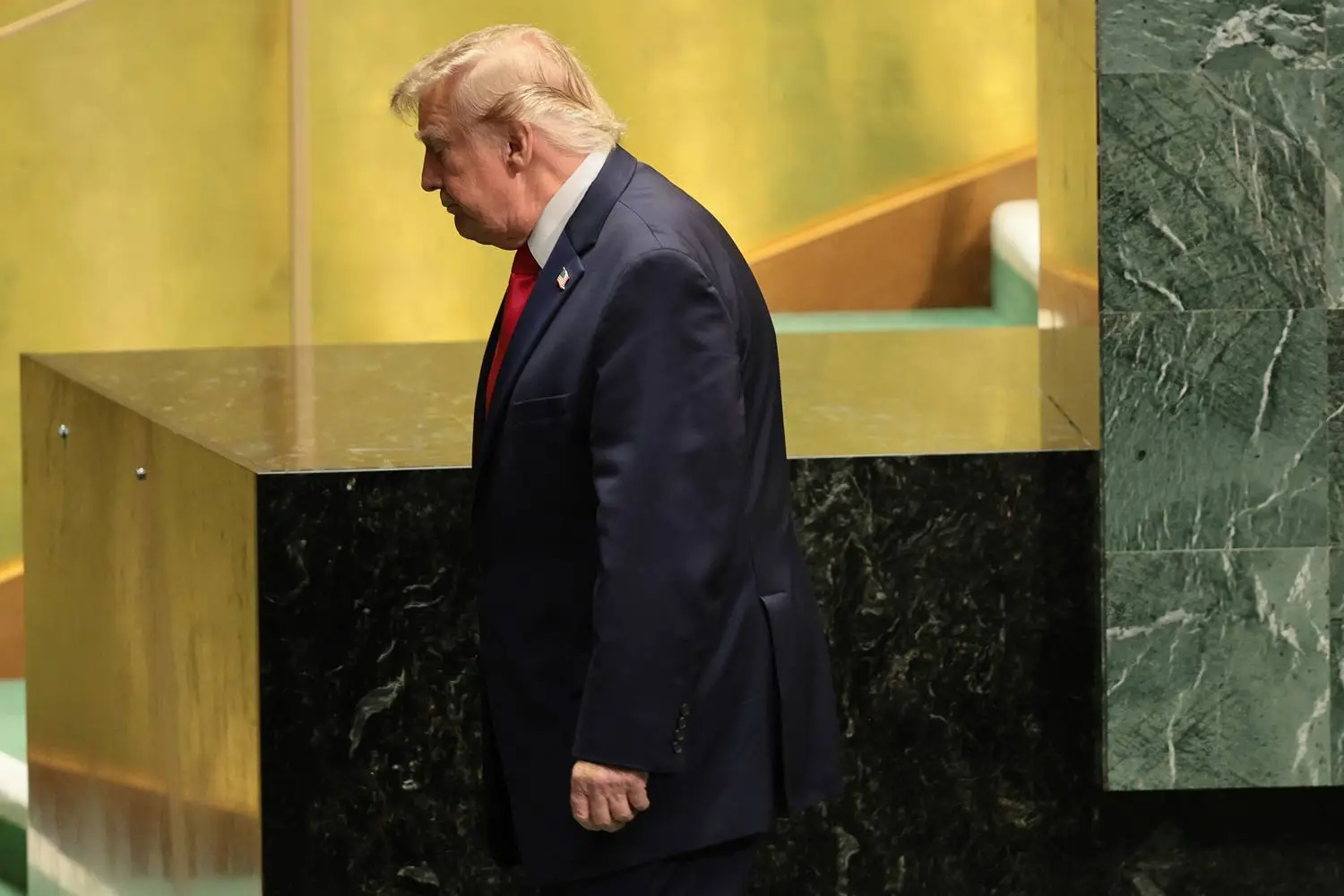
Welcome back to Foreign Policy’s Situation Report, on the ground for Day 2 of UNGA. Here’s what’s on tap for the day: Trump’s speech, Guterres’s swan song, and Zelensky’s press conference. U.S. President Donald Trump used his speech to the United Nations General Assembly on Tuesday to dial up the pressure on Iran, threatening to “annihilate” the country if it does not make a deal with the United States to end the war. “I have a big decision to make: Will a deal be made with Iran that lets them rebuild and create a far greater country than it ever was before, maybe one of the greatest in the Middle East or even the world?” Trump mused to the audience of world leaders and diplomats. “Or do I annihilate the Islamic Republic and do it quickly, never giving them a chance to kill and destroy people and countries again. Do I drive them into hell with no chance of survival and no hope of future greatness or generations?” After presenting the stark choice, Trump said he believed that the two sides would arrive at a deal after the upcoming U.S. midterm election “because it doesn’t make sense for them not to.” It remains unclear whether any progress toward such a deal will be made this week—Iranian President Masoud Pezeshkian is leading a delegation to UNGA, but we don’t yet know if the two sides will meet. Iran was also not the only country that Trump threatened: He called Cuba an “absolutely failed state” that “will fall,” adding that his administration would “not allow a haven for foreign adversaries to threaten America on our own doorstep.” Members of the Cuban delegation walked out of the chamber in response. Greenland. It wasn’t all fire and fury, however. Trump took a moment to tout a new deal with Denmark and Greenland that will significantly increase U.S. military presence in the latter, a compromise after he repeatedly threatened in the past year to take the territory by force . Trump said he would officially sign the agreement later today and praised the negotiating process. “It’s been a great experience, amazing experience, and we’ve really formed a bond in doing it,” he added. Global gripes. Trump somewhat toned down the excoriation of the U.N. and its member countries that he spent most of his UNGA speech last year on, instead praising the institution for cutting its budget this year (under immense U.S. pressure). “The United Nations has great, great potential. I’ve said that for many years,” he said. “But it must stop imposing the far-left agenda of globalist bureaucrats who nobody ever elected.” He reserved far more of his ire for the International Criminal Court, labeling it an “evil group of people” and calling on countries to resign from “this rogue institution.” ‘Superintelligence.’ Trump is leaving UNGA tomorrow to meet with Chinese President Xi Jinping back in Washington, and the growing conversation around the risk from artificial intelligence is expected to be high on the agenda. But the U.S. president made it clear that he isn’t thinking too hard about AI risks, with an extended riff on how the technology should be called “superintelligence” instead. “The use of the word ‘artificial’ makes intelligence … sound fake, and it is not fake. It’s actually amazing,” he said. “In other words, welcome to the new world of superintelligence—SI,” he added. “Whoever wins superintelligence wins.” Swan Song. Far better received was the day’s opening speech from outgoing U.N. Secretary-General António Guterres, who is stepping down at the end of this year after a decade at the helm of the institution. Guterres received several extended bouts of applause—particularly when he criticized Israel for its war in Gaza, advocated for African countries to receive “permanent representation” on the U.N. Security Council, and pressed to end global gender inequality. In an impassioned speech calling for the preservation of multilateral institutions in the face of “fragmentation,” Guterres said there was a need for “a recognition, especially by superpowers, that their power isn’t so super.” He also urged the body to recommit to the U.N. Charter and the principles underpinning it. “The test before us is whether power will be exercised with the law—or beyond it. And we must pass that test,” he said. “We must defend the charter without double standards.” Finally, in closing remarks that drew a standing ovation from the chamber, Guterres promised that he would keep fighting for those principles even out of office. “Wherever I will be, whatever I will be doing, I will keep championing the conviction that peace is possible,” he said. “I will never, ever give up.” War and gas prices. Conversations at UNGA so far are being dominated by the vast ways in which major conflicts are disrupting global energy supplies and markets. During a bilateral meeting with Ukrainian President Volodymyr Zelensky on Tuesday, Trump said that he supports a ban on U.S. diesel exports, which some lawmakers in Washington have pushed for in recent days amid record-high prices. Trump has blamed the price spike on the Russia-Ukraine war (though, as our colleague Keith Johnson wrote this month, the Iran war is far more to blame), urging Kyiv to stop targeting Russian energy infrastructure. But Estonian Foreign Minister Margus Tsahkna told Rishi that “the responsibility lies on Russia” because “Zelensky has said that if [Russian President Vladimir] Putin is ready to have an energy cease-fire, that he’s ready to do it.” He continued: “Maybe President Trump meant as well the message for the domestic audience, because oil prices are hitting all of us a little bit. But Ukraine is not responsible. It’s Russia.” John spoke with the European Union’s climate chief, Wopke Hoekstra, at Foreign Policy’s Energy Forum on the sidelines of UNGA about how Europe is moving to address vulnerabilities exposed by these conflicts. “If you look at the numbers, you see immediately how dramatically vulnerable Europe is. We import roughly 80 percent of our gas and roughly 95 percent of our oil,” Hoekstra said. “We’re learning the lesson that we’ve learned before once again. We learned it in ’73 with the oil crisis. We learned it in ’79 after the Iranian revolution. We learned it again in 2022 when we wanted to get rid of Russian gas, and we didn’t want to have the Kremlin have a leash on us and our ability to support Ukraine. And we’re learning it again.” In the short run, there’s “no simple solution,” he said, but in both the midterm and long term, the “only way out of this nightmare is more clean, Europe-made energy.” Watch the full conversation with Hoekstra here. At a press conference following his meeting with Trump, Zelensky reiterated his willingness to attend a trilateral meeting with the U.S. and Russian presidents. John asked Zelensky if this meant that he agreed with Trump that Putin is ready to end the war, and, if not, what he would hope to gain from a trilateral meeting. “I want to end the war,” Zelensky said, adding that he thinks “the person who is not ready” for a trilateral meeting “is not ready to end the war.” “If you will not support [a] cease-fire, it means that you are not ready to stop the war,” Zelensky said. “OK, you’re ready to speak or not,” Zelensky continued. “And you hear from Ukraine, ‘yes,’ and we don’t hear from Russia, ‘yes.’ For today.” In a new FP piece published Monday, Abdalfatah Alburhan, the president of Sudan’s transitional sovereignty council, wrote about how to end the African country’s yearslong conflict, which has killed tens of thousands of people and displaced millions more. He pushed for U.N. “oversight and assistance” to replace warring militias with a civilian government, but he said that ultimately, any lasting peace must “be homemade—by Sudanese, for Sudanese, in Sudan.” (Alburhan was scheduled to address UNGA but has reportedly had his visa withheld by the United States.) Canadian Foreign Minister Anita Anand spoke to FP’s editor in chief Ravi Agrawal on the sidelines of UNGA yesterday, telling him that Canada’s hedging away from the United States is here to stay. “We need to ensure our long-term resilience, and that is the case regardless of the trade negotiations between Canada and the United States.” Also yesterday, Rishi sat down with Amandeep Singh Gill, the U.N. undersecretary-general and envoy for digital and emerging technologies, for a conversation on how to think about global AI governance. Gill said the U.N. can serve as an “inclusive platform” for AI conversations but that countries will have to make the decisions. “I think the foundations are there, but in which direction we take them depends on the member states,” he said. The UNGA general debate continues on Wednesday, when Iran’s Pezeshkian will have the opportunity to counter Trump’s broadsides. Also taking the stage will be Syrian President Ahmed al-Sharaa, Ukraine’s Zelensky, Argentine President Javier Milei, and Kenyan President William Ruto.
A Tale of Two UNGA Speeches
Full Article
Original Source
Read the full article at Foreignpolicy →KhanList aggregates and links to publicly available news content. We do not host full articles from third-party sources. Always verify important information with original sources.