
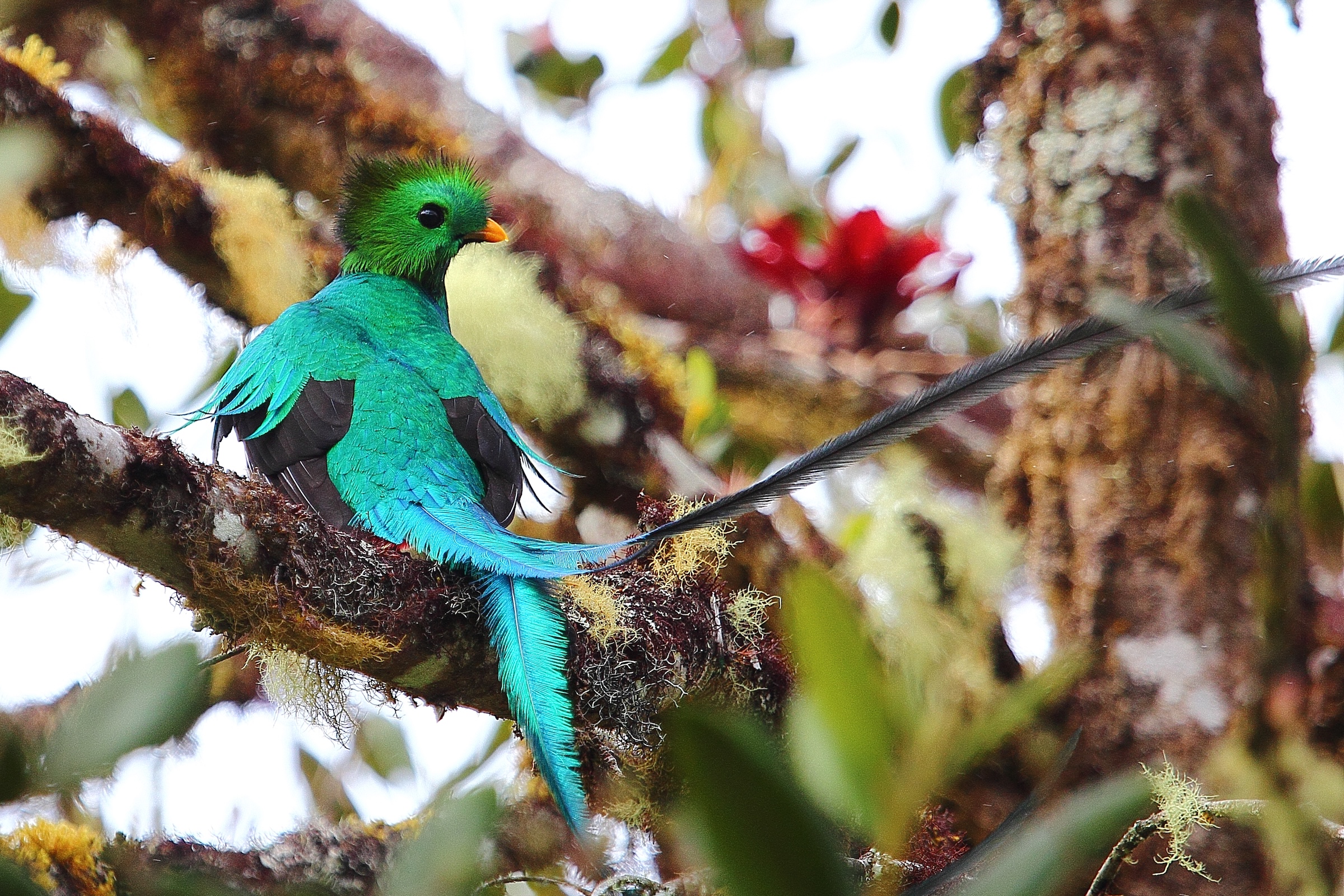
The resplendent quetzal, an emblematic bird with a range spanning Mexico and Central America, has lost more than 360,000 hectares of habitat since 1990, a recent study shows.Researchers highlight that the two different subspecies of resplendent quetzal have been affected differently, with the northern subspecies losing more than half its habitat, far more than its southern counterpart.Agriculture has consistently fragmented the cloud forest, a richly biodiverse, yet small ecosystem that makes the quetzal’s habitat, while climate change has brought drier conditions and less moisture for the forests, the research points out.The study advocates for a reassessment of the quetzal’s status on the IUCN Red List, which would call for a distinct evaluation of the two subspecies’ status. Resplendent quetzals — a strikingly beautiful bird — are iconic denizens of cloud forests from Panama to Mexico. Held in high regard and considered sacred by the Mayans and Aztecs, the quetzal, which also lends its name to Guatemala’s currency, still honors this tradition. But a recently published study has found that this spectacular bird is facing “extreme” forest loss in the northern part of their range, with the authors urging greater conservation action to halt deforestation. True to their name, resplendent quetzals are awash with color; males sport green bodies with a red and purple breast, a yellow beak and a tail complete with beautiful emerald green feathers that can reach more than a meter (3.3 feet) in length. When Edward Backus, the paper’s lead author and an independent researcher, shows people images of the bird for the first time, they often don’t believe it’s real. “It’s stunning to look at. It almost looks like a puppet,” Backus told Mongabay in a video interview. Two subspecies of resplendent quetzal are known: Pharomachrus mocinno mocinno in Mexico, Guatemala, Honduras and El Salvador, and Pharomachrus mocinno costaricensis in Costa Rica and Panama. Male and female resplendent quetzals in Monteverde, Costa Rica. The recent study estimated an overall population of 334,000 quetzals with 55,500 in the northern population and 277,500 in the southern population. Image by Sideny Bragg via Flickr (CC BY 2.0) The study modeled habitat loss using satellite data and revealed a “radical difference” in habitat loss between the two subspecies over the past 30 years, co-author Sofía Solórzano, a professor at the National Autonomous University of Mexico, told Mongabay in an email. Between 1990 and 2021, the data showed, the northern subspecies has lost around 51% of its habitat, while the southern subspecies lost 6.6%. Overall, the species has lost an estimated 361,000 hectares (about 892,000 acres) of potential breeding habitat, which according to the study, could warrant the species’ uplisting on the IUCN Red List from near threatened to vulnerable. “It is clear that more action must be taken to achieve effective protection of quetzal nesting habitats, particularly in the countries that protect the northern populations,” Solórzano wrote. A cloud forest story too The study isn’t only about the plight of the resplendent quetzal, Backus said, but also the diminishing cloud forest which it calls home. There are two primary concerns, Backus said. One is ongoing conversion and fragmentation of cloud forest for agriculture, that has already split up and parsed out much of the quetzal’s habitat into small parcels in the northern part of its range. The northern habitat is divided into just over 100 patches, with the largest — within the Sierra de las Minas Biosphere Reserve in eastern Guatemala — covering about 50,700 hectares (about 125,280 acres). That important habitat is beset by encroachment, due to agricultural like palm oil production. The largest single habitat patch in the south lies within the Cordillera de Talamanca, which spans Costa Rica and Panama, and overlaps about 442,000 hectares (1.09 million acres). “For the quetzal, highly fragmented habitats just don’t support the same numbers of population,” Backus said, adding that’s due to more disturbance, less food and limited nesting areas. Resplendent quetzals use cavities in trees, decaying wood or abandoned nests of other birds, such as woodpeckers. Another pressing concern is climate change that is essentially drying out the moist cloud forest and raising the risk of other threats like drought, increased storm frequency and forest fires. “Deforestation for agriculture has been going on for decades. That’s no surprise. What’s new is the effect of climate change on cloud forests,” Backus said. “You’ve got deforestation on the edges of things, but also climate change is pushing up that forest boundary climatically because of reduced cloud generation, reduced cloud cover and cloud formation.” He points to the Monteverde Cloud Forest Preserve as an example of climate change’s ongoing impact. Recent years have seen higher temperatures and lower humidity driving cloud cover to higher elevations. Eventually, it is feared that cloud forest-dependent species like the quetzal are going to run out of room, Backus said. Resplendent quetzal habitat in Panama. The southern sub-species is faring better than its northern counterpart, due to the presence of large protected areas in Costa Rica and Panama. Image by Edward Backus. “It’s not that the forest is disappearing, but it’s desiccating,” Backus said. “It’s no longer supporting the species that require those climactic conditions.” Continued fragmentation and desiccation of its habitat affect not only the quetzal, but have wider ecosystem impacts, threatening numerous other cloud forest-dependent species, such as epiphytes and amphibians. “It is also important to note that the loss of cloud forests, considered the most diverse, yet least represented ecosystems on our planet, impacts not only quetzals but also the taxonomic diversity of other groups of living organisms,” Solórzano said. She adds that losing cloud forests not only impacts biodiversity, but affects water and air quality and local climate regulation, which can bring knock-on effects for local communities. One or two resplendents? The data provided in the study suggest that the resplendent quetzal is getting closer but doesn’t yet cross the threshold to gain vulnerable status, said Rob Martin, Red List manager at NGO BirdLife International, in a video interview. To qualify for vulnerable status, there must be a 30% decline over three generations. Based on the team’s findings, for the quetzal that sits at around 26%, with the bulk of suspected loss occurring in the northern population. With an uncertainty range of around 8%, the authors believe the quetzal may well qualify. “There would need to be a bit of investigation as to whether actual rates of decline overall could breach that 30% threshold with sufficient evidence to provide a good reason for saying this species is declining at a sufficient rate to exceed the threshold,” Martin told Mongabay. Another consideration when it comes to assessing their status is that though they look very similar, mitochondrial and morphological analysis suggest that the resplendent quetzal sub-species in the northern and southern range should be treated as two individual species. That would result in vastly different statuses on the IUCN Red List. Yet, no formal request for a revision has been made as of now. Though he would like to see the resplendent quetzal recognized as two species based on the evidence, further conservation work is a more urgent need, Backus said: “I think the timeliness of helping agencies and NGOs in each of the countries get to work on conservation action is a much more effective path.” The authors also point to significant data gaps hindering a full analysis of the quetzal’s status. Populations in countries like Honduras, El Salvador, Nicaragua and Panama lack basic natural history studies, Solórzano said. Their study should be followed up by boots-on-the-ground research, the researchers said, and using tools like acoustic monitoring to better assess quetzal population sizes. A female resplendent quetzal. In contrast to the long-tailed males, female resplendent quetzals have much more modest plumage. Image by Judy Gallagher via Flickr (CC BY 4.0) But according to Backus, conservation should still come first: “If somebody were to say here’s $25 million to put into programs, I’d probably put it into conservation,” he said. “Because without the habitat, there’s nothing to study.” Though the resplendent quetzal may not qualify as a single species, for a higher threat status, Martin agrees that conserving their fragile habitat is required. “This is a region with high rates of forest loss that are of particular concern,” he said. In 2025 another bird — the northern nightingale wren (Microcerculus philomela) — was moved from least concern to near threatened based on rates of forest loss. Its habitat and distribution partially overlap that of the quetzal. “It’s uncertain how long the birds can persist in small and fragmented areas,” Martin said. “There’s real concern with that northern population not really having large blocks of forest that are entirely secure from further fragmentation and reduction.” Costa Rica and Panama provide examples of how conservation can support both the quetzal and people with networks of protected areas. “These two countries can also be taken as an example that, with regulated use, the quetzal can benefit local communities with ecotourism programs,” Solórzano said. The researchers emphasize that Guatemala — still home to a large but embattled protected area in Sierra de las Minas Biosphere Reserve — and the Mexican state of Chiapas is where progress could and should be made. “Aside from climate change, which is hard to combat, looking at deforestation along the edges of these large patches of habitat in Guatemala, in particular, would be a priority,” Backus said. “I hope that this study does not go unnoticed by the authorities of these countries or by the IUCN; there is a stark difference in habitat loss compared to countries like Costa Rica and Panama,” Solórzano said. Banner image: A male resplendent quetzal in Costa Rica. These iconic birds have a deep cultural history in Central America and were held in high regard within Mayan and Aztec cultures. Image by ryanacandee via Flickr (CC BY 2.0). Citations: Backus, E. H., Poole, A. F., Backus, D. H., Solórzano, S., & Eisermann, K. (2026). The resplendent quetzal Pharomachrus mocinno of Mesoamerica: Loss of breeding habitat and population estimates (1990–2021). Bird Conservation International, 36, e45. doi:10.1017/s0959270926100756 Helmer, E. H., Gerson, E. A., Baggett, L. S., Bird, B. J., Ruzycki, T. S., & Voggesser, S. M. (2019). Neotropical cloud forests and páramo to contract and dry from declines in cloud immersion and frost. PloS one, 14(4), e0213155. doi:10.1371/journal.pone.0213155 McDermott, A. (2024). Climate change is drying out canopy plants—that could mean less water for the entire rainforest. Proceedings of the National Academy of Sciences, 121(35), e2415456121. doi:10.1073/pnas.2415456121 Ballesteros-Barrera, C., Tapia-Pérez, O., Leyte-Manrique, A., Martínez-Bernal, A., Zárate-Hernández, R., Vargas-Miranda, B., … & Ortiz-Burgos, S. (2026). Potential Impacts of Climate Change on the Richness and Distribution of Endemic Anurans from the Montane Cloud Forest of Mexico. Climate, 14(6), 114. doi:10.3390/cli14060114 Solórzano, S., & Oyama, K. (2010). Morphometric and molecular differentiation between quetzal subspecies of Pharomachrus mocinno (Trogoniformes: Trogonidae). Revista de Biología Tropical, 58(1), 357-371. doi:10.15517/rbt.v58i1.5215 Schulz, U., & Eisermann, K. (2017). Morphometric differentiation between subspecies of Resplendent Quetzal (Pharomachrus mocinno mocinno and P. m. costaricensis) based on male uppertail-coverts. Bulletin of the British Ornithologists’ Club, 137(4), 287-291. doi: 10.25226/bboc.v137i4.2017.a6 FEEDBACK: Use this form to send a message to the author of this post. If you want to post a public comment, you can do that at the bottom of the page. Cite this articleSean Mowbray (2026). A ‘stunning,’ colorful bird losing ground to deforestation and climate change: Study. Mongabay Conservation news. DOI: https://doi.org/10.66709/news-336895 Credits Topics
A ‘stunning,’ colorful bird losing ground to deforestation and climate change: Study
Full Article
Original Source
Read the full article at News →KhanList aggregates and links to publicly available news content. We do not host full articles from third-party sources. Always verify important information with original sources.