
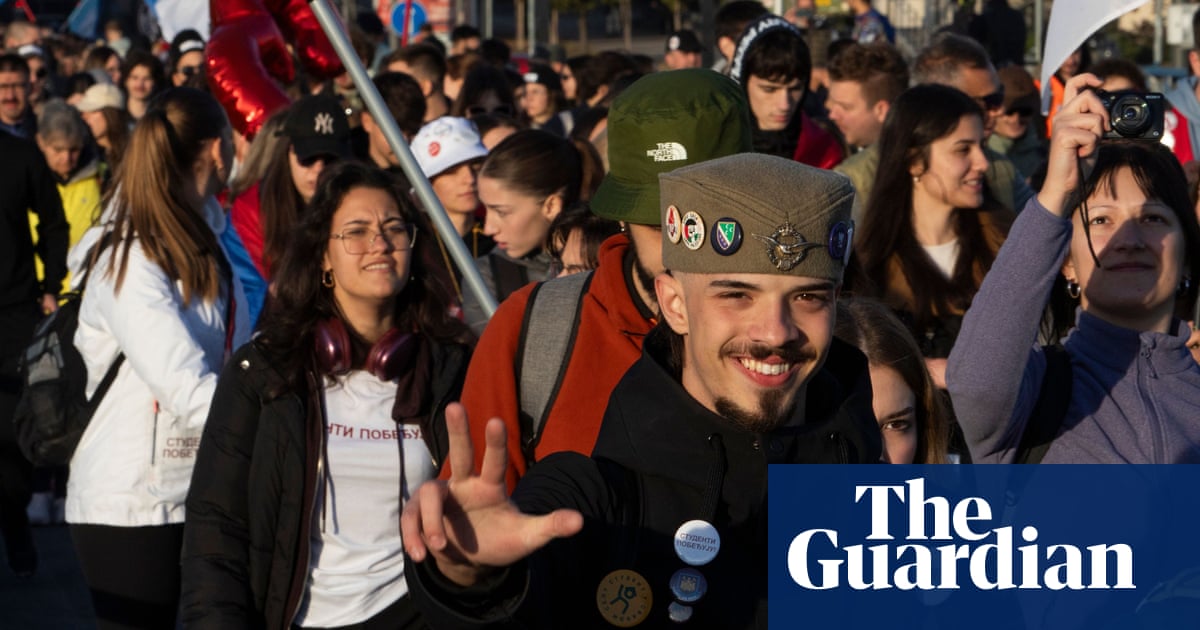
On a cool autumn evening, a team of Serbian student volunteers went canvassing in the housing estates of Krnjača, a Belgrade suburb. They were equipped with lanyards emblazoned with the word “victory”, a stock list of questions and a mobile app that mapped visited homes and the level of support in each.The volunteers were part of a mass student movement, Student List, that has rocked Serbia with two years of constant protests. On Sunday, the group will represent the most serious challenge Aleksandar Vučić has faced in his 12 increasingly authoritarian years in power, by putting forward their own candidates in parliamentary elections.They hope to emulate the defeat of Vučić’s ally, Viktor Orbán, in neighbouring Hungary six months ago, in a domino effect that could bring a democratic resurgence to central Europe.Opinion polls have varied wildly, but many expert observers say a close race is quite possible, with neither side prepared to accept a loss as a legitimate result, raising the risk of post-election unrest and clashes.Student List supporters in Nis hold balloons shaped like the number three, their position on electoral ballots. Photograph: Marko Đurica/ReutersIn order to win, the students’ list of 250 candidates would have to break the mould of Serbian politics, along with Vučić’s grip on the country. He stepped down as president last month, five months before the end of his second and last term in office under the constitution, but only with the aim of extending his hold on power as prime minister at the head of his Serbian Progressive party (SNS).In the section of the suburb assigned to them, law student Zak Veličković and campaign photographer Danijela Radojković were welcomed with overwhelming support. Apart from a small handful of polite doorstep rejections, from those claiming they had no interest in politics, people seized the opportunity to air their grievances.Most promised their vote and a large minority offered help: some taxi drivers with flats in the low-rise apartment blocks said they would help ferry voters to the polling stations.“Turnout is the key,” one said, adding: “Orbán fell with 80%” – a reference to the Hungarian elections in April.Veličković began each conversation by asking what was the biggest problem in Serbian society, a query that often raised a laugh and replies such as: “How much time do you have?”Corruption was the most frequent single complaint. On the corruption index run by Transparency International, Serbia ranks far worse than any of its neighbours, as the most corrupt country in Europe bar the dictatorships in Belarus and Russia.There are frequent allegations of links between the SNS and organised crime, and the Student List’s slogan confronts that widespread perception head on, posing the question: “Serbia or Mafia?” The government denies all accusations and officially claims to be tackling organised crime.The key local issues in Krnjača were the poor repair of the road bridge linking the suburb and central Belgrade, and the sewage system, which repeatedly fails in heavy rain, despite a personal promise by Vučić, who residents said had visited a few years earlier, to fix the problem.The economy has been growing in recent years, but there is a widespread opinion that the fruits are not being fairly distributed. Porsche and Land Rover car showrooms have been established in Krnjača but public spaces look neglected. Some of Belgrade’s trams are more than 50 years old.It was a major infrastructure failure that sparked the student protests – the collapse of a concrete canopy in Novi Sad railway station on 1 November 2024, killing 16 people. Evidence pointed to botched modifications made during refurbishment work, but so far there has been no official finding on the cause, and no official has been held accountable.Rescue service workers inspect the collapsed roof at Novi Sad railway station. Photograph: Interior Ministry of Serbia/APWhen Belgrade students blocked a road in a vigil for the victims three weeks after the disaster, they were attacked by a SNS mob and the protest movement went nationwide.The students initially distanced themselves from opposition parties and avoided any kind of hierarchy or conventional leadership structure. That was partly an ideological choice and partly practical. The SNS and state-run media rule in part through smearing opponents and the student’s collective approach offered fewer targets.Vučić rose to prominence in the 1990s as a radical nationalist, who supported the policies of Serbian expansion and ethnic cleansing led by Slobodan Milošević, who died of a heart attack in detention in The Hague during his trial on charges of genocide and crimes against humanity committed in Croatia, Bosnia and Kosovo. He served as Milošević’s information minister throughout the Kosovo conflict. As president, Vučić has not emulated his predecessor’s militarism, but he has maintained his nationalist playbook in domestic politics, dismissing the opposition as stooges of unspecified foreign powers.Aleksandar Vučić gives a speech at a campaign rally in Novi Sad last week. Photograph: Maxim Konankov/NurPhoto/ShutterstockSo far those well-worn tactics have proved ineffective against the students. A survey published in July by a Serbian pro-democracy group, the Centre for Research, Transparency and Accountability (CRTA) and Stanford University showed significantly more support for the students (45%) than for the SNS (36%), but that was well before Vučić announced his resignation on 27 September and his election machine went into top gear. Other, more recent domestic polls show the SNS in the lead, though the pollsters in question are seen by the opposition as pro-government.Vučić himself shows signs he is taking the political threat seriously enough to throw himself into the campaign, making 129 live television appearances in August, more than four times the previous month’s total.“Serbia has been an electoral autocracy and in electoral autocracies only ruling political parties can win,” Raša Nedeljkov, CRTA’s programme director, said. But he added that the status quo was now in jeopardy.“What we are seeing in the past days, weeks, months, is that strength; the homogeneous government that Vučić used to have is no longer there. He is faced with a completely unorthodox political actor and the toolbox that he has improved over the years since he came to power is no longer effective.”Unable to crush the students by force, division or denigration, Vučić gambled, announcing his resignation as president on 28 September and calling snap elections, in the apparent hope of catching the students off guard, but they responded by improvising a democratic experiment.The 250 candidates were mostly nominated by university faculties (there are more than 160 doctorates among them) with a sprinkling of farmers and other professions, and each candidate was subject to approval by plenary sessions of the student protests.skip past newsletter promotionafter newsletter promotionThe policy platform has also been decided by plenum, with the result that divisive issues, especially foreign policy, have been played down: the question of future EU membership has been left to a referendum and Kosovo is claimed as an integral part of Serbia.One of the chosen candidates, Milica Jovanović, an assistant professor at the University of Belgrade, argued the List’s lack of political experience was not necessarily a drawback.“We are political amateurs, but we are experts,” Jovanović said. “We are people who have led projects, led organisations, led our community, and actually I cannot see that we can do worse than these politicians … The only thing that matters is willingness to improve something, expertise to actually do it and support to do the actual change.”The Student List is pitted against the political monolith of the SNS, in power for 14 years and with control of the state apparatus. It has accused the foreign ministry of rigging the diaspora vote by keeping polling stations open where support for Vučić is strong, such as the Serbian part of Bosnia, while closing them in parts of North America where the opposition could expect to perform well. The ministry did not respond to a request to comment.The SNS grip on national media is meanwhile evident everywhere. A CRTA survey in September found that 69% of air time on Serbian television channels was dedicated to the ruling majority. Of the remaining coverage of the opposition, 42% was negative in tone and 53% neutral.A billboard with a campaign poster of Aleksandar Vučić in Belgrade. Photograph: Darko Vojinović/APThe student movement has sought to sidestep government domination of the media by, it says, going door to door, including sending a canvasser “to every village”, in the hope of making inroads into Vučić’s solid base in the Serbian countryside. The outcome could hinge on whether these student emissaries can change rural minds.No SNS officials responded to a request for comment. Gordana Čomić, a former member of the opposition Democratic party who served as a minister in the SNS government, said the students were exaggerating the extent of their rural campaign and were deluded if they thought they could win.“They are not in the field. It’s propaganda. They have no clue who their voters are,” Čomić said, predicting that the Student List would win about 80 of the 250 seats in the national assembly and then dissipate.“They won’t have a clue what’s their role there. How will they work when they don’t want to talk with anyone from the ruling parties? They will just dissolve.”Radivoje Grujić, a Serbian electoral consultant based in Warsaw, was also sceptical that the Student List could make gains in the countryside and argued the students’ only path to victory would be if the Novi Sad disaster mobilised Serbians who had previously stayed away from politics.“These people were saying: I’m not involved in politics, and then politics got them killed,” he said. “This definitely triggered a lot of people to get involved and obviously those people will not vote for Vučić. I think that’s the only chance for a change – that reservoir of votes of people who never voted.”In a close race, other factors are expected to come into play. Minority parties representing ethnic Hungarians, Bosniaks and Albanians could emerge as kingmakers.Previous elections have seen multiple allegations of various forms of rigging, including vote-buying, voter intimidation and ballot box stuffing, so the Student List is planning to deploy an unprecedented number of opposition monitors on Sunday.That could in turn raise the prospect of election day clashes. Attacks on opposition representatives by gangs of anonymous, black-clad burly men has been a frequent feature of SNS rule. In the days before the elections, one of those hired thugs has turned whistleblower.“My role was to lead a group of guys to the riskiest and most critical places, to any gatherings where students or the opposition were on the other side,” Momcilo Marjanovic told the Balkan Investigative Reporting Network, saying that he was covertly paid through a fictitious job at a public utility.“It was our job, as a last resort of course, to use force, although it often happened not as a last resort.”Diplomats in Belgrade thought that Vučić’s plans to host a major international event, EXPO 2027, next year, could constrain any violence. If his hold on power is threatened, Vučić also has the option of forcing repeated recounts in the hope that the students’ momentum may eventually dissipate.The movement is determined that will not happen and has focused its planning in recent weeks on post-election street tactics to defend any victory.“I think there is a strong feeling of now or never,” Jelena Kleut, an associate professor of media studies, said at a recent demonstration outside the education ministry in Belgrade.“I think that people have really felt in their skin what the regime is capable of and there is a sense you still need to stay strong because the job is not finished.”
A student protest movement has gripped Serbia for two years. This weekend it will try to take power
Full Article
Original Source
Read the full article at Theguardian →KhanList aggregates and links to publicly available news content. We do not host full articles from third-party sources. Always verify important information with original sources.