
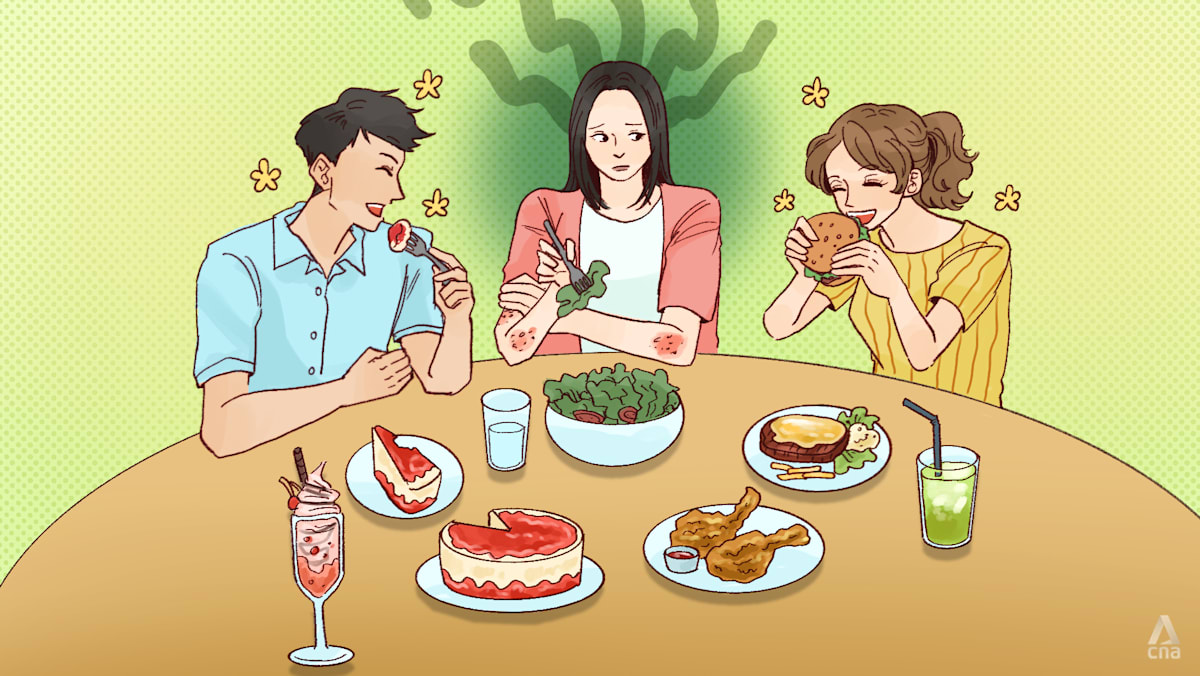
Growing up, I noticed that my arms and legs would turn red easily at the slightest friction or scratch, and I was prone to developing the occasional rash or welt.My skin remained sensitive even as I stepped into adulthood, but in September last year, things took a turn for the worse.What had been small rashes evolved into large red patches on random parts of my body. Instead of being irritating and uncomfortable, now they were intensely prickly, bringing on a burning sensation. At one point, my entire back was inflamed.I was gripped by an incessant need to scratch, and started waking up in the middle of the night to find myself scratching, even in my sleep. A dermatologist later told me that my condition wasn't just "sensitive skin". I had chronic hives – and I was suffering my first major flare-up.The causes of chronic hives aren't always clear-cut, she told me. While things like certain foods, medications, infections and stress can make symptoms worse for some people, they aren't necessarily the root cause. In fact, from what I have learnt, doctors often aren't able to pinpoint a specific trigger.She prescribed one antihistamine tablet, twice a day. It worked at first, but after about six months, some rashes started breaking through.On my dermatologist's advice, I doubled my antihistamine dosage. I kept this up for a while, but the thought of being indefinitely dependent on medication unsettled me.At a loss, I took a friend's advice and explored alternative treatment. A Western medical herbalist recommended I try a course of gut-healing supplements – and go on a temporary low-histamine diet to lower my body's histamine overload. Little did I realise that a simple diet would go on to impact me as much as it did.CHANGING MY DIET WAS PART OF HEALINGBefore this, I had no idea what a "low-histamine diet" even entailed.After a consultation with my herbalist and some deeper research online, I learnt that I had to choose foods that were fresh, unprocessed and naturally had lower histamine levels than others. High on the "no" list: fermented foods such as soy sauce. My heart sank when I realised I would have to temporarily give up many things that brought me joy: caffeine (specifically coffee and matcha), kimchi, yoghurt, sourdough bread, and anything with gluten and dairy.It would also be nearly impossible for me to eat out. How could I possibly escape soy sauce at hawker stalls and restaurants here in Singapore?Almost immediately, I realised that I would have to prepare most of my own meals.Like many other young adults in Singapore, eating out and ordering takeaway have been a major part of my lifestyle for years. But now I had to spend up to two hours each day cooking for myself – not the easiest for anyone with a packed schedule.Whole foods quickly became my best friends: steamed chicken with fresh greens, fried eggs, or fish like seabass if I was feeling fancy. To add flavour, only a handful of basic ingredients were safe: ginger, garlic, spring onions, salt, olive oil and fresh herbs such as parsley. CRAVINGS, ANXIETIES AND UNEXPECTED GAINS The healing effects of my new diet weren't immediately obvious. It would take time, my herbalist advised. I was also still taking antihistamines daily, which blocked the itch and made my recovery progress hard to gauge.Far more immediate and evident were the mental and emotional effects.Before embarking on this diet, I'd always thought of myself as someone who "eats to live" rather than the other way round.I treated my body as a temple, favouring salads, steamed dishes, herbal soups and fruit over fast food and sugary treats. I would side-eye my husband when he ordered cookies to go with his Subway sandwich or tore into a bag of chips hours after dinner.Two weeks into my low-histamine diet, I found myself eyeing his cookies with envy instead of disdain. As he munched on chips while we watched television, I yearned to feel the satisfying snap of salty fried potato slices on my own teeth and tongue.Supermarket trips used to be a no-brainer. I'd head to the familiar aisles on autopilot and fill my basket with breakfast essentials like milk, yoghurt and granola, and add some fruits for fibre. The writer's dietary restrictions changed even routine grocery runs, as she began carefully searching online to see whether certain foods and ingredients were high or low on histamine. (Photo: iStock) But now, almost everything sitting on the shelves felt like poison to my body. Before putting anything into my shopping cart, I'd have to do a quick online search.Could I eat avocados or tomatoes on a low-histamine diet? Not really.What about spinach or a banana? Nope.Perhaps, plain crackers were safe? (They weren't.)However, some things about my diet weren't quite so depressing or stressful.I thought I'd go crazy without coffee or matcha, but cutting out morning caffeine also meant no more midday energy crashes. I've always had interrupted sleep, but now I was sleeping soundly through the night, undisturbed.Another side effect: my skin was thriving.My complexion was so clear that I didn't need to pore over my skin every day like I used to, looking for bumps to squeeze out. I stopped wearing foundation to work, and my colleagues exclaimed in disbelief when I told them I was wearing only lipstick.Nevertheless, it was hard to feel entirely happy about these unexpected upsides, given what I was going through to get them. I looked as if I'd discovered some miracle serum but really, my beauty secret was just saying goodbye to most foods that were worth living for. NOT JUST FOMOOne of the hardest things I faced during this period was something I didn't anticipate prior to starting this diet.Group meals used to be something I looked forward to, a chance to catch up with friends over piping hot "tea" – both literally and figuratively – and confiding in one another about the struggles we were going through.But my new diet effectively put my entire social life on hold.I started turning down invitations to meet up over food and drink, guilty about the prospect of having to impose my new dietary restrictions on friends and loved ones. I also had to stay home to prepare my own meals.Truthfully, going to restaurants and eateries just felt too depressing. I didn't want to expose myself to tantalising treats I couldn't have. I knew it would only make me feel worse.Even on my birthday in May, I stayed home, cooking for myself with the limited ingredients I could eat. "I'll meet you after this diet is over" became my new auto-reply, but it never felt any easier the more I had to say it. The writer's chronic hives flare-up caused intense itching, at times waking her from sleep in the middle of the night. (Photo: iStock) Not every meal could be postponed, though.Throughout these four months, I still participated in special-occasion meals such as farewell dinners for departing colleagues and welcome lunches for new team members.The problem was never the people – my colleagues were kind and considerate, taking every care to be mindful of my diet whenever we shared snacks in the office.But things got harder whenever we had to dine together outside of the office.Not wanting to cause any trouble, I usually rushed to eat my own meal or buy my own food before joining my coworkers at their table.On these occasions, I was surrounded by people – but I couldn't help feeling like I was on my own.I'd sit and eat my cold salad, listening to others gush about how good the shared food was. I'd look down at my cardboard takeaway container, trying to ignore the tempting aromas as they passed warm plates and bowls around.I tried my best to maintain perspective, to keep the mounting self-pity and self-loathing at bay. But no amount of looking on the bright side could change the fact that it thoroughly sucked to sit at a table laden with freshly cooked dishes I couldn't dig into."This too shall pass," I told myself, over and over.REMEMBERING WHAT JOY TASTES LIKEMy diet officially ended in July. Since then, I've kept taking antihistamines and have not experienced further rashes.Earlier this month, I sat down for my first meal out, sharing food with friends for the first time in four months. It was just brunch at a cafe, but it was a strangely emotional experience, taking my first sip of matcha and savouring my favourite Japanese dishes.It felt less like a meal and more like a victory – one worth celebrating only with those near and dear to me. No amount of looking on the bright side could change the fact that it thoroughly sucked to sit at a table laden with freshly cooked dishes I couldn't dig into. I've heard it said many times that "food brings people together". I didn't fully understand this before, but now I recognise that it's really about more than sitting at the same table.Something special happens when you can say: "Wow, this tastes really good. Try it!" and your dining companion replies: "Mmm, yes, it does!"It's not just about sharing sustenance – it's about creating new connections with the people important to me.I'm still taking gut-healing supplements, but I've recently begun weaning myself off antihistamines. At first, the rebound itch hit hard, making me feel like I was back in the early days of my flare-up – but thankfully, my body settled down within a couple of weeks. Despite how challenging the strict diet was, I still count myself fortunate, since it was temporary. People managing lifelong allergies or other conditions that restrict what they can eat may have no such endpoint. Though I'm not yet 100 per cent hive-free, I now get only occasional mild rashes, as I did before my severe flare-up last year.On the recommendation of a traditional Chinese medicine physician I started seeing a few weeks ago, certain foods remain off the menu, including spicy and fried foods as well as shellfish. But I now allow myself to indulge in the occasional decaffeinated coffee once or twice a week, hawker staples such as chicken rice, and some gluten-laden bakes.I also started ordering takeaways again – and I can't overstate how glad I am to regain all the time I used to spend researching, buying and preparing ingredients and cooking meals every single day.Slowly, but surely, it feels like my life is becoming mine again.Amanda Yeap is a senior journalist at CNA TODAY.If you have an experience to share or know someone who wishes to contribute to this series, write to voices [at] mediacorp.com.sg (voices[at]mediacorp[dot]com[dot]sg) with your full name, address and phone number.
A strict diet helped manage my chronic hives – and changed my relationship with food
Full Article
Original Source
Read the full article at Channelnewsasia →KhanList aggregates and links to publicly available news content. We do not host full articles from third-party sources. Always verify important information with original sources.