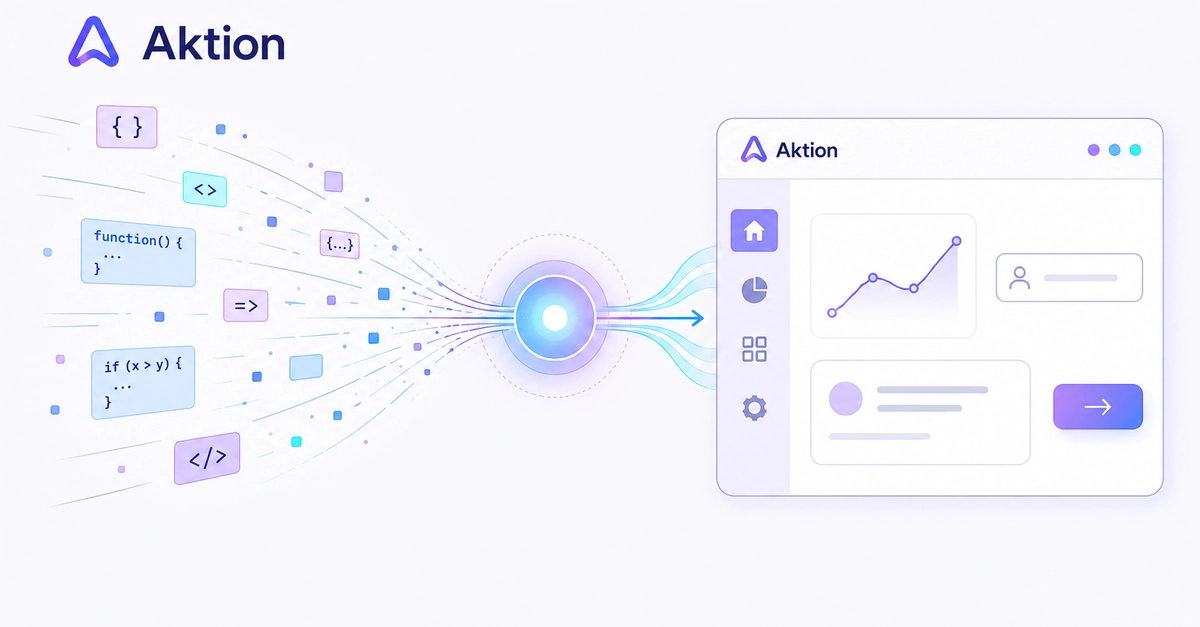
Most AI products still stream words. But what if an AI model could stream the interface itself? I recently explored Aktion, an ambitious open-source project created by my mentor, Asfandiyar Khan, a senior frontend engineer based in Germany. Aktion is a streaming-first UI framework designed to turn compact, JavaScript-shaped instructions into reactive and interactive user interfaces. Instead of producing another Markdown response or a large block of frontend code, an AI model can progressively generate: Cards Charts Forms Tables Dashboards Navigation Interactive workflows What makes Aktion different? Traditional AI-generated frontend code often requires the model to coordinate several independent systems: Framework syntax Package imports State management Routing Form handling Styling Data fetching Component libraries Dependency versions Aktion takes a different approach. It gives developers and AI agents: A compact JavaScript-shaped reactive language A unified UI runtime A consistent component vocabulary Built-in application capabilities A framework-agnostic Web Component Streaming support for progressively generated interfaces The central integration point is the Web Component. Because of this approach, Aktion can be embedded inside React, Vue, Angular, Svelte, plain HTML, or another host environment without rebuilding the generated UI layer for every framework. Why streaming-first UI matters Most AI interfaces wait until a response is complete before presenting the final output. Aktion is designed so completed statements can be rendered while the model is still generating the rest of the response. A heading can appear first. Then a chart. Then filters, forms, cards, and interactive controls. The AI response does not only describe an application. It gradually becomes the application. A smaller target for AI-generated interfaces One of Aktion’s most interesting ideas is its constrained language. AI models normally have enormous freedom when generating frontend applications. They must choose libraries, understand different APIs, manage imports, and connect tools that were not necessarily designed to work together. More freedom can also create more incompatible decisions. Aktion reduces that decision space by providing one language, one runtime, and one predictable set of interface primitives. The important idea is not only that Aktion contains many features. It is that AI-generated interfaces may become more dependable when models generate into a smaller and more controlled environment. More than a component library Aktion brings several common frontend concerns into one system, including: Reactive state Routing Forms Data fetching Themes Responsive styling Charts Realtime interfaces Internationalization Testing utilities Server-side rendering A large built-in component vocabulary This does not automatically make it the right solution for every application. However, it makes Aktion an interesting experiment in how frontend runtimes could evolve for generative UI. The engineering effort behind Aktion Building a framework is very different from building a small library. Aktion brings together: A language A parser A reactive runtime A rendering system A component vocabulary Streaming behavior Developer tooling LLM integration Documentation Interactive demonstrations It is inspiring to see my mentor transform years of frontend experience into such an ambitious open-source project. An idea worth exploring Aktion may still be an early project, and questions around security, runtime size, extensibility, debugging, and long-term stability deserve careful discussion. But the architectural question behind it is important: Should AI continue generating unrestricted frontend applications, or should we design smaller runtimes that give models a clearer and more predictable target? The future of generative UI may not depend only on making AI models more capable. It may also depend on designing better environments for them to generate into. Explore the project 🌐 Visit the Aktion project homepage 💻 View Aktion on GitHub 📖 Read my complete article on Medium Congratulations to Asfandiyar Khan on this impressive engineering effort and valuable contribution to the open-source community. What are your thoughts on streaming-first generative UI?
A Streaming-First UI Framework Built for the AI Era
Full Article
Original Source
Read the full article at Dev →KhanList aggregates and links to publicly available news content. We do not host full articles from third-party sources. Always verify important information with original sources.