
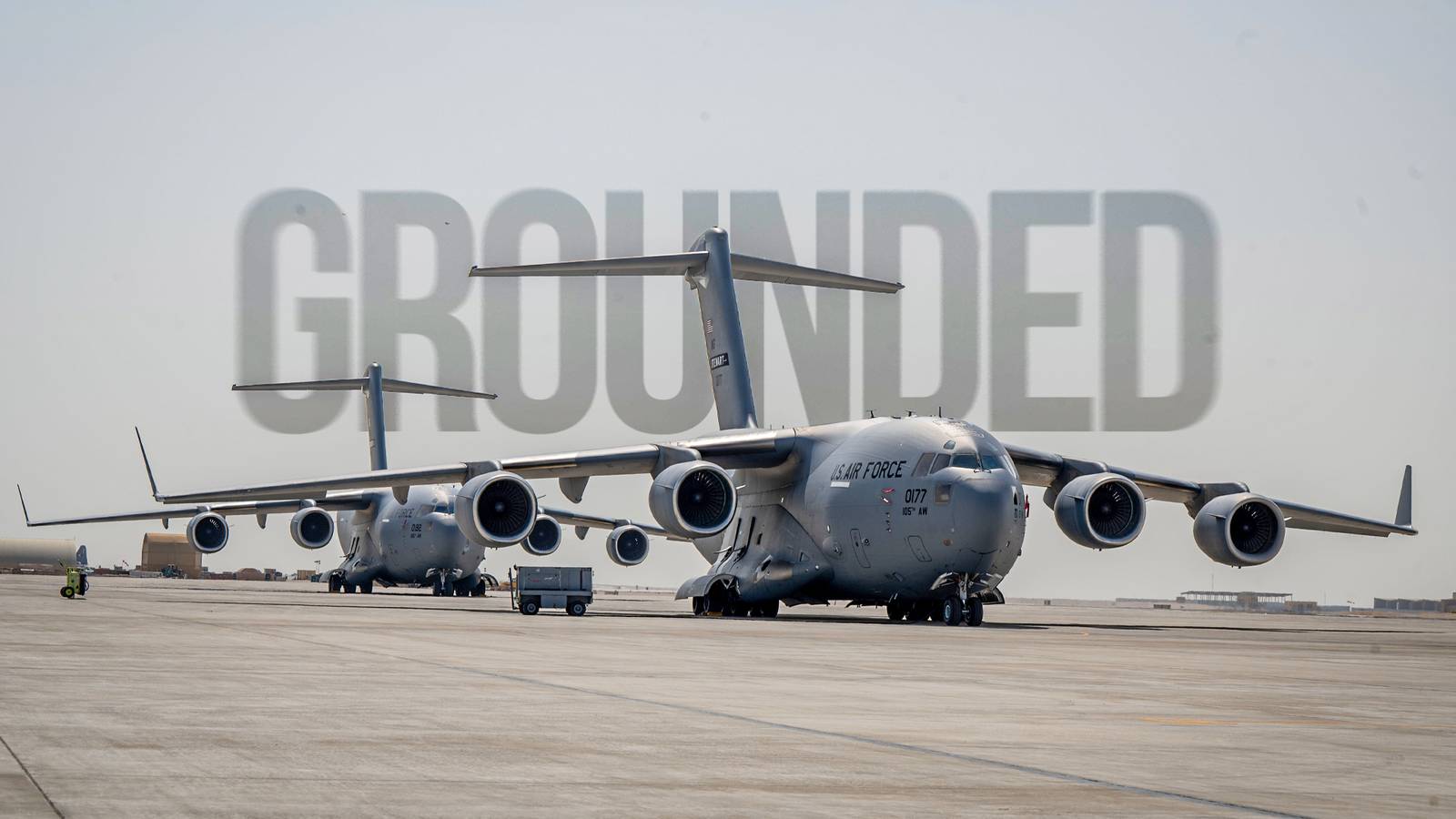
Published Aug 31, 2026, 6:00 AM EDT Luke Diaz is a freelance military writer with experience with active duty experience in the US Navy as well as defense and industrial engineering. He is a former Naval Flight Officer who performed tactical air control on the carrier-based E-2 Hawkeye. In March 2025, a US Air Force (USAF) McDonnell Douglas C-17 Globemaster III was parked on the ramp at Perot Field Fort Worth Alliance Airport (AFW) during stormy weather. Unfortunately for tail number 01-0194, powerful microburst wind conditions pushed two Bombardier Challenger business jets into the parked airlifter. A door on the left side of the plane was severely damaged, as were fuselage panels, but most critically, the big jet's nose. Over the next 17 months, the plane will be repaired painfully slowly due to a total lack of supply chain support. After taking over the assembly line in Long Beach, Boeing shuttered the C-17 factory in 2015, which leaves a limited industry support base for major repairs today. Although there has been discussion of reopening the line, it has not happened yet, leaving the USAF in a bind to fix tail 01-0194. The solution would require extensive collaboration between the Air Force Rapid Sustainment Office and the University of Dayton Research Institute, but the initiative succeeded in returning the airlifter to service on July 30, according to The Aviationist. This joint effort enabled the USAF to use robotic incremental sheet forming to fabricate the large sheet metal panel needed to repair the stricken C-17. Using digital scans and 3D modeling to identify every single detail of the nose shape, robots deformed sheet metal point by point to craft a replacement panel. This extremely complex process kept the jet grounded longer than hoped, but the improvements made are now slated to help repair parts for other legacy planes like the Boeing KC-135 Stratotanker and F-15 Eagle. 5 The Mishap That Started It All Credit: US Air Force Tail 01-0194 was parked overnight at Perot Field on March 4, 2025, according to Aerospace Global News. Then a severe weather system passed through the Dallas/Fort Worth area, including a tornado that touched down in nearby Irving, Texas. Meteorological reports estimated wind gusts as high as 110 mph at the peak of the storm. When the dust settled the morning after, the 445th Maintenance Group found two business Jets had struck the C-17, with one coming to rest underneath the wing of the airlifter. The 445 patched up the military-grade quadjet well enough to fly home to Wright-Patterson Air Force Base. Once it was on the ground, the 89th Airlift Squadron was unable to repair the left nose panel. To most outside observers, it would seem that a platform with over 200 active examples in the fleet should be readily repairable regardless of the damage. Unfortunately for the 89th, that was not the case, and its mauled Globemaster would be grounded for nearly a year and a half. Since Boeing, as the prime contractor for the C-17 program, had to shutter the line a decade before the accident, no contractor was willing to fabricate the part for just a single jet. The loss of tail 01-0194 took out 10% of the 89th's flyable airframes when it was grounded after the mishap. For a unit that flies hundreds of missions a year and moves millions of pounds of cargo per annum, the loss of a tenth of its airlift platforms dealt a major operational blow. In many cases, like this one with other Legacy aircraft in the fleet, the USAF cannibalized parts from mothballed airframes at the Davis-Monthan AFB 'Boneyard' in Arizona. However, there are virtually zero C-17s to be found in the base's graveyard of warbirds. Therefore, the only way to replace the panel was to make a new one. That is when the Air Force Life Cycle Management Center's Rapid Sustainment Office got involved to help bring the Squadron back up to full strength. 4 The USAF's New In-House Fabrication Credit: US Air Force The USAF's RSO took charge in January of this year to spearhead an unproven method of fabricating one-off parts using an innovative new technique. Instead of relying on traditional machine tool processes or sheet metal shaping, the RSO teamed up with the University of Dayton to leverage recent advances in robotic incremental sheet metal forming. As a result, the Air Force can now manufacture low-volume or completely unique parts without paying a vendor millions to set up shop. The RSO's effort to mature ISF to the point where it could produce a major component that could be certified for flight was a lengthy, intensive process, but ultimately a valuable investment in sustaining the USAF fleet well into the future. By shifting the burden of part fabrication from physical tooling to digital software templates, the Air Force can now create a vast digital library of parts. In the future, the RSO will not need 17 months to find a solution. They can simply load the CAD file, spin up an industrial robot, and form a replacement component on demand. Then sheet metal is clamped tightly down for a robotic arm, wielding a generic forming tool, to progressively shape the panel along tracks defined by a CAD model. The robot continuously applies pressure and tiny strokes, progressively 'kneading' and stretching the flat metal into the complex, curved contours of the aircraft skin. 3 Technology Transfer: Sustaining The Stratotankers Credit: US Air Force Beyond the immediate value of returning a C-17 worth $340 million to action, the USAF could save many more millions and billions of dollars by applying the Robotic ISF process to parts fabrication for other platforms. One of the best use-case examples in the current inventory is the six-decade-old fleet of Boeing KC-135 Stratotanker jets. These airframes were derived from the same prototype that yielded the world's first mass-produced jetliner, the 707. Today, new tankers cannot be fielded fast enough, so the KC-135 fleet must fly indefinitely. While many retired KC-135s sit mothballed at Davis-Monthan, relying on them for parts is a rapidly fading luxury. Airframes parked in the desert for decades suffer from hidden issues, such as internal corrosion, fracture propagation, and dry-rotted seals. Exterior skin panels, curved fairings, and structural brackets can also warp or be compromised during extraction. The boneyard is also a finite resource. Once a specific panel or structural block is cannibalized from all the available hulls, that part is gone forever. ISF creates an infinite supply without needing a donor aircraft. This is an extremely important supply chain quality when the successor to the Stratotanker, Boeing's KC-46 Pegasus, continues to struggle with technical deficiencies and has yet to arrive in sufficient numbers to replace the Vintage jets. 2 Keeping the Eagles soaring: ISF for the F-15 Credit: US Air Force The recent breakthrough in robotic ISF for the C-17 applies to the legacy F-15 Eagle and Strike Eagle fleet just as much as it does for the KC-135 Stratotanker. As fighter jets, these aircraft endure high-G maneuvers regularly and are directly exposed to the possibility of enemy fire on combat missions. Unlike the tankers, the line is still open, but Boeing is focused on the latest and greatest F-15EX Eagle II and has limited capacity to produce complex spares for the fleet of older Eagles. This is an especially acute problem based on the difficulties that the Boeing defense division has had in recent years, as highlighted with the extremely delayed next-gen Air Force One and KC-46 programs. The Air Force can improve overall fleet readiness by gaining maintenance independence through ISF to make F-15 parts when Boeing cannot deliver components on an acceptable timeline. Much like the KC-135 waiting on its successor, the legacy F-15 fleet is being forced to fly years past its intended structural retirement date due to supplier bottlenecks. The delayed arrival of the F-15EX is especially noticeable at forward-deployed locations like Kadena Air Force Base, where legacy jets like the F-15E, General Dynamics F-16 Viper, and even the Lockheed Martin F-22 Raptor have temporarily taken its place. Like the KC-135, F-15s pulled from the Davis-Monthan AFB boneyard often suffer the same fatigue and material-rot trends. Cannibalizing a stressed panel from a retired jet to put on an active fighter is often unsafe. The ultimate long-term benefit of applying ISF to the F-15 centers on the Air Force's strategic doctrine of Agile Combat Employment. This is especially valuable in 2026 as the USAF and US Armed Forces in general optimize their force structures for the 'Pivot to the Pacific.' 1 Pivot To The Pacific Credit: US Air Force The pivot to the Pacific presents the US military with its greatest logistical challenge since WWII: the tyranny of distance. Under the Air Force’s ACE doctrine, large, centralized megabases like Kadena in Okinawa or Andersen AFB in Guam will no longer be safe havens. Instead, the military must disperse aircraft into small, austere islands across the Indo-Pacific. In this distributed environment, robotic ISF transitions from a novel engineering feat into a force-enhancing strategic asset. In a high-end conflict in the Pacific, traditional supply chains will be actively targeted or overwhelmed. Carrying warehouse volumes of replacement metal skins, panels, and brackets for multiple airframes to every remote Pacific island is physically impossible. ISF replaces physical parts with "Digital Spares." Instead of shipping thousands of distinct, heavy, pre-formed metal parts, the military only needs to ship a generic crate of flat sheet-metal blanks and a ruggedized container housing an ISF robotic arm. The Indo-Pacific theater also requires synchronization between the Air Force, Navy, Marines, and regional allies like Australia and Japan. ISF acts as a universal fabricator across these disparate forces, guided purely by software code. With ISF, a forward-deployed maintenance team can use a handheld 3D laser scanner to map the damaged section of a fighter jet. The software automatically generates a custom form, and the robot crafts a perfectly matching skin patch within hours. This keeps aircraft in the combat cycle rather than forcing a costly, force-degrading evacuation stateside to a depot.
A Storm Grounded This C-17 For 17 Months Because No Supplier Would Build 1 Panel
Full Article
Original Source
Read the full article at Simpleflying →KhanList aggregates and links to publicly available news content. We do not host full articles from third-party sources. Always verify important information with original sources.