
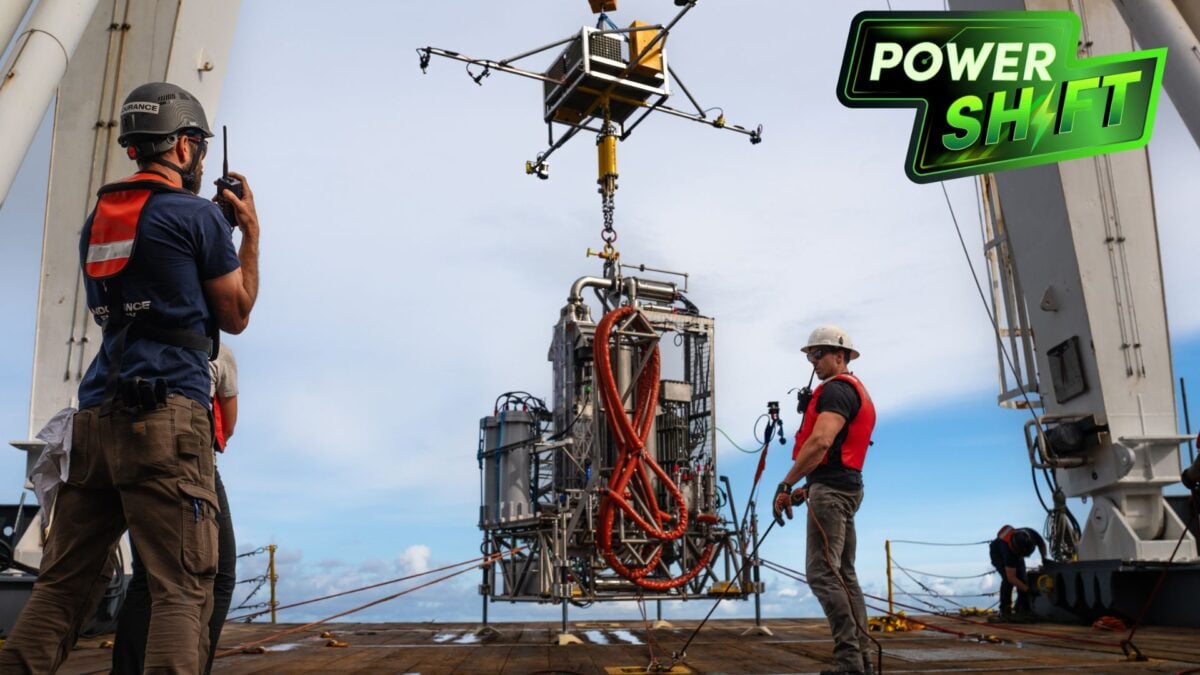
Seattle-based startup Endurance Energy recently tested the world’s first subsea geothermal power plant at Axial Seamount, an active underwater volcano about 300 miles (500 kilometers) off the coast of Oregon. The results, announced last week, show that its technology is technically feasible. The company’s “Adélie” test plant harnessed the seamount’s hydrothermal fluid to generate 8.7 seconds of net-positive electricity, producing a median of about 2 kilowatts of net power and peaking at 16.5 kilowatts of net power. That’s a tiny amount of energy, but the goal of this first test was simply to show that Adélie could generate more than it consumes. With that milestone achieved, engineers can now work toward higher power and longer sustained generation, but getting there will be challenging. Endurance, founded in January 2025 by former SpaceX engineer Andrew Redd, is considered the first commercial venture into subsea geothermal energy. The company envisions a future where its commercialized systems provide continuous, weather-independent, clean electricity to coastal grids and industrial sites around the Pacific and, eventually, worldwide. It’s developing its first commercial project in the Kingdom of Tonga and targeting first power in 2027—an ambitious timeline given the results of this first test. Experts told Gizmodo that Endurance faces a long, arduous road to commercial viability, but Redd expressed confidence that his company will scale. “Many of the places with the strongest offshore resources also depend heavily on imported fuel,” he told Gizmodo in an email. “For them, this is a chance to replace diesel with clean, local baseload power and real energy security. As the technology matures, we expect to compete on cost in open electricity markets.” Subsea geothermal’s first big test Mid-ocean ridges hold immense, yet largely untapped, heat potential. Extracting geothermal energy from these tectonically active regions could offer several advantages over onshore initiatives. This power source sits relatively close to the seafloor, allowing for shallower drilling. Running a power plant in the deep ocean also capitalizes on free ambient cooling and pressurization from the surrounding seawater. What’s more, subsea power plants can avoid land-use restrictions that sometimes stymie onshore geothermal projects. Offshore geothermal has made some progress in recent years, but most initiatives have focused on research, not commercialization. In 2017, a project in Iceland successfully drilled a geothermal well near the Mid-Atlantic Ridge but encountered problems due to corrosive seawater. The year before, researchers in China produced about 4 watts of sustained power from the Southwest Indian Ridge. Overcoming the engineering challenges of a harsh underwater environment will be the biggest hurdle for Endurance as it aims to make offshore geothermal commercially viable. For its Adélie demonstration, the company used a subsea lander drill to bore two holes less than 2 feet (0.6 meters) apart, both of which began venting hydrothermal fluid. The team then cased, cemented, and capped the second hole with a valve before completing a 52-foot (16-meter) geothermal well that flowed at 500 degrees Fahrenheit (260 degrees Celsius) after cementing. Once the 100-kilowatt Adélie power plant was installed on the seafloor, Endurance realized the well was not delivering enough hydrothermal fluid to run the plant. So, they pivoted to a natural vent nearby. There, hydrothermal fluid was already flowing at about 538 degrees F (281 degrees C), and Adélie briefly managed to generate net-positive energy until a software issue stopped the system. The team attempted to restart, but then a power cable feeding Adélie’s refrigerant pump failed, bringing an end to the demonstration. “None of those [issues] point to a problem with the resource or physics,” Redd said. “They’re engineering issues, and we already know the fixes: deeper, larger wells for more flow, sturdier power electronics, and a new way of building and testing subsea cables.” “Is it technically viable that this can operate for more than 10 seconds? I believe the answer is yes,” Dani Merino-Garcia, vice president of research at Project Innerspace, a nonprofit dedicated to geothermal energy growth, told Gizmodo. But clearing these engineering hurdles may be easier said than done. Merino-Garcia emphasized the challenges of designing a system that can withstand deep-ocean conditions over the long term. “You have a vent that is very hot, bringing in fluids that are very, very low pH,” Merino-Garcia said. This could cause critical components—particularly the heat exchanger, which transfers heat from the hydrothermal fluid to a working fluid that spins the turbine—to suffer corrosion or scaling. If an onshore geothermal plant fails, it’s easy for technicians to access and fix the faulty part. The same can’t be said for a subsea system—any maintenance it requires would be high risk and extremely expensive, so designing it to last is key to commercial viability. With that said, Redd pointed out that Endurance was able to retrieve Adélie, service it, and return it to the seafloor for hydrothermal vent operations within 16 hours of the first failed power generation attempt, demonstrating how efficiently the company can work at sea. In an email to Gizmodo, Roland Horne, director of the Geothermal Program at Stanford University, agreed with Merino-Garcia that Adélie seems technically feasible but noted that subsea deployment is likely to be costly, too. Endurance aims to test a refurbished and upgraded version of Adélie, called Gentoo, this winter. Those upgrades include redesigned subsea cables, more robust electronics, and deeper wells, according to Redd. Merino-Garcia said he is curious to see how the company progresses and added that the technologies it is developing could prove viable in less extreme underwater environments. “The fact that they’re able to install power generation units in the subsea is a technical achievement that can be applied to shallower resources or more benign conditions,” he said.
A Startup Just Pulled Electricity From an Underwater Volcano Off Oregon. The Next Step Is Much Harder
Full Article
Original Source
Read the full article at Gizmodo →KhanList aggregates and links to publicly available news content. We do not host full articles from third-party sources. Always verify important information with original sources.