
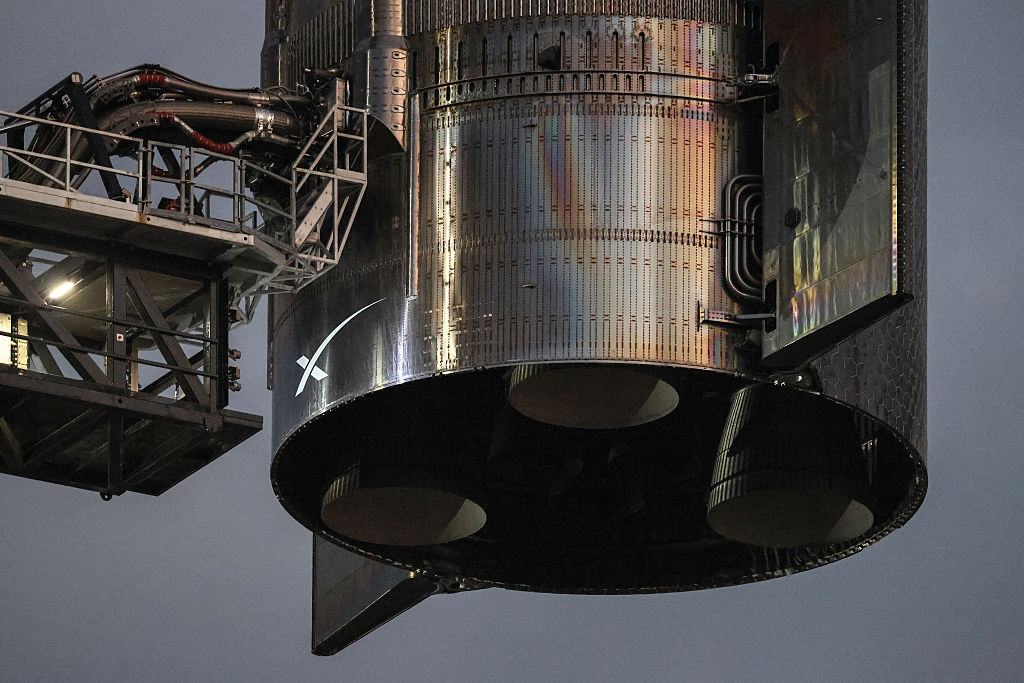
SpaceX achieved an engineering first on November 14: the first launch tower catch of a rocket stage returning from orbit. The steel arms of a Texas launch tower recovered the Starship rocket’s upper stage — the part that carries payloads (space cargo) — after it spent more than 22 hours in orbit and deployed 26 Starlink satellites. The lower stage that powers Starship’s liftoff, known as the Super Heavy booster, diverted offshore and self-destructed; SpaceX had caught such boosters during earlier tests. If SpaceX can routinely catch and refly both stages, it could lower launch costs and, with fast turnarounds, launch more often. But its incentive to prioritize its own satellites, combined with limited alternatives for launch services, could leave U.S. military and intelligence missions competing with other customers for scarce launch slots. Starship Could Expand U.S. Launch Capacity SpaceX accounted for 85 percent of U.S. orbital launches in 2025. The U.S. government and commercial satellite operators rely heavily on SpaceX’s partially reusable Falcon 9 rocket to reach orbit. The company reflies Falcon’s booster but builds a new upper stage for each flight. Recovering an upper stage is harder because it reenters Earth’s atmosphere at higher speeds and faces more intense heat than a booster. Starship is designed to reuse both stages, potentially lowering costs and, with faster turnaround between flights, increasing launch frequency. SpaceX plans to transition from Falcon to Starship and expand launch capacity through its planned “Starbase Louisiana” spaceport, with a first launch targeted as early as 2029. Louisiana officials say the site could have 10 launch pads at full buildout and eventually support thousands of launches annually, compared to 217 total U.S. launches in 2025. With 83 percent of U.S. launches concentrated at Kennedy, Cape Canaveral, and Vandenberg, Louisiana could provide another major, albeit private, launch location. More Launch Capacity May Not Mean More Access for Government and Commercial Customers SpaceX has warned investors it may prioritize its own payloads over additional government contracts and commercial customers. It reported $5.2 billion in satellite-connectivity revenue in the third quarter of 2026, compared with $1.1 billion from launch services. Maintaining that larger satellite business gives SpaceX a commercial incentive to reserve launch capacity for its own satellites. Replacing Falcon 9 with Starship also poses engineering concerns for outside customers, including the U.S. government. Starship’s current dispenser deploys flat Starlink satellites stacked like trays, while bulkier military satellites may require different mechanisms to fit and deploy. Securing launches is already a challenge. Politico reported in October that three Space Force satellite missions received no launch bids. Moreover, Reuters reported in August that SpaceX was telling commercial customers that Falcon 9 was booked through 2028-2029. A Space Force official described these difficulties as temporary, yet even brief delays could push back priority missions. Alternatives to SpaceX remain limited. Blue Origin’s New Glenn, which has a reusable booster, has been sidelined since a May ground-test explosion. United Launch Alliance’s Vulcan, a single-use rocket, failed on November 15 during its first flight since February, complicating its return to supporting U.S. government launches. Washington Should Secure Launch Services and Broaden the Space Industrial Base Space Force should expand its new Commercial Augmentation Space Reserve (CASR) to include launch services. CASR uses pre-negotiated contracts to secure critical commercial services during crises. Space Force should negotiate with SpaceX, along with other providers, to reserve crisis launch capacity, specifying military payload requirements, priority access, and activation procedures. Although these agreements would not resolve current launch bottlenecks, they could secure emergency access to launch capacity before a conflict occurs. The Pentagon should expand financing for emerging launch providers through its Office of Strategic Capital, building on conditional loan commitments of $150 million each to Rocket Lab and Stoke Space. Additional financing should target manufacturing, launchpad, and rocket-recovery infrastructure that could help more providers increase launch frequency and compete for government missions. SpaceX is a major American asset, but a broader pool of reliable providers would make U.S. access to orbit more resilient and encourage further innovation. Emmerson Overell is a project coordinator at the Center on Cyber and Technology Innovation (CCTI) at the Foundation for Defense of Democracies (FDD), where she researches threats to U.S. and allied security in the Arctic, space, and cyberspace. For more analysis from Emmerson and FDD, please subscribe HERE. Follow FDD on X @FDD and @FDD_CCTI. FDD is a Washington, DC-based, nonpartisan research institute focusing on national security and foreign policy.
A SpaceX Milestone Exposes America’s Rocket Launch Bottleneck
Full Article
Original Source
Read the full article at Fdd →KhanList aggregates and links to publicly available news content. We do not host full articles from third-party sources. Always verify important information with original sources.