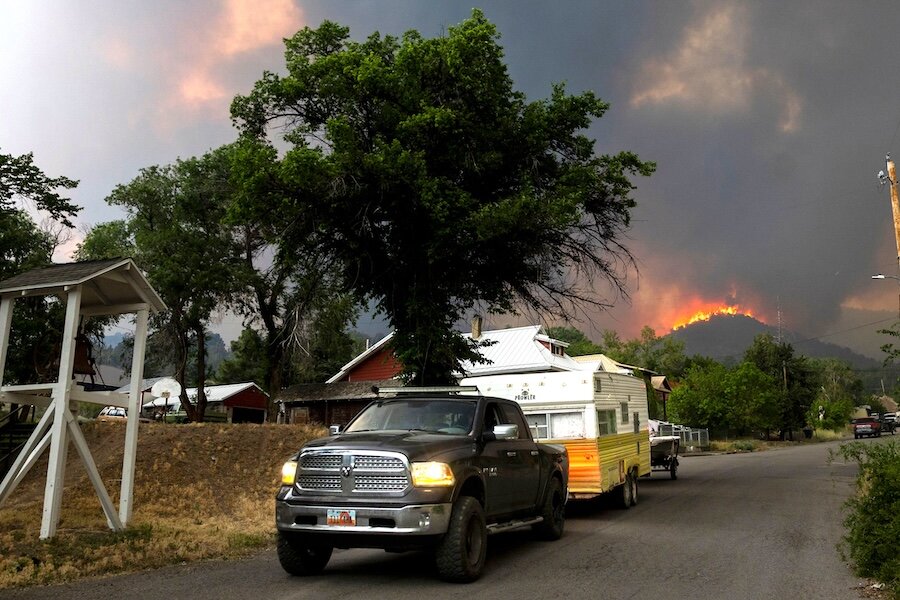
With wildfires again threatening the American West this summer, Utah has become the latest state helping homeowners in high-risk areas to fortify their properties against drought-driven fire. From 2021 to 2024, the state saw the largest percentage increase in home insurance costs – a 59% hike – of any U.S. state.Yet unlike in Colorado and California, both of which recently enacted stricter rules on insurance companies and tough building codes to “harden” a home from fire, Utah’s plan is more partnership than paternalism.It will first nudge homeowners with information on risks and remedies and only threaten a fee for noncompliance with new codes that aim to ensure a “defensible space” from wildfire.“Our goal is to empower homeowners, communities, fire departments, and municipalities to act in reducing their vulnerability to wildfire by giving them the necessary tools to identify and understand their wildfire risk,” states an official Utah website.Whether this softer approach will ensure entire neighborhoods are fire-resistant – a necessary requirement to prevent the spread of fire from property to property – remains to be seen. At the least, homeowners who take all the recommended steps – such as installing metal roofs and clearing away brush and debris – should be better able to negotiate for a better insurance rate or obtain coverage at all.As more governments aim for proactive resilience against climate change’s many threats, they are often researching tactics used to curb other problems, such as poverty. One successful model that began in Bangladesh is called the “graduation approach.” Those living in poverty are offered tools such as business training and a savings account to eventually “graduate” into earning a sustainable livelihood.Sustainability is also a key concept in curbing wildfires. Utah’s experiment in getting voluntary buy-in from homeowners to fortify their properties against fire could result in long-term results.“Effective [climate] resilience depends on local ownership, trusted institutions and the ability of countries and communities to create or adapt solutions to their own contexts,” wrote Tafadzwanashe Mabhaudhi, a professor at the London School of Hygiene & Tropical Medicine, and Mendy Ndlovu, an agrometeorologist at the University of KwaZulu-Natal, in The Conversation.“Climate resilience can’t be built through one-way relationships,” they added, “where solutions are designed elsewhere and delivered” to a community.
A soft way to harden homes against wildfire
Full Article
Original Source
Read the full article at Csmonitor →KhanList aggregates and links to publicly available news content. We do not host full articles from third-party sources. Always verify important information with original sources.