
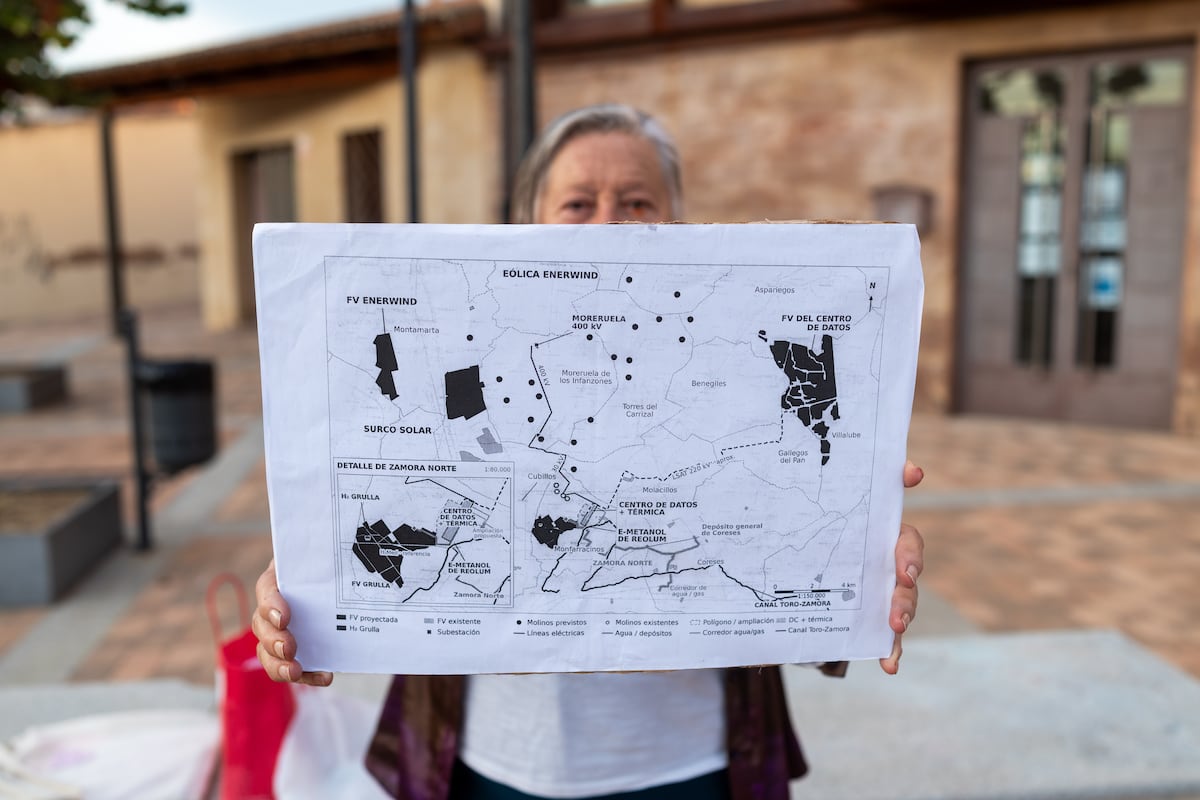
A huge expanse of countryside in Spain is about to be covered with a macro-data center for AI purposes. The center is being constructed close to the small town of Monfarracinos, just over 10 kilometers (six miles) from the provincial capital, Zamora. It is a place of socio-economic and demographic decline. The land has traditionally been used for arable and livestock farming. The main crop is wheat while herds of cattle graze by the Valderaduey River, near the River Duero. But now the area has been earmarked for a data center that will produce high levels of noise and heat. Although it will also create local jobs, critics say that the benefits of the project, rubber-stamped by the regional government of Castile and León, do not offset the drawbacks. A neighborhood group is accusing the conservative mayor of Monfarracinos of a lack of transparency with farmers “scared” of losing land and the pollution of the environment.The organization’s members distribute pamphlets with information on the project to passers-by, some of whom have moved into the new residential projects swelling the population of Monfarracinos, turning it into a commuter zone for the city of Zamora. Group spokesperson Pilar Sánchez says that “the town council has negotiated behind everyone’s back. When the project was announced in August and we asked for information, there was no response; the mayor has pulled the wool over our eyes.” Sánchez condemns the lack of transparency, arguing that if it were such a positive initiative, there would be no need to sneak about. The farmers, she says, “are scared” by the lack of clarity and the potential harm to their livelihoods in terms of pollution, lack of water or loss of pasture. The platform replicates others that have emerged in the United States protesting against the installation of noisy and polluting data centers in rural areas.The companies involved in putting up the center are subsidiaries of the energy companies Edison/EDF and FRV, and the project estimates 426 jobs will be created, without specifying the areas or characteristics of employment. Instead, it claims the center will benefit the region’s economy as “it boosts sectors such as construction, telecommunications and renewable energies.” A document detailing the center’s construction cites a tax contribution, without specifying what that would amount to.Manuel García, a researcher at the Spanish National Research Council (CSIC), breaks down the impact in terms of probable increases in temperature, noise and energy consumption: 2,255 gigawatts per hour all year, amounting to 330% of the current electricity consumption of the province of Zamora and up to 18% of the whole of the Castile and León region. The center will cover 33 hectares of land, with five buildings fueled by 978 hectares of solar panels in a solar park 14 kilometers (nine miles) away, which will cover 18% of the municipality of Aspariegos and 19% of Villalube. Natural gas will also be involved while a green hydrogen plant is planned. The project also requires a thermal power plant powered by natural gas, a consumption equivalent to that of 300,000 homes over the course of a year in a province with 165,000 inhabitants. With an expected life span of 25 years, the center will emit as much carbon dioxide annually as 2% of Spain’s total and 10% emitted by the region of Castile and León alone. “This is, without a doubt, the most serious damage associated with this data center,” observes García.García also talks about the noise: “It would mean an increase of 280% in the vicinity during the day and 900% at night, equivalent to an old refrigerator or a large fan,” he says. The nearest Monfarracinos homes would suffer “an increase of 12% during the day and 48% at night, adding little noise over what may already exist” although anything built closer to the macro-center would receive higher levels. The greatest impact would be to “ecosystems and nearby work and residential spaces.” García flags up the impact of heat due to the energy consumed, although the environmental report does not include thermal studies, which is “incomprehensible” to him. García cites the University of Cambridge’s reports of increases of between 2ºC and 9ºC (35.6ºF and 48.2ºF); the University of Arizona calculates between 0.9ºC and 2.2ºC (33.6ºF and 36ºF). García believes the increases would be greater in Monfarracinos because these analyses are based on smaller centers without thermal power plants.Regarding the demand for water, García considers that it would be “relatively low in relation to other industrial consumption,” although Monfarracinos already suffers from frequent bouts of drought. García cites the dean of the Official College of Industrial Engineers of Zamora, José Luis Hernández, who says: “We cannot oppose everything.” García points out the need for industries, especially in unpopulated areas, but suggests thinking “collectively about what type of development is desirable and if a project of this type is compatible.” The mayor of Monfarracinos, Manuel Martín who belongs to Spain’s conservative People’s Party (PP), has not responded to EL PAÍS for comment. In previous statements, he slammed criticism of the center for “going against progress” but stressed that he was flexible: his town, he said, “will not support any project that goes against the well-being and health of locals.” The regional government, comprised of a coalition of the PP and the far-right Vox party, has declared it a regional project while the socialist authorities of the city of Zamora have asked for that label to be removed.The reason given by the mayor of Zamora, Francisco Guarido from the United Left, is that the center is “an oversized model that could have been proposed on a much smaller scale.” He rejects the project and accuses the regional government of “confusing the commercial interest of a private developer with the general interest of citizens.” The socialist party in the region has urged authorities to guarantee “transparency, public participation and compliance with the regulations.” Regional government spokespersons have declined to comment until the so-called period of allegations is closed.But the locals are up in arms. “It is not going to favor the area, it is very destructive,” says Sánchez, who questions any potential positive impact on employment because these centers “only hire people during construction, the companies bring their own teams, and then the centers are maintained from afar.” The neighborhood association has organized informative meetings: on November 5 they will meet in Torres del Carrizal. “It’s a way of kicking us out,” Sánchez says. “Some people have been paid for land far more than it is worth and they will use the money to buy two apartments and rent them out.” Meanwhile, “working farmers are not on board.”Sign up for our weekly newsletter to get more English-language news coverage from EL PAÍS USA Edition
A small town in Spain battles again construction of a macro data center: ‘It’s a way of kicking us out’
Full Article
Original Source
Read the full article at English →KhanList aggregates and links to publicly available news content. We do not host full articles from third-party sources. Always verify important information with original sources.