
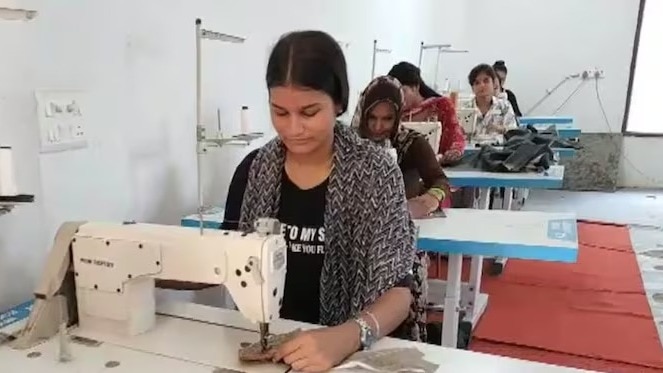
One learnt a new skill in three months. Another turned a generations-old footwear trade into a growing business. Their stories show what Uttar Pradesh's ODOP scheme can mean beyond loans, training and official numbers.A skill, bigger orders, a new home: How Agra's ODOP is changing livesLakshmi sits at a machine, carefully working on a product that, until a few months ago, she did not know how to make.Today, she can make it herself.After 90 days of training at a Common Facility Centre in Nawada village on Agra's Shamshabad Road, Lakshmi has learnt how to work with leather and non-leather products. More than the skill itself, she says, the training has given her something she did not have before: the confidence that she can earn from her own work. Around her, other young women are learning too. Someone is making a bag. Another is working on a purse or a wallet. Machines whirr as trainees learn the cutting, stitching, finishing and packaging that go into products that may eventually find buyers beyond the training centre.For Lakshmi, the journey has started with a sewing machine. For Rajendra Soni, it began with a shoe.Soni comes from a family that has been making footwear for generations. In Anguthi village in Agra's Bichpuri area, he still runs a small cottage unit from home, making shoes, sandals, slippers and juttis.But his market is no longer confined to the area around his village.Soni has travelled to exhibitions in Delhi, Lucknow, Meerut and Gorakhpur, where he has been able to showcase his products, meet larger buyers and secure new orders.His business has grown. So has his income.The result is now visible in a place far removed from a footwear workshop: Soni has bought a home of his own.Earlier, he lived with his five brothers in their ancestral house.A shoe. A sewing machine. A home.The three tell a story about what Uttar Pradesh's One District One Product, or ODOP, initiative is trying to change in Agra.WHEN A SKILL GETS A CHANCEGovernment schemes are usually explained through numbers.How many people received loans. How much subsidy was disbursed. How many trainees completed a course.But numbers do not always show what happens after a person walks out of a training centre or receives the first bit of financial support.Can they actually earn?Can a product find a buyer?Can a small artisan grow beyond the limits of a local market?In Agra, those questions matter because the city has a long history of making footwear, much of it built around small workshops and family-run units.According to the district industries department, around Rs 4,000 crore worth of leather products are exported from Agra every year. The sector has around 150 export units and provides livelihoods to an estimated four to five lakh people.But the industry depends on far more than its big exporters.It rests on a vast network of skilled workers and small artisans, many of whom have inherited the craft but have not always had the money, machinery or market access needed to turn it into a growing business.That is where ODOP comes in.Anuj Kumar Singh, Joint Commissioner of Industries for the Agra Division, describes ODOP not as one scheme but as a combination of different forms of support.For Agra's artisans and small entrepreneurs, that includes bank loans, subsidies ranging from 10% to 25%, toolkits and sewing machines. Under the Chief Minister's Youth Entrepreneur Scheme, assistance of up to Rs 5 lakh is also available.But the support does not end there.Artisans are also being taken to exhibitions across the country, where small producers who may otherwise never meet large buyers get an opportunity to put their products before the market.For Rajendra Soni, that access has mattered.He says he received a credit limit of up to Rs 3 lakh under the scheme, along with subsidies of Rs 10,000 twice a year. The money helped his small unit, but reaching exhibitions helped him find a larger market.It was the combination that made a difference.THE NEXT GENERATION WAS WALKING AWAYAt the Common Facility Centre in Nawada, the challenge is slightly different.Here, the question is whether an old industry can attract new hands.Ravindra Singh Tomar, who runs the centre, says the younger generation had increasingly begun moving away from the traditional footwear trade.That was a problem for an industry where skills had long been passed down through families.The centre, which started in June 2022, was meant to create another path.Young people do not have to grow up in a footwear-making family to learn the work. They are trained in cutting, stitching, finishing, packaging and operating modern machinery.In its first year, around 90 people were trained at the centre. Nearly 1,600 artisans have now received training there.And the faces at the machines are increasingly those of young women.They are making bags, purses, wallets and other leather and non-leather products. Some may eventually find jobs. Others are being encouraged to consider working for themselves.One woman who underwent three months of training is now selling products made with her own hands. She has become financially independent and contributes to her family's income.That, perhaps, is where the idea behind the programme becomes most visible.The aim is not simply to train a worker.It is to give an artisan the chance to become an entrepreneur.THE HARD PART BEGINS AFTER TRAININGLearning a skill is one thing. Turning it into a livelihood is another.A person can spend three months learning how to stitch a bag or make a shoe. But after the training ends, they still need tools, capital and customers.A loan can solve part of that problem.A sewing machine can solve another.An exhibition can open a door to a buyer.ODOP's attempt is to bring those pieces together.Agra was initially identified under the initiative for leather products and stone and marble handicrafts. Non-leather footwear was later added.The scheme's impact, however, is not uniform and not every beneficiary will see the same results. Small manufacturers still face competition, rising costs and changing consumer tastes. A training certificate is not a guarantee of employment, just as a loan does not guarantee a successful business.But for some artisans, the difference has already begun to show.Lakshmi now knows how to make something she once could not.Rajendra Soni's products now reach buyers beyond his village.And his growing income has allowed him to buy a house after years of living with five brothers in the family's ancestral home.These are small changes when placed beside the Rs 4,000-crore scale of Agra's leather exports.But they may be the more meaningful ones.Because an industry is not changed only when export numbers rise.Sometimes, it changes when a young woman sits down at a machine and realises she can earn from what she makes.Sometimes, it changes when an artisan who inherited a trade gets the chance to build a bigger business from it.And sometimes, the story of a shoe ends not at the customer's feet, but at the door of a new home.- EndsPublished By: Akash ChatterjeePublished On: Aug 20, 2026 16:57 IST
A skill, bigger orders, a new home: How Agra's ODOP is changing lives
Full Article
Original Source
Read the full article at Indiatoday →KhanList aggregates and links to publicly available news content. We do not host full articles from third-party sources. Always verify important information with original sources.