
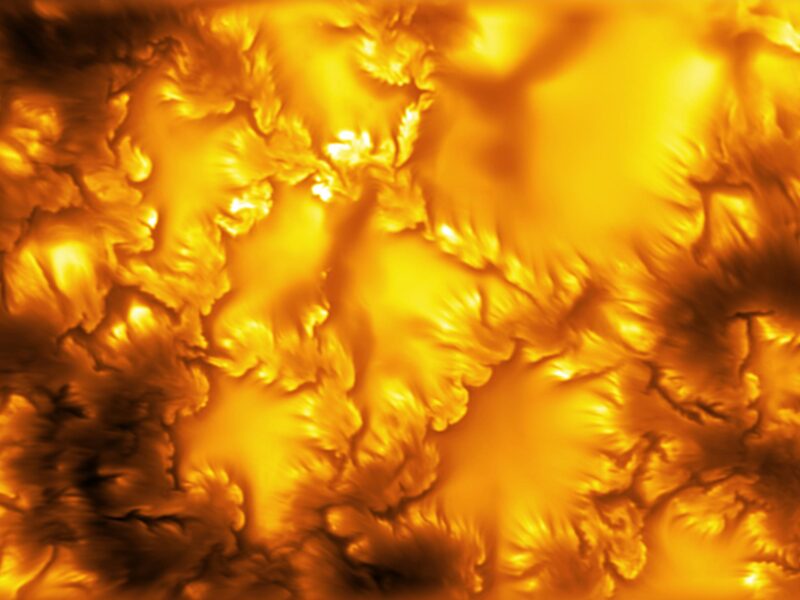
The newly observed plasma swirls resemble patterns seen in Earth's clouds and oceans, and may improve computer models of solar activity.(CN) — The highest-resolution images ever captured of the sun are giving astronomers their clearest look yet at the forces shaping our closest star, revealing a phenomenon never before seen on its surface.Among the biggest discoveries is the first direct evidence of Kelvin-Helmholtz instabilities on the sun’s visible surface, a fluid phenomenon that creates swirling, ripple-like structures when layers of plasma move past each other at different speeds.The findings, publishedWednesday in the journal Nature, could help scientists better understand the processes that drive solar eruptions capable of disrupting technology on Earth. The images were captured by the Daniel K. Inouye Solar Telescope in Hawaii, which recorded the sharpest views yet of the sun’s photosphere, the thin layer where light escapes into space.Researchers focused on a turbulent region near a sunspot, catching glimpses of intricate bands and swirling vortices that had never been seen so clearly before.Friedrich Woeger, a scientist at the National Solar Observatory, said the discovery is significant because it confirms a well-understood physical process that may help explain everything from the sun’s constant churning to the magnetic forces behind powerful eruptions.“The discovery of Kelvin-Helmholtz instability on the sun’s surface at the smallest scales is very significant because it is a well understood phenomenon that can help with explaining the underlying physical processes that impact the dynamics of our own sun, and stars in general, from the characteristics of ubiquitous convective motion all the way to the explosive nature of big eruptions that can impact technology on Earth caused by magnetic fields,” Woeger wrote in an email interview.Kelvin-Helmholtz instabilities are a familiar concept in fluid dynamics and can sometimes be seen in wave-like cloud formations or ocean swells on Earth. Until now, however, they had never been directly observed on the sun’s visible surface.“When we all sat together and viewed the data we had acquired, we were absolutely blown away by the new details we were able to see,” Woeger said.The images were so sharp that researchers immediately recognized the same vortex patterns seen in Earth’s clouds and oceans, something earlier observations had only hinted at.The discovery could also improve computer models that simulate how the sun behaves. Researchers say confirming that these instabilities occur on the sun gives scientists a better way to test those models against real observations.“Modern society depends on technologies that are vulnerable to space weather. To better understand and eventually forecast the sun’s most disruptive behaviors, we first have to understand the tiny physical processes that drive it, but we need the right tools to do so,” Woeger said.Many of the small-scale processes that power the sun’s activity have remained hidden from view.“We’ve seen the sun’s large-scale events, but we’ve been missing some of the small-scale physics that power these events — the ‘tiny engines’ that drive solar activity,” Woeger said. “The Inouye gives us a clearer view of these processes, and Kelvin-Helmholtz instability may be one of these engines.”The team had originally set out to test an improved way of collecting data with the telescope before realizing they had captured something much more significant.“As is sometimes the case in scientific research, our collaboration with MPS produced results that went beyond the original objective — a happy accident,” Woeger said. “We initially set out to test an enhanced approach for acquiring data that would allow us to more easily and effectively realize the full potential of the Inouye. While we achieved that goal, we also gained a deeper understanding of the fundamental physics governing magnetized plasma on the solar surface.”Subscribe to our free newslettersOur weekly newsletter Closing Arguments offers the latest about ongoing trials, major litigation and rulings in courthouses around the U.S. and the world, while the monthly Under the Lights dishes the legal dirt from Hollywood, sports, Big Tech and the arts.Additional Reads
A sharper look at the sun reveals a missing piece of the puzzle
Full Article
Original Source
Read the full article at Courthousenews →KhanList aggregates and links to publicly available news content. We do not host full articles from third-party sources. Always verify important information with original sources.