
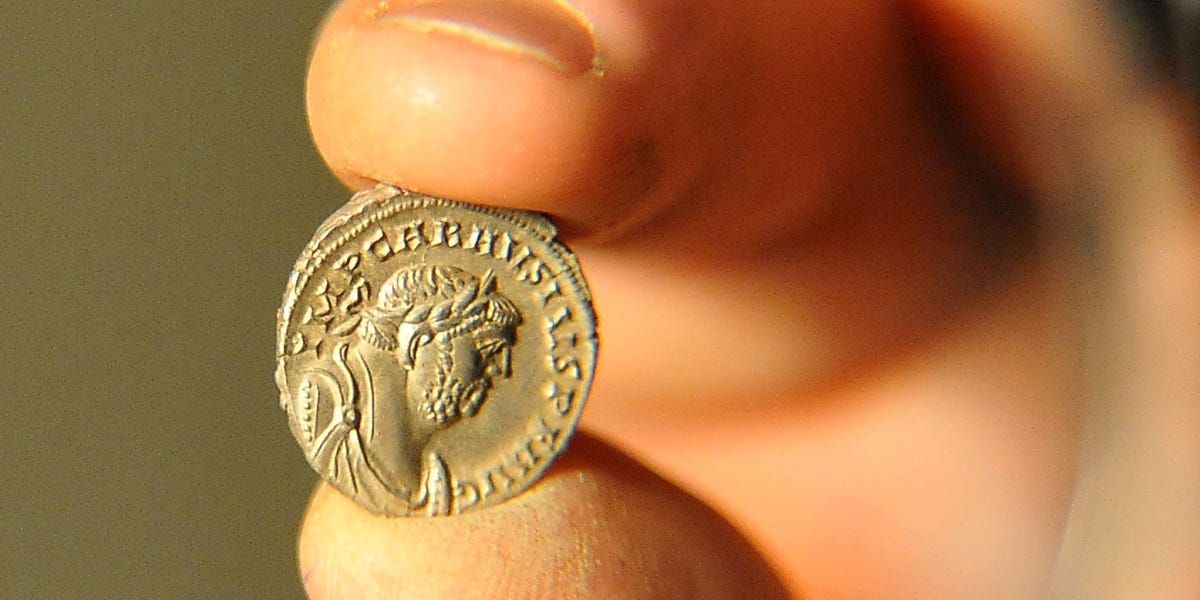
3 min readHere’s what you’ll learn when you read this story:Archaeological crews working on a new rail line in Britain uncovered a rare Roman coin made between 286 and 293 C.E.The coin, minted by Carausius, helps date the discovery thanks to the seven-year duration of his self-established breakaway empire in Britain. Rail officials plan two years of extensive test trenches and expect to discover more finds of historic value. Carausius, the self-proclaimed “Emperor of the North,” had an eventful seven-year reign in Britain from 286 to 293 C.E., including creating multiple mints to craft gold and silver coins bearing his image. One of those coins was just discovered by an archaeological team working with crews building a new railway line between Oxford and Cambridge.The Carausius coin was one of a few different notable discoveries in archaeological trial trenches dug ahead of construction by the East West Rail Company. Other discoveries included another Roman-era coin—this one dated to between 138 and 180 C.E., minted under either Antoninus Pius or Marcus Aurelius—and a late Iron Age jar, each piece helping define Britain’s history. “Every discovery helps build a richer picture of the people who once lived here,” Joss Piper-Jarrett, archaeology survey manager at East West Rail Co., said in a statement. “When you’re excavating these features, you’re often the first person to see them in 2,000 years, sometimes even longer, which is a really special feeling. It’s pretty amazing.”Under the government’s rules, East West Rail must dig 6,000 trenches, each about 165 feet long, six feet wide, and 1.5 feet deep. The archaeological trenches allow specialists to identify points of interest and then, armed with metal detectors, to excavate targeted sample sections, helping uncover important pieces like the Carausius coin before any potential damage from construction work.“We know from other projects nearby that this part of Britain has a rich archaeological landscape, and we weren’t disappointed,” Mike Court, historic environment lead at East West Rail, told Fox News. “By the time we [are] finished, we expect to find archaeology from most, if not all, periods of British history and prehistory.”As significant as the coin is, it actually isn’t even the most impressive discovery related to Carausius. The largest-ever coin hoard found in a single pot, also uncovered by a metal detector, is one of the greatest Carausius finds in history. The 2010 discovery occurred in Somerset, England, and featured more than 52,000 Roman-era coins in a single pot, weighing a combined 350 pounds. The 766-coin haul was the largest-ever find of coins minted under Carausius.Originally stationed in the English Channel and employed by the Roman Empire to patrol the North Sea to fend off pirates, Carausius decided to keep the pirate bounties for himself. Roman co-emperor Maximian wasn’t keen on the plan, making Carausius persona non grata in the Roman Empire. Instead of facing the consequences at home, Carausius declared himself the “Emperor of the North,” according to a report in The Conversation, and established his reign in Britain, the far reaches of the empire.Carausius did take some steps to actually elevate his self-proclaimed rule from theory to practice, including founding mints in London and Colchester. Those mints produced gold and silver coins of higher quality than those of the emperors in Rome, and Carausius commissioned multiple coin styles during his reign, helping experts pinpoint the new find to about 287 C.E., roughly 1,740 years ago.The team also found evidence of postholes that would have helped support houses, indicating the site was home to a Roman settlement. Over a two-year period, archaeologists plan to investigate 6,000 archaeological trial trenches, cleaning, analyzing, and recording each of the artifacts pulled out. “We are confident,” Court said, “that we’ll uncover additional major sites over the next two years of our trenching program.”Tim Newcomb is a journalist based in the Pacific Northwest. He covers stadiums, sneakers, gear, infrastructure, and more for a variety of publications, including Popular Mechanics. His favorite interviews have included sit-downs with Roger Federer in Switzerland, Kobe Bryant in Los Angeles, and Tinker Hatfield in Portland.
A Self-Proclaimed Emperor Minted His Own Coins 1,700 Years Ago. Archaeologists Just Found One.
Full Article
Original Source
Read the full article at Popularmechanics →KhanList aggregates and links to publicly available news content. We do not host full articles from third-party sources. Always verify important information with original sources.