
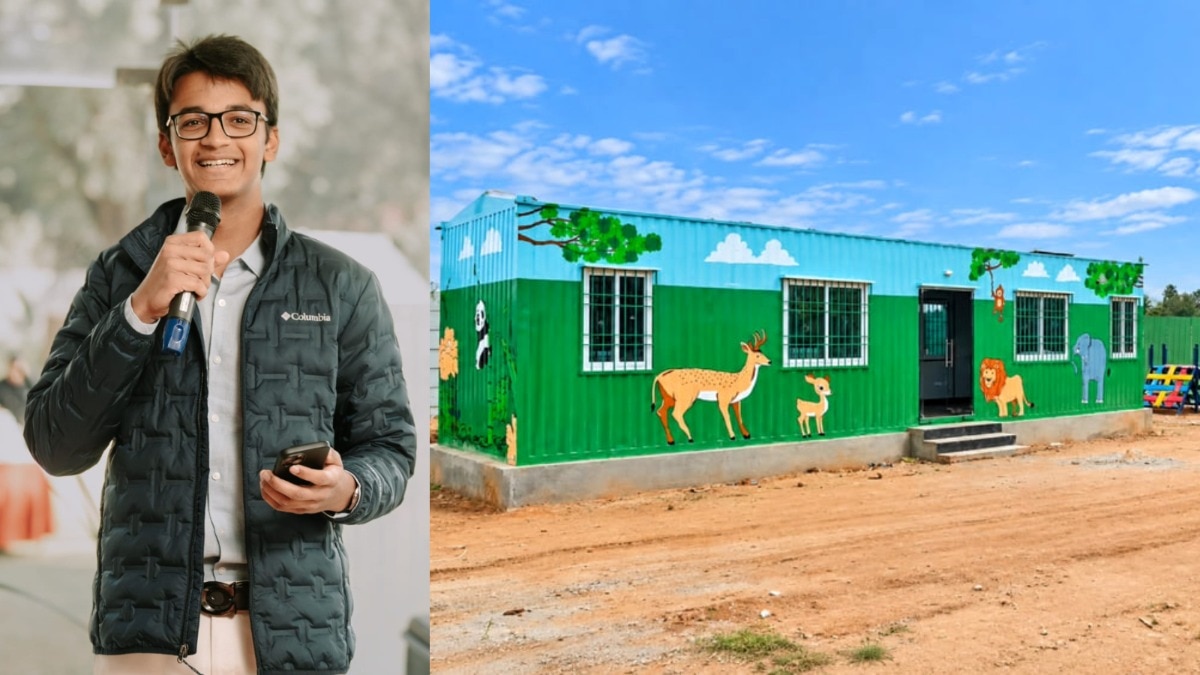
For children of migrant construction workers, moving from one project to another can mean losing access to education altogether. While their parents work, some spend their days around sand heaps, iron rods and heavy machinery, with no safe playground or classroom to go to.A UNESCO Global Education Monitoring Report published in 2019 cited a survey across seven Indian cities in which eight in 10 migrant children living at worksites had no access to education.Divit, a Class 12 student, believes the answer could be a school that moves with them. He has designed a portable classroom inside a shipping container, complete with a washroom and space for 20 to 25 children. The Rs 5 lakh structure is nearing completion at a residential real estate development on Sarjapur-Attibele Road in Bengaluru, with the school expected to begin operating by the end of 2026.The idea is unusual, but the problem that inspired it is not. A 2020 report by UNICEF and Young Lives India, using Census 2011 data, estimated that India had 92.95 million internal child migrants. This figure covers child migrants across India, not just children of construction workers, and does not represent the number who have dropped out of school. For Divit, the question was more immediate: if children keep moving, why must their access to education depend on a permanent building? Labour colony in Bengaluru where Divit built his container school (Photo: theunboxedschool.org) THE PROBLEM HE SAW IN GOVERNMENT SCHOOLSThe idea began a few years ago, when Divit taught Economics in government schools. He noticed that some classrooms had unfinished spaces, damaged walls and peeling paint. The experience made him think about the relationship between a child's surroundings and their education. Then he began looking more closely at construction sites and the labour colonies around them."The colonies are incredibly dusty, noisy, and cramped," he said in a conversation with India Today Digital. "Once the parents leave for construction early in the morning, the children are left on their own."Older siblings often look after younger children, while others play around materials that can be dangerous. When a construction project ends, families move to the next site. Enrolling children in local schools becomes difficult, particularly when they arrive midway through the academic year or face language barriers. (Photo: theunboxedschool.org) Divit had a concern about permanent infrastructure, too. "If the government cannot maintain the current schools in place, there is no way they can accommodate these children," he said.His response was to rethink the building itself. Instead of creating another permanent structure, could he design something affordable, portable and easy to reproduce wherever children needed it?FROM A CLASS 9 DESIGN COMPETITION TO A SHIPPING CONTAINERDivit's first step towards that question came in Class 9, when he entered a high school design competition organised by the University of Illinois Urbana-Champaign. He chose to design a playscape for a government school in India rather than an idealised setting. The project earned him an Honourable Mention, and he said he was the only participant from India to receive the recognition.A few months later, he delivered a TEDx talk on sustainable public spaces centred on young people. But he wanted to move from discussing the importance of children's spaces to actually building them. (Photo: theunboxedschool.org) That led him to Anthill Creations, an organisation that develops low-cost playgrounds using recycled materials. During his internship, he worked on outdoor playscapes and projects involving shipping containers, learning how to fabricate structures and turn designs into physical spaces.The experience gave him a practical solution. A used shipping container could provide a ready-made shell, reducing the need to build an entire classroom from scratch.The idea of doing more with limited resources also runs through Divit's book, Jugaad 5.0: 23 Businesses You Can Build with the Technology of Tomorrow, which explores how technology, AI and resourcefulness can open up new opportunities.HOW DO YOU TURN A METAL BOX INTO A CLASSROOM?The initiative, called The Unboxed School, is designed to bring learning and play closer to children whose families move between construction sites.The proposed school uses a standard 40-by-8-foot container. Inside, there is room for 20 to 25 young students, a small washroom at one end and a storage area at the other. The storage space can also serve as a smaller classroom for children who need specialised learning support. Early sketch (Photo: theunboxedschool.org) Floor plan of The Unboxed School (Photo: theunboxedschool.org) There was, however, a major obstacle. Steel containers absorb heat, making their interiors uncomfortable during the day."In the daytime, shipping containers are like ovens," Divit said.Conventional insulation would have raised the cost, so he researched alternatives. His design uses smart paint solutions and passive turbine vents to help manage heat without depending on electricity for ventilation. Solar panels are planned for the final fit-out, which is among the remaining steps before the classroom can open. Structural world (Photo: theunboxedschool.org) The target cost is Rs 5 lakh, although the amount could vary by location. The container will sit on a concrete platform of about 420 square feet. Transport by truck is expected to cost around Rs 30,000, depending on the distance.The structure is built, but the interiors and solar installation still need to be completed. A real estate developer is funding the project through its corporate social responsibility requirements, and the container school and playscape are located within one of its residential developments. The Unboxed School near completion (Photo: theunboxedschool.org) THE BIGGER TEST BEGINS WHEN CHILDREN ENTERDivit hopes the first unit will become a model that other developers, NGOs and public agencies can replicate. Additional containers could be installed at sites where more children need access to learning spaces. Teachers could be arranged through government schools, where staff have time after regular hours, or through local volunteer groups.But the classroom's success will depend on more than its design or price. It will need reliable teaching, regular maintenance and a way to ensure children can continue learning when their families move again. The project has not yet begun operating, so its effect on attendance, learning and continuity remains to be seen. Interior of the schoool being developed (Photo: theunboxedschool.org) Divit wants the idea to reach beyond one development. He hopes real estate companies will eventually include a classroom and playscape in each of their projects, making educational infrastructure part of the planning process rather than an afterthought."Beyond giving them a safe space away from the construction site, I want this project to be able to give all these children basic life and literacy skills that will help them continue their education wherever they go," he said. Kids playing in The Unboxed School (Photo: theunboxedschool.org) A shipping container cannot solve every barrier facing migrant children. It cannot, on its own, guarantee trained teachers, recognised schooling or uninterrupted records when families relocate. But it offers a different starting point: bringing a learning space to children whose circumstances make reaching a conventional school difficult.For Divit, the first classroom is nearly ready. The harder question is whether the idea can work well enough to travel far beyond Bengaluru.- Ends
A school inside a shipping container? This Bengaluru teen wants to reach migrant kids
Full Article
Original Source
Read the full article at Indiatoday →KhanList aggregates and links to publicly available news content. We do not host full articles from third-party sources. Always verify important information with original sources.