
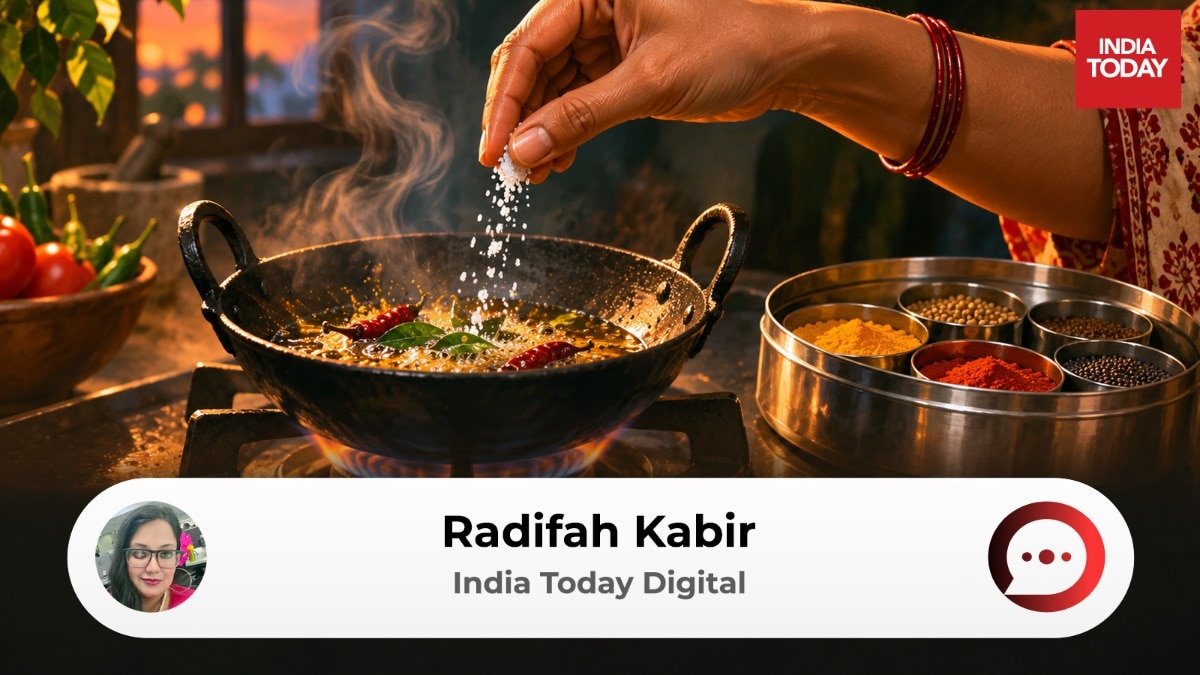
The mustard seeds pop and scatter in the hot oil. Curry leaves follow, spitting. Then, without a glance, a hand reaches into the steel dabba and takes a pinch of salt between thumb and forefinger. It is one of the most automatic gestures in an Indian kitchen, repeated at lunch and again at dinner, and nobody counts it.Perhaps someone should. India’s average intake is 8 to 11 grams of salt a day, says an April 2026 consensus statement from The George Institute India and Resolve to Save Lives. The World Health Organization advises no more than 5 grams, about a teaspoon.We have been told, again and again, to eat less. The Prime Minister has asked Indians to cut cooking oil by 10 per cent, most recently in Mann Ki Baat on March 29, 2026, and FSSAI's campaign asks for the same cut in salt and oil.Trim 10 per cent from 8 to 11 grams, though, and you still eat 7 to 10 grams, far above 5. Eating less is not enough. The salt itself has to change. A new study asks what would happen if we changed what is in the pinch. HOW MUCH SALT SHOULD YOU EAT A DAY?Table salt is sodium chloride, and sodium is the part that matters. Picture your blood vessels as garden hoses. Sodium makes the body hold on to extra water, so more liquid pushes through the same hoses and the pressure rises. That is high blood pressure, and over the years it strains the heart, the brain and the kidneys, the two bean-shaped filters that clean our blood.Potassium does the opposite. This mineral helps the kidneys flush sodium out and lets the vessel walls relax. Most of us eat too much sodium and too little potassium. The consensus statement says only 2.9 to 6.6 per cent of Indians eat the recommended balance of the two, and that 75 to 80 per cent of our sodium comes from salt added in home cooking.WHAT IS POTASSIUM-ENRICHED SALT? It looks, pours and cooks like ordinary salt. The difference is that part of the sodium chloride is swapped for potassium chloride, a salt made with potassium instead of sodium.One packet cuts sodium and adds potassium together. In January 2025, the WHO issued a guideline on lower-sodium salt substitutes for policy-makers and health professionals.CAN A SALT SWAP REALLY SAVE LIVES?On November 4, a team led by Dr Liping Huang of The George Institute for Global Health published a study in Nature Health. It is a modelling study: researchers feed real figures into a computer to estimate what would happen, instead of following real people.They did this for 193 countries. If the world switched fully, they estimate, about 2.96 million deaths and 10.17 million cases of heart, blood vessel and kidney disease would be prevented every year.For India alone, the figure is about 4,00,000 deaths and 1.53 million cases a year, according to the study. Two spoonfuls of salt and a jar on a dark surface. Potassium-enriched salt looks and pours like ordinary salt, but part of its sodium chloride is swapped for potassium chloride. (Photo: Maria Kovalets/Unsplash) A computer estimate is not a promise, but it stands on real trials. In China, the SSaSS trial (Salt Substitute and Stroke Study) followed 20,995 people, mostly older adults with a past stroke or high blood pressure, for nearly five years.Those given a salt substitute had 14 per cent fewer strokes, 13 per cent fewer major heart and blood vessel events and 12 per cent fewer deaths than those who kept ordinary salt.A trial in rural India, which the consensus statement cites, found that adults with high blood pressure who switched saw the top number of their blood pressure readings fall by 4.6 mmHg.IS LOW-SODIUM SALT SAFE FOR KIDNEY PATIENTS?Not for everyone, and honesty matters here. Healthy kidneys remove extra potassium. Failing kidneys cannot, and potassium can pile up in the blood, a condition called hyperkalaemia that can disturb the heart’s rhythm.The consensus statement advises against these salts for people with advanced chronic kidney disease, for those taking potassium supplements or potassium-sparing diuretics, a kind of water tablet, and for anyone with known high blood potassium. A wooden bowl of salt on a worn board, with grains spilling across the wood. Indians eat 8 to 11 grams of salt a day, nearly double the 5 grams the WHO advises. (Photo: Faran Raufi/Unsplash) The SSaSS trial left out people already known to have kidney disease, because their kidneys may not clear extra potassium and it could harm them. For everyone else, the risk looked no higher: imagine 1,000 people on ordinary salt for a year and another 1,000 on the salt substitute, and about three in each group had a serious high-potassium problem.Dr Sandeep Mahajan of AIIMS New Delhi says nearly 90 per cent of the population can safely benefit. Still, the global switch is a hypothetical scenario, and anyone with kidney trouble should ask a doctor first.WHY IS HEART-FRIENDLY SALT SO HARD TO BUY IN INDIA?Because of price and rules. The consensus statement says these salts typically cost roughly twice as much as regular iodised salt and sit mostly in urban markets. Tata Consumer Products sells low-sodium versions as Tata Salt Lite, with 15 per cent less sodium, and Superlite, with 30 per cent less.The consensus statement’s authors ask FSSAI to recognise potassium-enriched iodised salt as an approved edible salt. They ask governments to cut GST, offer production subsidies and buy it for school mid-day meals, Integrated Child Development Services (ICDS) centres, ration shops, hospital kitchens and railways.They also want labels that give “appropriate caution for those at risk” without being “overly restrictive” for everyone else.That is the part that should trouble us. A salt that can protect hearts should not need a metro postcode.India does not need yet another salt warning. It needs a better salt packet, priced for the home that cooks with it and labelled honestly for the person who must avoid it.The next time a hand reaches into the steel dabba, the pinch will look the same. It need not be the same pinch.Radifah Kabir is a food and biotechnologist- Ends
A salt swap could save 3 million lives. Why is it still a metro luxury?
Full Article
Original Source
Read the full article at Indiatoday →KhanList aggregates and links to publicly available news content. We do not host full articles from third-party sources. Always verify important information with original sources.