
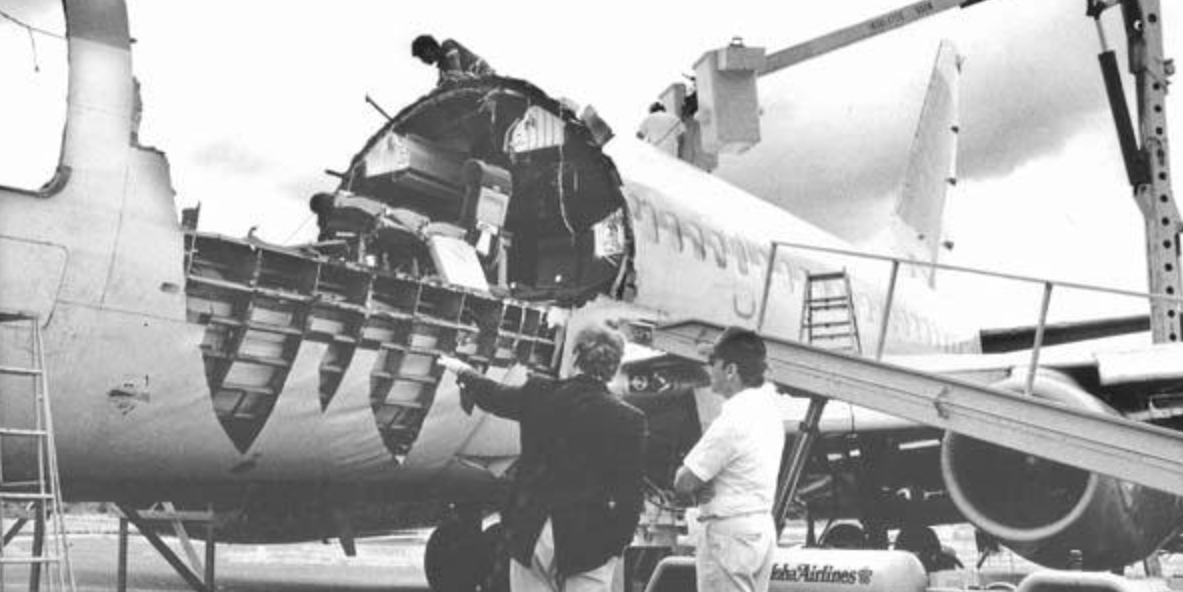
4 min readHere’s what you’ll learn when you read this story:On April 28, 1988, Aloha Airlines Flight 243 departed from Hilo Airport on its way to Honolulu, and a terrifying weakness was soon exposed.Corrosion caused part of the upper fuselage to tear away from the plane, exposing a stretch of aisles to the open sky.Though the plane amazingly landed in Maui with only one fatality, it was later determined that the fuselage had not been inspected thoroughly.When Patricia Aubry finally found her seat on Aloha Airlines Flight 243, she couldn’t shake the feeling that she needed to move. This flight was supposed to take just over a half hour to travel from Hilo Airport on Hawaii’s Big Island to Honolulu on Oahu. It was short enough that the three stewardesses on board were already serving coffee before the Boeing 737 (which would shortly be taking off on its ninth flight of the day) even left the tarmac.The plane had encountered nothing but clear blue Hawaiian skies so far on April 28, 1988, with no change in the forecast. The aircraft had already gone through 89,000 flights during its 19 years of jumping back and forth between the islands. Its crew was highly experienced, and the jet had been inspected for defects the previous night. There was no issue as the plane reached its cruising altitude 20 minutes after its departure at 1:25 pm, until a sudden flash of light followed by an onrush of roaring, freezing winds changed everything.Panic took hold of the passengers and crew as Captain Bob Schornstheimer and first officer Mimi Tompkins realized they were suddenly losing air pressure. Stewardess Michelle Honda was slammed to the floor, and her coworker Jane Sato-Tomita was lying unconscious and bleeding after being struck by metal debris. Stewardess Clarabelle “C.B.” Lansing had vanished.Some passengers looked up and realized that they were being blasted by wind because an entire section of the fuselage had been torn off, and the first five rows were now exposed to the open sky. With the pressure now equalized, there was no longer any suction pulling people out, and the belted passengers stayed in their seats. But one passenger in row 5 who was about to fall from what was left of the aircraft was seized by Howard Kitaoka, who was seated next to him.An almost 377-square-foot section of the fuselage was gone.Everything had happened too fast to put emergency safety measures in place. The brutal cold at 24,000 feet could easily kill, and so could the lack of oxygen at that altitude, which had passengers scrambling for their oxygen masks (which were useless, as the tubing that supplied supplemental oxygen had been disconnected). Some people began to lose consciousness from hypoxia amid 300 mph winds.With communication from the cockpit to the main cabin cut off, Honda began frantically dragging herself down the aisle and asking everyone she saw if they knew how to fly a plane—at that moment, she had no idea whether Schornstheimer and Tompkins had survived.Luckily, they had, but they were getting desperate—fast. Tompkins kept trying to contact air traffic control in Honolulu as Schornstheimer took over command to initiate an emergency descent, dropping through the sky while maintaining an airspeed over 310 mph. They weren’t far from Kahului Airport in Maui, but volcanic mountains stood between them and the airport. Though Tompkins was unable to get through to Honolulu air traffic control, she did reach the Maui tower, and was cleared for an emergency landing.The plane finally dipped into a lower altitude that made breathing possible again, and wind noise subsided, but Schornstheimer was struck with alarm. The light that indicated the nose wheel was extended for landing had not blinked on, and without it, the plane was at risk of crashing headfirst on the runway. Radio messages to air traffic control were barely making it through (though he and Tompkins were able to confirm an ambulance would be needed). Without nose gear, they focused on the rest of the landing gear, and as passengers reached out toward each other in the face of what seemed like certain death, the plane safely touched down 13 minutes after depressurization. Ambulances and fire trucks rushed to the scene. Of the 95 people on board, the only fatality was C.B. Lansing.In the aftermath of the accident, the National Transportation Safety Board (NTSB) investigated and found that critical issues had been overlooked when the plane was inspected the previous night. Flight 243 was found to have gone far beyond the number of flights considered safe before structural breakdown began (the number of flights determines wear and tear on an aircraft, rather than miles flown). On a Boeing 737 like Flight 243, the fuselage expands the higher it rises and contracts when it’s near the ground, and this constant pressurization and depressurization can weaken its structural integrity. As it turns out, epoxy used to bond the panels together had degraded by the time the flight took off, and the aluminum outside had also suffered corrosion.“We determined that the probable cause of this accident was the failure of the Aloha Airlines maintenance program to detect the presence of significant disbonding and fatigue damage which ultimately led to the failure of the lap joint at S-10L and the separation of the fuselage upper lobe,” the NTSB stated in an official report.Search parties were sent out to find the remains of C.B. Lansing and anything that may have been left of the lost fuselage, but the Pacific ultimately kept what it had claimed. Honolulu Airport now blooms with a memorial garden for Lansing, who is thought to have been instantly ejected from the aircraft when the fuselage exploded. Lush palm trees are surrounded by flowers and a tranquil waterfall in remembrance of someone who died under the Hawaiian sky.Elizabeth Rayne is a creature who writes. Her work has appeared in Popular Mechanics, Ars Technica, SYFY WIRE, Space.com, Live Science, Den of Geek, Forbidden Futures and Collective Tales. She lurks right outside New York City with her parrot, Lestat. When not writing, she can be found drawing, playing the piano or shapeshifting.
A Routine Flight Took to the Sky Over Hawaii. Then Its Roof Ripped Open.
Full Article
Original Source
Read the full article at Popularmechanics →KhanList aggregates and links to publicly available news content. We do not host full articles from third-party sources. Always verify important information with original sources.