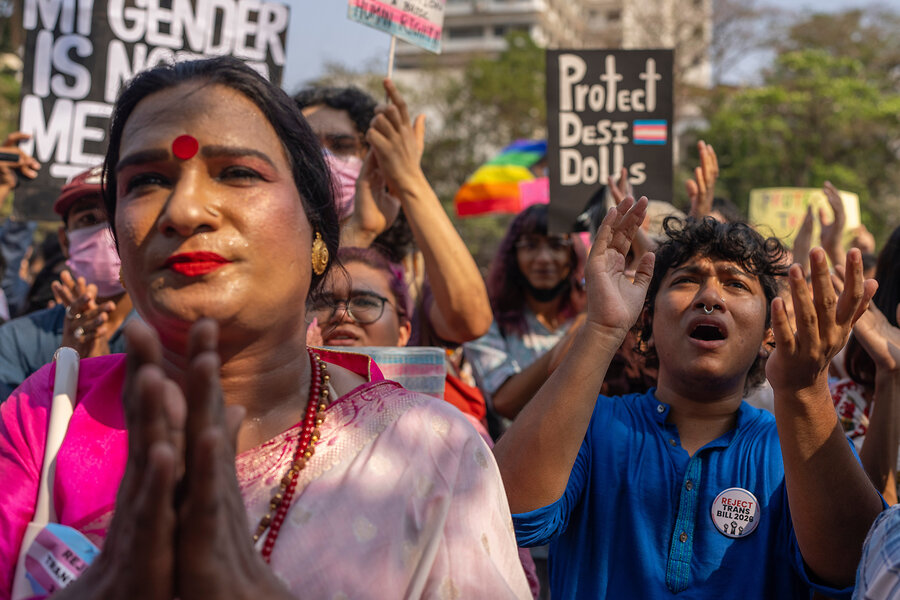
On a hot evening at Jawaharlal Nehru University in south Delhi, students sit painting protest banners beneath rainbow flags. Verses of the Urdu poets Faiz Ahmed Faiz and Habib Jalib – long associated with protest movements across South Asia – play from a speaker nearby.They have gathered to oppose a new law that has ignited a debate that echoes in many parts of the world: Who has the authority to determine a person’s gender identity? The individual, a doctor, or the state?Since 2014, India has granted transgender people legal recognition by grounding their self-identification in constitutional rights. That changed in March when the Parliament passed the Transgender Persons (Protection of Rights) Amendment Act, which requires medical evaluation and state certification of gender. Why We Wrote This India has changed the process for how individuals identify their gender, sparking protests and court challenges. The government says this amendment is about ensuring that benefits reach the right people, while LGBTQ+ rights activists call the law regressive. India’s new law comes in the context of wider debates about identity in India under the leadership of Prime Minister Narendra Modi. Supporters say the change is necessary to prevent misuse of welfare programs intended for transgender individuals. Critics say it reverses a decade of legal gains. The amendment is currently being challenged at the Supreme Court, where trans rights advocates are arguing that it violates Indians’ constitutional rights.“There is nothing wrong with a simple verification process,” says Arvind Sharma, a master’s student, outside the Jawaharlal Nehru University protest. “This law will help the actual transgender community and expose the fake ones.” Students gather beneath rainbow flags during a protest against India's Transgender Persons (Protection of Rights) Amendment Act at Jawaharlal Nehru University in New Delhi, April 11, 2026. Supporters of the law say it creates a more accountable system for legal recognition, while critics argue it rolls back transgender rights. The debate is deeply personal for Bhumi, a transgender undergraduate from Lucknow in northern India who, like many in India, uses a single name. Raised as a girl and recognized as such in her official documents, she worries the new law could place her identity under state scrutiny.“I don’t want someone else deciding whether I am transgender enough,” she says. “That feels invasive and humiliating.”“I hope the courts will intervene,” she adds.How this fits into the history of trans rights in IndiaSouth Asia has a long, unique history of gender diversity. For centuries before modern LGBTQ+ rights movements emerged, the region recognized there were communities that existed outside biological designations of gender.Most famous are the hijras, who traditionally attended weddings, births, and religious ceremonies across the subcontinent, offering blessings and receiving gifts or alms in return. In southern India, two other groups, the Aravanis and jogtas, uphold local Hindu traditions.Visibility has not translated into social acceptance. The term hijra has long carried social stigma, and transgender Indians face high levels of discrimination, family rejection, and economic exclusion.Yet the existence of these third-gender communities has helped shape the LGBTQ+ rights movement in India. While Western countries debated whether trans people existed, in India, that was a widely accepted fact. It made it harder to argue that LGBTQ+ rights are a foreign import. On the contrary, activists in India say that anti-LGBTQ+ discrimination is a colonial holdover.But this history brings unique challenges, too. For years, terms like “transgender” and “third gender” were largely treated as synonymous with belonging to one of these traditional communities, which left many Indians in a legal gray area. That changed in 2014, when India’s Supreme Court recognized transgender people and affirmed their right to determine their own legal gender markers – no government or medical sign-off required. Nazariya Kutty gets ready in a parlor to participate in the Koovagam transgender festival in Villupuram, in the southern Indian state of Tamil Nadu, April 28, 2026. The unanimous ruling was seen by supporters of self-identification as a watershed moment, pushing India ahead of much of South Asia on transgender rights. Yet the ruling itself did little to outline how benefits and protections would be delivered to India’s trans population, which researchers estimate is between 2 million and 6 million people. (India’s 2011 census recorded 487,803 transgender people, but that is broadly considered a vast undercount due to a reluctance to self-report.)A 2019 law called the Transgender Persons (Protection of Rights) Act prohibited discrimination against trans Indians, retained a broad definition of transgender identity, and outlined a process for trans Indians to obtain official recognition through district authorities. Many LGBTQ+ activists criticized the 2019 act for creating bureaucratic barriers, but welcomed the reaffirmation of the right to self-identification.The new law signed in March “erases all of that,” says Arundhati Katju, a senior advocate challenging the amendment before the Supreme Court. The new law narrows the definition of transgender people to recognized sociocultural communities or those meeting specific biological criteria, and grants the state the authority to determine who qualifies.The debate todayMedha Vishram Kulkarni, a member of Parliament from the ruling Bharatiya Janata Party (BJP) and a primary supporter of the new act, says the government has “no intention of undermining” Indians’ constitutional rights.“Self-identification is central to an individual’s dignity and lived experience,” she says, in a written interview with the Monitor. “However, where legal entitlements, welfare benefits, or official records are involved, the State also has a responsibility to ensure transparency, consistency, and accountability.”When advocating for the amendment, BJP officials – including India’s social justice and empowerment minister, Virendra Kumar – cited concerns about potential misuse of welfare programs. On the floor of the Parliament, Mr. Kumar said this bill will help the government administer welfare programs more effectively by distinguishing genuine beneficiaries from fraudulent claimants. The objective of this legislation, he added, is to protect those individuals who face social exclusion due to their gender identity.The Monitor reached out to more than a dozen BJP spokespeople and parliamentarians. Only Dr. Kulkarni responded to emailed questions. She says the law is “rooted in the need for coherence across multiple public systems,” from education to healthcare to employment.“A framework based exclusively on self-declaration, without any standardized process, may create challenges in ensuring consistency,” she adds, whereas “state-backed verification” can be “an administrative safeguard that promotes public confidence [and] legal certainty.”Yet activists argue that this framing misses the reality. There is no evidence that the laws governing trans identification have led to systemic welfare abuse. Data shows that just 32,000 transgender certifications have been issued as of 2026, a low number by any measure of the population. An analysis by the Centre for Budget and Governance Accountability, a think tank in New Delhi, found that the government has consistently underspent its budget earmarked for transgender welfare.Ms. Katju, the lawyer, says uncertainty surrounding the new law has already led to legal challenges.Dr. Kulkarni says that the assessment mechanism in the new law is intended to be applied in ways that uphold individual privacy, informed consent, and nondiscrimination. She emphasizes the need for medical board training and mechanisms for grievance redressal. “The focus is on ensuring administrative clarity without compromising human dignity,” she says.The new law, however, includes a provision that critics say undermines privacy and threatens individual safety. Many transgender Indians rely on community organizations and informal support networks when facing family rejection. The law imposes prison sentences of five to 10 years for compelling a person to present as transgender against their will. Activists say families who reject a relative’s transition could use this to target support networks.“Every time we do a rescue case, the natal family’s narrative is: My child was not like this; these people made my child like this,” says Tan, an activist who works with transgender communities in Delhi. “Now they have a mechanism to criminalize us.”But Palli Venkatesh, a master’s student in economics at Jawaharlal Nehru University, sees the act as a step forward.“India has a distinct history of recognizing transgender and third-gender communities, and our laws should reflect our own traditions, institutions, and administrative realities,” he says. At the same time, he says he understands why the amendment worries many of his transgender peers.“Those concerns deserve to be heard, and if the certification process is found to be insensitive or difficult, the government should improve it,” he says.
A rollback of rights, or an imperfect step forward? India amends transgender rights act.
Full Article
Original Source
Read the full article at Csmonitor →KhanList aggregates and links to publicly available news content. We do not host full articles from third-party sources. Always verify important information with original sources.