
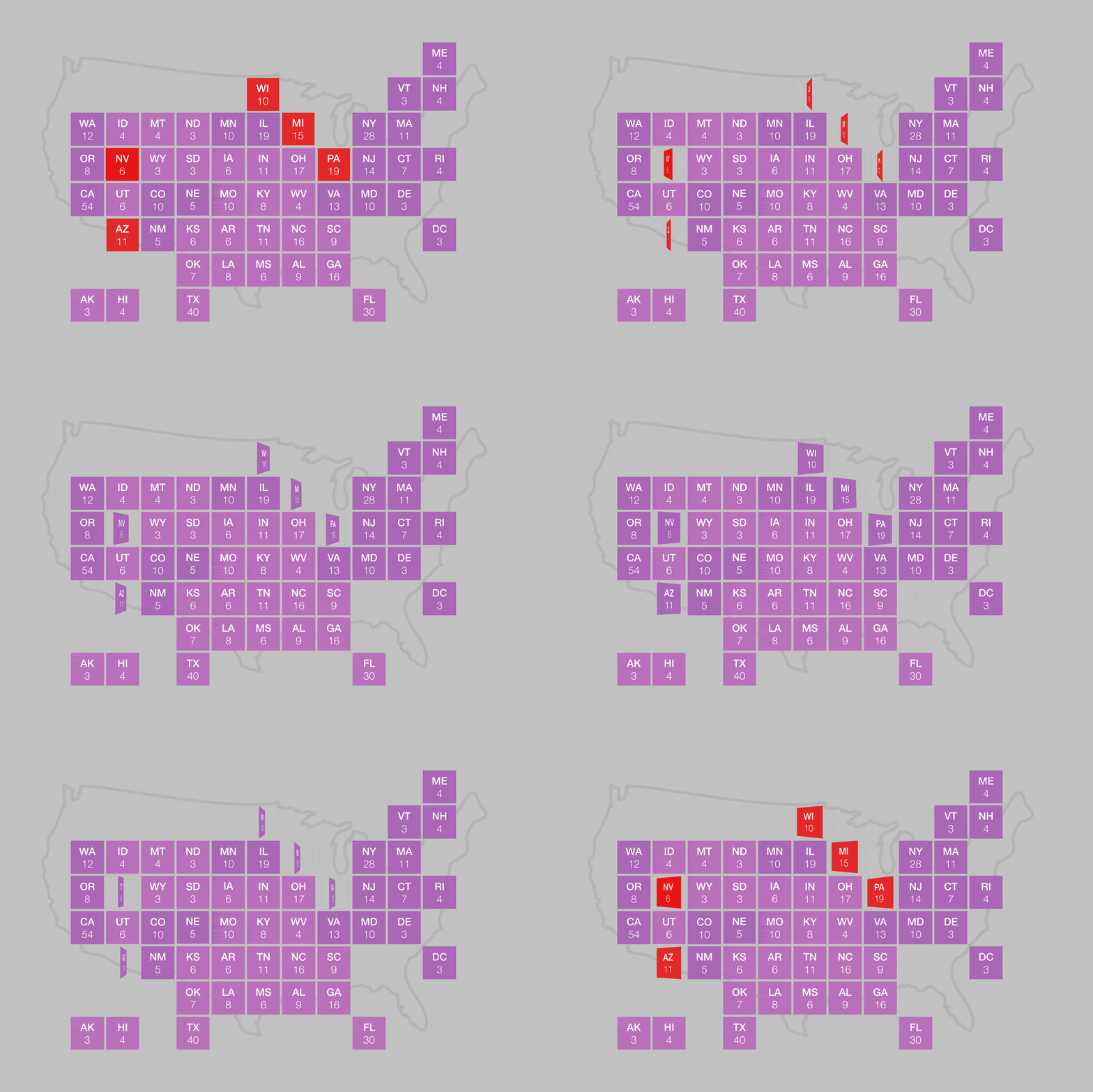
Jurisprudence By Enter your email to receive alerts for this author. Sign in or create an account to better manage your email preferences. Unsubscribe from email alerts Are you sure you want to unsubscribe from email alerts for Shirin Ali? Nov 23, 20262:58 PM We’re so darn close. Photo illustration by Slate. Image by Dimitrios Karamitros/Getty Images Plus. Sign up for the Slatest to get the most insightful analysis, criticism, and advice out there, delivered to your inbox daily. Come January, Democrats will face a mountain of to-dos, from reining in Big Tech to bringing down costs to stamping out corruption. But there’s another less-talked-about priority that’s been quietly building momentum for the past 20 years that Democrats might also be able to finally accomplish: moving to a national popular vote in presidential elections. The effort to shift America away from its current winner-take-all system of electing presidents has been a slow burn since the early 2000s, through an initiative called the National Popular Vote Interstate Compact. It was created by John Koza, a computer science professor, shortly after the 2000 presidential election, when George W. Bush won the presidency by the skin of his teeth despite losing the national popular vote. The pact is designed to get states to pass legislation directing their electors to cast their votes for the winner of the national popular vote, instead of the statewide winner, and doesn’t take effect until a critical mass is reached at 270 electoral votes, the magic number required to clinch the presidency. At that point, states with enough Electoral College votes to secure the presidency would agree to award their electoral votes to the winner of the popular vote, making presidential elections truly national. Every state legislature in the country has considered a national popular vote bill, but so far only 18 states and D.C. have joined the pact, putting it just shy of nationwide adoption by 48 electoral votes. After this year’s midterm elections, the calculus for the NPVIC has pretty drastically transformed. So far, the states that have signed on have been almost exclusively Democratic-controlled, but now there are a slew of purple states that suddenly have Democratic trifectas in their statehouses. Arizona, Georgia, Michigan, Nevada, Pennsylvania, and Wisconsin have freshly minted Democratic trifectas that could collectively contribute 61 electoral votes toward the NPVIC if they were to pass the necessary legislation. That would put the pact at 283 electoral votes, more than enough to suddenly shift how U.S. presidents are elected. “The time is right,” Carrie Rheingans, a Democrat in the Michigan House of Representatives, told the New York Times about whether her state would consider joining the NPVIC. “This blue tsunami is really going to help push this forward across the whole nation.” Pennsylvania Gov. Josh Shapiro said he’s open to signing his state on to the pact and, during a recent Crooked Con event, endorsed the idea of electing presidents via the national popular vote. Nevada Gov.-elect Aaron Ford said he wants Nevada to join the pact after considering the “racist underpinnings” of the Electoral College. In Wisconsin, newly elected Democratic Gov. David Crowley previously was on board with the NPVIC, in 2019 backing a bill to have his state join the pact. Since winning the governorship, he hasn’t committed to joining the pact, but state Democratic lawmakers have said they’re interested in moving a bill forward on it. For the better part of the past 25 years, Republicans have benefited from the Electoral College, helping elect Bush and Donald Trump, despite both of them losing the national popular vote in 2000 and 2016, respectively. “Bush and Trump won because the Electoral College inflates the power of smaller states, which on average are whiter, more rural, and thus more Republican,” Tom Schaller, professor of political science at the University of Maryland, Baltimore County, explained in Public Notice. That is changing, as 2026 has shown that not just small white states but large red ones—we’re looking at you, Texas, Arizona, and Georgia—are capable of flipping to Democrats. This means that even with the Electoral College’s small-state bias, the GOP’s electoral math, especially in 2028, may simply not be enough to win the presidency. This fact could offer further nationwide openness to adoption of the compact. Even if enough states pass legislation in favor of the NPVIC, the U.S. would not overnight eliminate the Electoral College without a legal fight. “If we have 283 electoral votes in the compact, then there will be a lawsuit,” Patrick Rosenstiel, a Republican senior consultant for the bipartisan group National Popular Vote, told me. “They’ll sue over whether or not the National Popular Vote Interstate Compact requires congressional consent.” This question has been looming large over the NPVIC for years, but Rosenstiel is confident that the pact would prevail in court. He argues that there is existing case law that deals with this very question, specifically from conservative courts. “This is exactly the kind of interstate compact that current case law says does not require congressional consent,” he explained. “Because case law by conservative courts take the position that unless an interstate compact encroaches on what’s called federal supremacy, meaning the federal power is supreme, they do not require congressional consent.” The federal government does not control how states run their elections, and that extends to how states determine how their electoral votes are cast. The 10th Amendment gets at this, affirming that state powers not given to the federal government—or banned from the states—belong to the states or the people. Rosenstiel believes that if the NPVIC were to work its way up to today’s Supreme Court, the conservative majority would side with the compact states. “They like the 10th Amendment,” he said. It’s also worth noting that the question of states’ power to control their electors goes back over a hundred years, with the Supreme Court considering the question in 1892, in McPherson v. Blacker. In a unanimous decision, the high court concluded that the Constitution doesn’t direct states on any specific methods for how to award their electors. “From the formation of the government until now the practical construction of the clause [Article 2, Section 1 of the Constitution] has conceded plenary power to the state legislatures in the matter of the appointment of electors,” former Chief Justice Melville Fuller wrote. However, something that could damage the compact’s chances is the fact that there is no formal method in place to certify the national popular vote winner in the same way that there are processes in place to certify statewide popular vote winners. This would quickly become a critical problem in a close election. And if a formal method were created by, say, a government agency, it could get dangerously close to federalizing U.S. elections. It’s unclear who or what body should be responsible for making that call. If the compact were to gain at least 270 electoral votes, and if Rosenstiel’s prediction comes true that lawsuits will follow challenging the pact, it is sure to land in front of SCOTUS. If the court’s conservative supermajority goes against decades of precedent and strikes it down, there is still a potential scenario where the national popular vote prevails in presidential elections. Consider this possibility: Democrats achieved a massive sweep of both chambers of Congress this year and are heavily favored to win the presidency in 2028. If they win back the presidency, Democrats could easily pass new laws to federally authorize the NPVIC, or some similar form of it. If the party pulls this off, in addition to passing laws expanding the Supreme Court bench, well, America’s electoral system would be reformed in a way not seen in over a century. Setting aside the hypotheticals, restructuring how the U.S. calculates the winner of the presidency is worth serious consideration. Pew Research found in 2024 that 63 percent of American adults would prefer to see the winner of the presidential election be the person who gets the most votes nationally. It’s not hard to see why, when you consider that the current winner-take-all system gives a handful of battleground states, which are predominantly white and small, immense control over presidential campaigns and media attention. In 2020 the major-party presidential and vice presidential candidates held 96 percent of their campaign events in just 12 states and 58 percent in only four, according to the Center for American Progress. Candidates are spending most of their money on ads and organizing efforts in these handful of states, which results in a policy platform that caters to a small subset of largely white voters. The rest of the country and its wants and needs basically go ignored. “I want every voter in every precinct to be relevant in presidential elections, and I want campaigns and candidates to have to change,” Rosenstiel said, “so they’re not flushing the interests of four-fifths of the American voters.” Moving to a national popular vote system would not only invigorate grassroots politics; it would also encourage voter turnout, as Rosenstiel noted: Battleground states see turnout numbers that are 11 points higher than in nonbattleground states in presidential elections. “Let’s just say you’re in North Dakota. Do you believe that because you live in Bismarck, you should be totally ignored in presidential elections in the general election campaign, or do you believe your vote should matter in Bismarck?” Rosenstiel posited. “If you believe your vote should matter in Bismarck, you belong in the National Popular Vote Interstate Compact.” Moving to a national popular vote system stands to strengthen America’s democracy and benefit Republicans and Democrats. Typically, presidential candidates have avoided certain issues in general elections in order to curry favor with swing voters in battleground states, a strategy that not only leaves millions of voters on the table but weakens their policy agenda and ultimately leads to poorer governance. The less promises a candidate makes, the easier legislating becomes. A national popular vote system would end the disenfranchisement of minority-party voters in both blue and red states, something this year’s midterm elections proved can be a boon for any political party. Mississippi, Georgia, South Carolina, Kansas, and Iowa flipped their historically Republican leadership to Democrats who went out on a limb and aggressively courted all of the states’ voters. This produced a historic wave of exceptionally strong candidates who are going into Congress with a mandate for change. We could soon be so lucky to have the same situation in U.S. presidential elections. Constitution Democrats Electoral College Jurisprudence 2026 Midterms 2028 Campaign
A Revolutionary Change to the 2028 Presidential Election Is Within Reach
Full Article
Original Source
Read the full article at Slate →KhanList aggregates and links to publicly available news content. We do not host full articles from third-party sources. Always verify important information with original sources.