
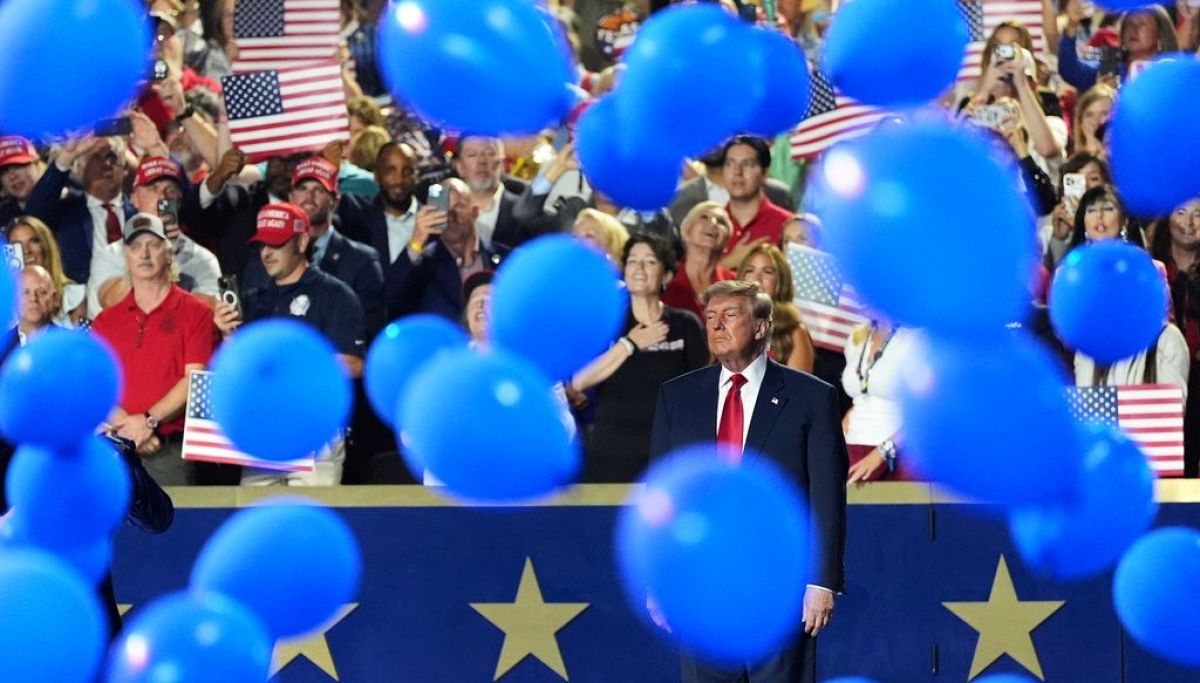
It was a bet born of desperation. With Democrats dominating the midterm polling all year and leading across nearly every competitive Senate race, the GOP went all in on the spectacle, hoping a polling bounce would shock its campaign back to life. Party conventions in recent cycles typically produce a 1- to 2.5-point bounce — a modest margin, but big enough to potentially save the Senate.In the end, the convention bounce was on the high end. It just went to the wrong party. On Sept. 9, the first day of the two-day Trump-a-ganza, the RealClearPolitics generic congressional vote average had Democrats ahead by 6 points. A week later, their lead ballooned to 8.7 points. Ken Paxton, the Republican Senate nominee in Texas, said the obvious out loud at a private gathering of conservative donors and lobbyists last week. According to audio obtained by the New York Times, he admitted the convention had backfired: “So to be honest with you, the numbers — when we did that convention — it dropped our numbers. Everybody’s numbers dropped. Right now, yeah, not good.”Paxton, one of the worst Senate nominees a major party has put up in recent memory, was understandably eager to deflect blame. Dogged by corruption scandals and stricken with the charisma of a lamppost, Paxton trails progressive Democratic state Rep. James Talarico by 3 points on the RealClearPolitics average. After beating incumbent Sen. John Cornyn (R-TX) in the primary with the help of President Donald Trump, Paxton has run a campaign so moribund that national Republicans have had to bail him out, putting at risk what should have been a safe seat in a deep-red state.Paxton’s failing campaign was a central reason the convention landed in Texas, but far from the only reason the GOP held one. Republican nominees are cratering around the country, and the White House’s bet was that a convention starring Trump could turn out the voters who show up for him but not for anyone else.President Donald Trump watches as balloons fall at the Republican convention Thursday, Sept. 10, 2026, in Dallas. (AP Photo/Alex Brandon) “I’m asking you to pretend that I’m on the ballot — I’m on the ballot — just one more time,” Trump said in his nearly two-hour keynote address. Voters in Texas and beyond considered the president’s request — and thought, “Well, when you put it that way, hell no.” Polls immediately began showing they were even less enthusiastic about voting Republican this fall.It’s no mystery why. Trump’s disapproval rating is higher than it was after the Jan. 6 riot at the Capitol, and three-quarters of Americans rate the nation’s economy as “poor.” The idea behind the convention — make the midterm elections all about Trump — flew in the face of all available evidence and common sense.The execution of the event was even worse than the idea.In one respect, it’s easy to see why the event’s architects structured it the way they did. In the past, multi-hour events devoted to celebrating Trump energized the base and even encouraged some fence-sitters to hop down and join the party.But America isn’t in a party mood right now. It doesn’t want to be told how great its president is doing; it wants to hear how the president and his party plan to do things better. It doesn’t want to close its eyes and sway to Lee Greenwood singing “God Bless the USA” — a ritual that has lost all of its countercultural magic in an era of Trump rule. And it really doesn’t want to hear Trump’s greatest hits in a two-hour speech that no one who isn’t already voting Republican listened to for more than a few minutes.The failure of the convention reflects the limits of Trump as a politician. He performs masterfully as the change agent — that’s why he’s still promising to “demolish the deep state” in new, and probably illegal, taxpayer-funded ads. When Trump is the tip of the spear aimed at the establishment, his swagger reads as strength and his certainty as courage.But when he is the establishment, those qualities translate differently. His swagger reads as arrogance, his certainty as delusion. What Trump lacks so plainly is empathy: the ability, as Bill Clinton once famously put it, to “feel your pain.” It’s so alien to him that he doesn’t even try to fake it.Trump is constitutionally incapable of feeling anyone’s pain over the state of the economy he oversees because Trump economies don’t cause pain. They are “the greatest” — “you’ve never seen anything like it” — and America is “the hottest country in the world.” In his mind, if he’s running something, it can’t be anything but perfect; it can only be unappreciated.The problem is that this political context cries out for humility. The very last thing Republicans need is a victory celebration. But that’s exactly what the convention broadcast to the country for six hours on primetime in early September. Democrats couldn’t have drawn it up better if they’d tried.Trump’s speech wasn’t the only self-inflicted wound. The rest of the spectacle gave voters plenty more reasons to ditch the GOP this fall, starting with Donald Trump Jr.’s speech in the prime 8:45 p.m. slot on the second night. Whatever one thought of the content — he paid tribute to Charlie Kirk and decried the dangers of socialism, which is fine — most voters would be hard-pressed to explain why Don Jr., whose only discernible accomplishments are running the family business and swinging crypto deals on the back of his father’s presidency, was being paraded as a Republican leader.Swing voters were probably asking themselves, “What on earth does this guy have to do with my life? My government? I didn’t vote for him.”In a recent column called “The Stench of Corruption,” First Things editor R.R. Reno summed up what many feel about the Trump sons, even on the populist Right.“The Trump family’s exploitation of every opportunity to enrich themselves demoralizes me, as I’m sure it does many readers,” he wrote. “Don Jr. and Eric Trump are the Uday and Qusay Hussein of our unhappy times, harvesting great sums from investors who seem interested in influencing the White House.”And yet, convention organizers made Don Jr. into a headliner, as if the party’s biggest liability were its brightest star.Vice President JD Vance‘s speech was the lone bright spot — but only for him, not his party. Vance looked every bit the part of a runaway front-runner for the 2028 Republican nomination: in command of the room, svelte, and graying at the temples. His pitch on affordability seemed perfectly tailored for voters worried about the cost of living, the ones Republicans badly need right now.But the viral line from Vance’s speech — that America was becoming “dirtier and poorer and less safe and less prosperous” — likely turned off many of those same voters. The public has also soured on the Trump administration’s handling of immigration, especially deportations, and they knew what he was alluding to by “dirtier.”AFTER THE BLUE WAVE: TRUMP’S PRESIDENCY STARES DOWN AN EARLY ENDThe line was aimed at GOP primary voters who think deportations haven’t gone nearly far enough. But that isn’t where the general electorate is on the issue. For voters already uneasy about deportations, it confirmed their worst suspicions about where the GOP is headed.It was the cherry on top of a $40 million production that bought the opposition a nearly 3-point bounce.
A Republican midterm convention bounce — for Democrats
Full Article
Original Source
Read the full article at Washingtonexaminer →KhanList aggregates and links to publicly available news content. We do not host full articles from third-party sources. Always verify important information with original sources.