
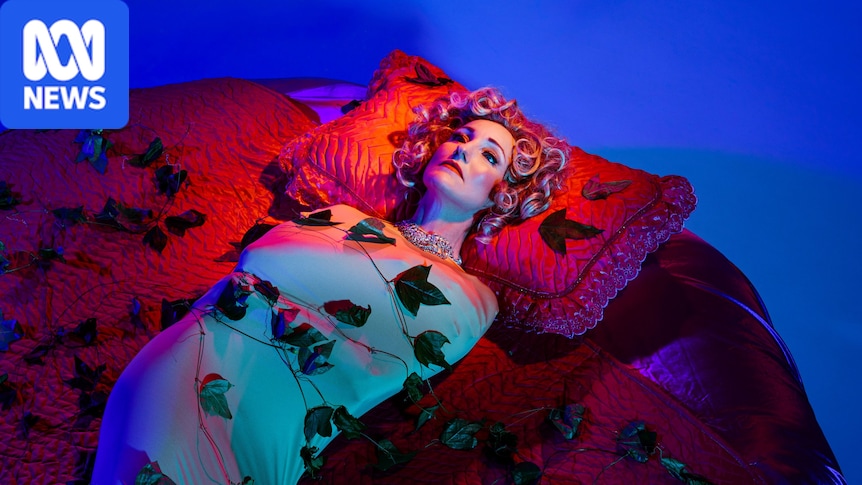
It's a familiar fairytale: a girl is cursed to sleep for 100 years, until a kiss from a prince breaks the spell and she wakes to live happily ever after.Once upon a time, Leah Shelton believed the story was romantic. She still has a recording of herself on cassette retelling it as a child.But these days the Queensland performance artist feels differently, because a sleeping beauty cannot give consent.The story takes on a dark resonance when set against a world grappling with sexual violence against women, from the Gisèle Pelicot case to the Cornell University gang rape allegations, and the rise of online "sleep content" featuring women who have been drugged and assaulted while unconscious."At this moment, it feels like there's this backlash against #MeToo, and this intense growth of the manosphere, and an overt hatred of women that seems to be able to be displayed with impunity," Shelton says.Leah Shelton appears to sleep on stage as the audience takes their seats, but the peaceful scene soon becomes a nightmare. (Supplied: Joel Devereux)Shelton has channelled her rage — and hope — into a new solo show, Keep Sleeping, Beauty, premiering at Metro Arts in Meanjin/Brisbane as part of Melt Festival.The work is a sobering indictment of the objectification of women, and an urgent call to challenge the cultural attitudes underpinning it."With all my work there is a layer of political activism, which is to ask how we can address this and look at options to move forward," Shelton says."It's hard to not feel entirely hopeless, but we still must resist. We still must find a way."Waking up to 'subliminal messaging'Keep Sleeping, Beauty navigates its unsettling themes with care, finding room for Shelton's high-camp theatricality, wit and absurdity along the way."If there's no dancing at the revolution, I don't want to be part of it," she says.She has again teamed up with Olivier Award-winning director Ursula Martinez, following the success of their previous collaboration, Batshit.Together the pair explored art history, finding the sleeping woman has long been rendered as a passive object of desire; her vulnerability transformed into something alluring.London-based theatre-maker Ursula Martinez was Artist in Residence at Perth Festival in 2019. (Supplied: Daniel Hambury)British artist Frederic Leighton's iconic painting Flaming June, for example, is described on the Metropolitan Museum of Art's website as presenting "an opportunity for uncomplicated contemplation of a beautiful body".Their research also took them back to the earliest recorded version of sleeping beauty, Giambattista Basile's Sun, Moon, and Talia (1634).In this telling, the sleeping princess is raped by a king, and even gives birth to twins before waking up.The version we all know has been sanitised, but the artists still find it problematic."If you break Sleeping Beauty down to its essence, this is a sleeping non-consensual woman, and he comes in, 'I like the look of that, I'll kiss her on the lips'," Martinez says."The essence is, 'I invade your body, and you can't say no, and I end up being the hero'. That's what we grew up with, the subliminal messaging of that."The 'sleep content' nightmareKeep Sleeping, Beauty springboards off the fairytale to confront an insidious real-life issue.Gisèle Pelicot, who was drugged and raped by her then-husband and dozens of strangers for almost a decade, became a global icon in the fight against sexual violence after waiving her right to anonymity during his trial in 2024.In the two years since, more cases of drug-facilitated sexual assault (DFSA) have emerged on a "truly international" and "deeply concerning" scale.In March, a CNN investigation exposed an online "rape academy" where men shared so-called "sleep content", sexual material featuring unconscious and non-consenting women, and exchanged advice about how to drug their partners and conceal the side effects.The stage features a bed surrounded by recording devices, in reference to the role of technology in image-based abuse. (Supplied: Jade Ellis)Some of the videos show men lifting women's eyelids to prove they are unconscious before assaulting them.This disturbing practice promoted the End Eye Check campaign, led by victim-survivors to push for laws to prevent the dissemination of image-based abuse.Shelton's play references a shocking number of cases across the globe, including in Australia.At one point, the audience is told the 51 co-accused men in Ms Pelicot's case were dubbed "Monsieur Tout-le-monde" or "Mr Everyman" by French media.Then a projection plays; a simple scene of ordinary people walking along a street. The implication is clear and chilling: "Mr Everyman" could be anyone.Balancing real-life trauma and humourShelton and Martinez had considerable back-and-forth during development to find the right tone, balancing the gravity of the subject matter with the show's entertainment value."We both use comedy as a way into the work. We draw people in and then give the politics and messaging embedded in the entertainment," Martinez says.Some references to sexual assault are censored; spoken words replaced by loud audio beeps.Leah Shelton's signature hyper-visual style is showcased through the elaborate costume design. (Supplied: Jade Ellis)Martinez says this leaves space for audiences to fill in the blanks with their own worst imaginings."There is also a layer of erasing memory," Shelton adds."If you are sedated, you actually don't have a choice over what you remember, but there's also what history remembers, who gets to write history, how it's erased and redacted."Even thinking about the Epstein files. We so often see these things that are removed. Who gets to have that control?"'Sedated by the patriarchy'Shelton plays herself in the 50-minute show, which is at times intensely physical. She likens the performance to "three cardio workouts" in a row.Among its references is Emma Sulkowicz's Mattress Performance (Carry That Weight), in which the artist hauled her 23-kilogram mattress around Columbia University in protest against its handling of her rape allegation against a fellow student.The work went viral in 2014, becoming a powerful symbol of protest.Leah Shelton includes a personal experience in the story to explore the misplaced shame sometimes felt by victim-survivors. (Supplied: Jade Ellis)In the making of her show, Shelton took her own mattress to the streets of Brisbane, crawling around with it strapped to her back."The show is about literal sedated women, and it's also a metaphor for the way women are sedated by the patriarchy," she says."We are all existing within this condition, and sometimes it's so invisible."I've been conditioned, I've bought into the lie. There's a lifelong work in unpicking that."Keep Sleeping, Beauty ultimately asks us to reconsider familiar stories — the ones we inherit, and the ones we tell ourselves — and start to shape a different narrative.Her hope is that the work can help fuel a vital conversation, and encourage more men to take an active role in the change that is needed."How do we make a space for men to speak out, and hold each other accountable?" she asks."How do we collectively call men in, to be traitors to the patriarchy?"Keep Sleeping, Beauty is at Metro Arts in Meanjin/Brisbane from November 4-14.
A remake of Sleeping Beauty is taking on the manosphere
Full Article
Original Source
Read the full article at Abc →KhanList aggregates and links to publicly available news content. We do not host full articles from third-party sources. Always verify important information with original sources.